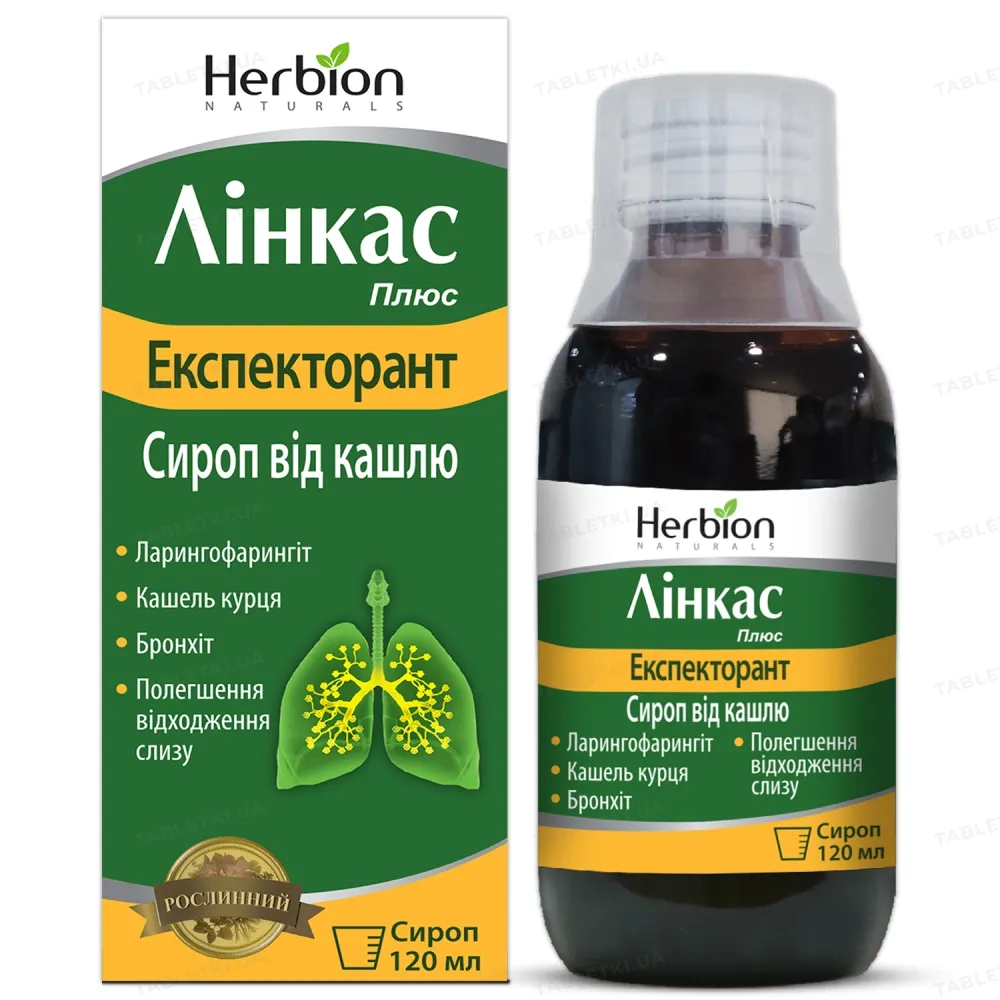
LINKAS PLUS EXPECTORANT
UkraineThe drug is used to treat inflammatory diseases of the upper and lower respiratory tract, such as bronchitis, pneumonia, bronchial asthma, tuberculosis, the common cold, smoker's cough, as well as tracheitis, laryngopharyngitis, and tracheobronchitis.
Frequently asked questions
How should Linkas plus expectorant be taken correctly?
Shake the syrup well before use. Adults and children aged 12 years and older should take 2 teaspoons (10 ml) 3–4 times daily. Children aged 7 to 11 years should take 1 teaspoon (5 ml) 3–4 times daily. Children aged 2 to 6 years should take ½ to 1 teaspoon (5 ml) 3–4 times daily. The course of treatment is 3 to 7 days.
Who should not take this drug?
Contraindications include hypersensitivity to the components, diabetes mellitus, severe obesity, liver and kidney dysfunction, hypokalemia, arterial hypertension, and organic heart lesions (e.g., myocardial infarction, myocarditis, or pericarditis). The drug should also not be taken by pregnant or breastfeeding women.
What are the possible side effects of Linkas plus expectorant?
Possible side effects include weakness, increased blood pressure, allergic reactions (rash, itching, edema, urticaria), increased salivation, irritation of the gastric mucosa, and decreased potassium levels (hypokalemia).
Can the drug be taken with other medicines?
It is not recommended to take this syrup simultaneously with antitussive drugs that suppress coughing and reduce phlegm excretion (e.g., codeine). If you are taking other medications, be sure to inform your doctor.
Is it safe to take the drug in children?
This drug should not be prescribed to children under 2 years of age.
What happens if an overdose is taken?
Overdose or prolonged use (more than 2 months) may lead to an imbalance of water and electrolytes, which can cause muscle weakness (hypokalemic myopathy) and other complications.
Instructions for use
INSTRUCTIONS FOR MEDICAL USE OF THE MEDICINAL PRODUCT LINKUS PLUS EXPECTORANT
Composition:
Active substances: 5 ml of syrup contains: extract of Solanum xanthocarpum fruit, dry (1:5) (extraction solvent – water) 15 mg; extract of Adhatoda vasica leaves, dry (1:5) (extraction solvent – water) 35 mg; extract of Glycyrrhiza glabra roots and rhizomes, dry (1:5) (extraction solvent – water) 7.5 mg; extract of Ocimum basilicum flowers and leaves, dry (1:5) (extraction solvent – water) 15 mg; extract of Cordia latifolia fruit, dry (1:5) (extraction solvent – water) 5 mg; extract of Piper longum fruit, dry (1:5) (extraction solvent – water) 5 mg; extract of Althea officinalis seeds, dry (1:5) (extraction solvent – water) 7.5 mg; extract of Illicium verum fruit, dry (1:5) (extraction solvent – water) 25 mg.
Excipients: sucrose, anhydrous citric acid, methylparaben E 218, propylparaben E 216, eucalyptus oil, peppermint oil, "Chewing gum" flavouring, ammonium chloride, propylene glycol, purified water.
Pharmaceutical form. Syrup.
Main physicochemical characteristics: brown syrup with a specific odour. Sediment formation may occur, which dissolves upon shaking.
Pharmacotherapeutic group. Medicinal products used in cough and common cold. Expectorants. Combinations. ATC code: R05CA10.
Pharmacological properties.
A complex herbal-based preparation with anti-inflammatory, expectorant, mucolytic, spasmolytic, and antipyretic properties. It activates the secretory function of the respiratory epithelium, alters the surface-active properties of pulmonary surfactant, and stimulates ciliary epithelial function, thereby exerting a positive effect on the exudative and proliferative phases of inflammation. It liquefies thick mucus and facilitates the elimination of sputum from the respiratory tract. Acts locally on the mucous membranes of the pharynx and bronchi as an antiseptic. Administration of the drug reduces the tone of smooth muscles of the bronchioles and decreases edema of the respiratory mucosa. Changes in cough intensity are observed within 3–4 days of taking the medication.
Clinical characteristics.
Indications.
As part of complex therapy for inflammatory diseases of the upper and lower respiratory tract:
- bronchitis, pneumonia, bronchial asthma, and tuberculosis;
- common cold, smoker's cough;
- inflammatory diseases of the upper respiratory tract (laryngopharyngitis, tracheitis, tracheobronchitis).
Contraindications.
Hypersensitivity to the components of the drug; diabetes mellitus; organic heart lesions (myocarditis, pericarditis, myocardial infarction); arterial hypertension; liver and kidney dysfunction; hypokalemia; severe obesity.
Interaction with other medicinal products and other forms of interaction.
Concomitant use of this medicinal product with antitussive agents that reduce sputum expectoration (e.g., codeine) is not recommended.
If simultaneous use of any other medicinal products is required, a physician should be informed.
Special precautions for use.
Important information about excipients.
Since the medicinal product contains methylparaben and propylparaben, it may cause allergic reactions (possibly delayed).
The medicinal product contains sucrose, which may be harmful to teeth.
If intolerance to certain sugars has been diagnosed, consult a physician before taking this medicinal product.
Use during pregnancy or breastfeeding.
Use during pregnancy or breastfeeding is contraindicated, because the liquorice root contained in the medicinal product increases estrogen levels, thereby disrupting hormonal balance. If use of the medicinal product is necessary, breastfeeding should be discontinued.
Effect on the ability to drive vehicles or operate machinery.
The effect on the ability to drive vehicles or operate machinery has not been studied.
Dosage and Administration.
For adults and children aged 12 years and older: 2 teaspoons (10 ml) of syrup 3–4 times daily; for children aged 7 to 11 years: 1 teaspoon (5 ml) of syrup 3–4 times daily; for children aged 2 to 6 years: ½–1 teaspoon (5 ml) of syrup 3–4 times daily.
Duration of treatment: 3 to 7 days.
Shake well before use.
Children. The medicinal product must not be administered to children under 2 years of age.
Overdose.
Overdose and prolonged use (more than 2 months) may cause disturbances in water-electrolyte balance, potentially leading to hypokalemic myopathy and myoglobinuria. Exacerbation of adverse effects is possible.
No reports of accidental overdose have been received.
Side effects.
Weakness, increased blood pressure, hypokalemia, allergic reactions (including rash, itching, skin hyperemia, urticaria, swelling formation); increased salivation, irritation of gastric mucosa may occur during the use of the medicinal product.
If any adverse reactions occur, discontinue use of the medicinal product and consult a physician.
Reporting of suspected adverse reactions.
Reporting of suspected adverse reactions after medicinal product registration is an important procedure. It allows continuous monitoring of the benefit-risk ratio of the medicinal product. Healthcare professionals are required to report any suspected adverse reactions through the national reporting system.
Shelf life. 3 years.
Storage conditions.
Store in a dry place at a temperature not exceeding 25 °C.
Keep out of reach and sight of children.
Packaging. 120 ml in a bottle, in a cardboard box.
Supply classification. Over-the-counter (without prescription).
Manufacturer.
Herbion Pakistan Private Limited, Pakistan / Herbion Pakistan Private Limited, Pakistan.
Manufacturer's address and place of business.
Plot №30 Sector 28, Industrial Area Korangi, Karachi, Pakistan / Plot №30 Sector 28, Industrial Area Korangi, Karachi, Pakistan.
Similar drugs
The original data is available in the language of the country of manufacture.
Data source: State Register of Medicinal Products of Ukraine
Data last verified: August 13, 2026