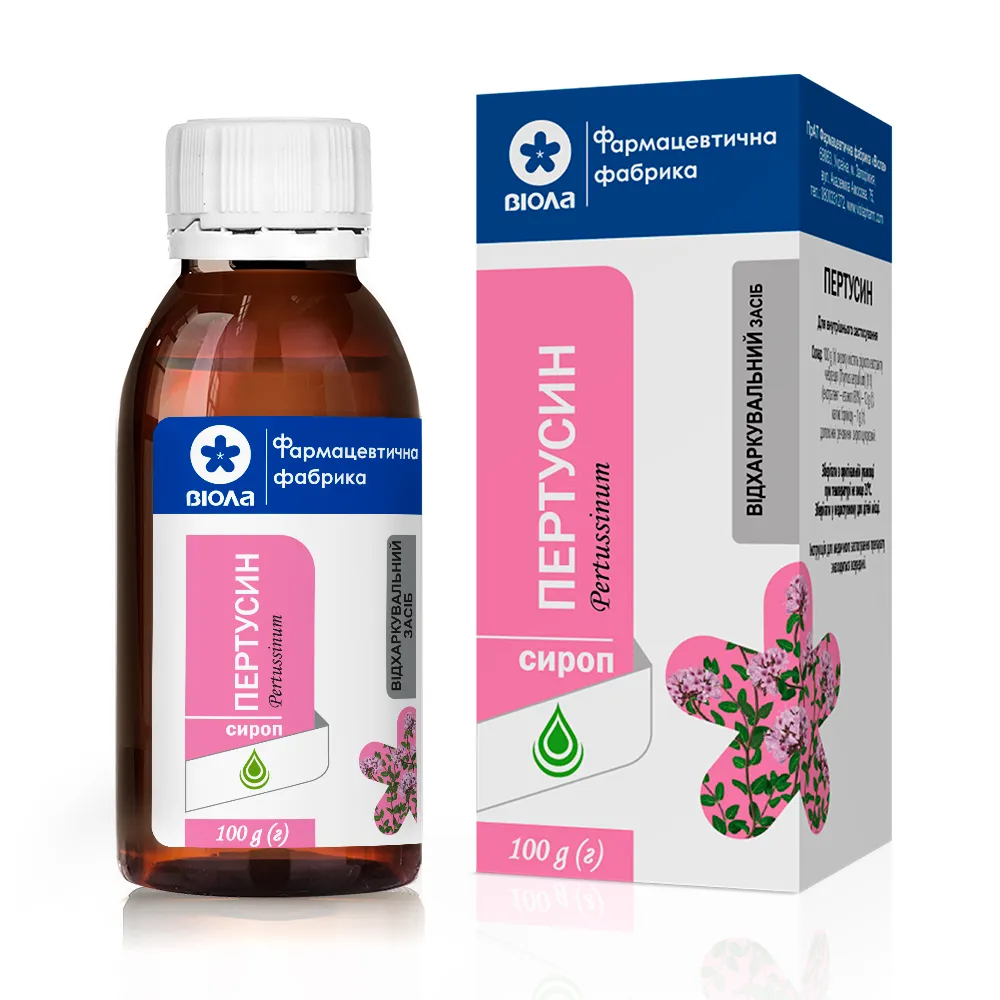
PERTUSSIN
UkraineThe drug is used for cough caused by bronchitis, tracheitis, pneumonia, pertussis, or inflammatory diseases of the upper respiratory tract.
Frequently asked questions
How to take Pertussin correctly?
The drug is taken orally. Children aged 4 to 6 years — 2.5–5 ml, dissolved in 20 ml of boiled water, 3 times a day. Children aged 6 to 12 years — 10–15 ml 3 times a day. Adults — 15 ml 3 times a day. The duration of the course should be determined by a physician.
Who should not take this drug?
Contraindications include hypersensitivity to the components (including bromides, plants of the Lamiaceae family, celery, or birch pollen), kidney disease, diabetes mellitus, alcoholism, anemia, severe atherosclerosis, arterial hypotension, and cardiovascular decompensation.
What are the possible side effects of Pertussin?
Allergic reactions and gastrointestinal disorders (nausea, vomiting, diarrhea) are possible. With prolonged use, symptoms such as skin rash, rhinitis, conjunctivitis, gastroenterocolitis, general weakness, impaired coordination (ataxia), or slowed heart rate (bradycardia) may occur.
Can the drug be combined with other medicines?
Inform your doctor if you are taking any other medications simultaneously. Due to the presence of potassium bromide, caution is required when using barbiturates, as their effect may be enhanced.
Does the drug affect the ability to drive a vehicle?
Since the syrup contains alcohol, caution should be exercised when driving a vehicle or operating machinery.
Can the drug be taken by pregnant or breastfeeding women?
Due to the lack of sufficient data, use of the drug during these periods is not recommended.
What should I do if symptoms do not subside or worsen?
If symptoms persist for a week, or if shortness of breath, fever, or purulent sputum develops, it is essential to consult a physician.
Instructions for use
INSTRUCTION FOR MEDICAL USE OF THE MEDICINAL PRODUCT PERTUSIN
Composition:
Active ingredients: 100 g of syrup contains liquid extract of wild thyme (Thymus serpyllum) (1:1) (extraction agent – 80% ethanol) – 12 g, potassium bromide – 1 g;
1 ml of syrup contains liquid extract of wild thyme (Thymus serpyllum) (1:1) (extraction agent – 80% ethanol) – 0.16 g, potassium bromide – 0.01 g;
Excipient: sugar syrup.
The preparation contains 8–11% ethanol; the content of absolute alcohol is: up to 0.43 g in 1 teaspoon (5 ml), up to 0.87 g in 1 dessert spoon (10 ml), up to 1.3 g in 1 tablespoon (15 ml).
The sucrose content in 1 teaspoon (5 ml) of the preparation corresponds to approximately 0.32 bread units, in 1 dessert spoon (10 ml) – approximately 0.64 bread units, in 1 tablespoon (15 ml) – approximately 0.96 bread units.
Pharmaceutical form. Syrup.
Main physicochemical properties: brown liquid with a pleasant odor.
Pharmacotherapeutic group.
Respiratory system. Cough and cold preparations. Expectorants, combinations. ATC code R05C A10.
Pharmacological properties.
Pharmacodynamics.
Pertusin belongs to the group of secretomotor agents. It stimulates the physiological activity of the ciliated epithelium and peristaltic movements of the bronchioles, promoting the movement of mucus from the lower to the upper respiratory tract and its subsequent expulsion. The drug softens cough and exerts a soothing effect.
Clinical Characteristics.
Indications.
Cough associated with bronchitis, tracheitis, pneumonia, whooping cough, and inflammatory diseases of the upper respiratory tract.
Contraindications.
Hypersensitivity to the components of the drug, including bromides or to other plants of the Lamiaceae family; sensitivity to celery and birch pollen (possible cross-reaction); decompensated cardiovascular disease, arterial hypotension, severe atherosclerosis, anemia, renal diseases, diabetes mellitus, alcoholism.
Special precautions.
Patients with impaired glucose tolerance must consult a physician before taking this medication.
The recommended dosage must be strictly observed during treatment.
Interaction with other medicinal products and other forms of interaction.
Concomitant use of potassium bromide is incompatible or requires caution with barbiturates (their effect is potentiated).
Inform your doctor if you are taking any other medicinal products!
Special precautions for use.
If symptoms worsen and/or dyspnea, fever, or purulent sputum occur during treatment with the medicinal product, medical advice must be sought.
If symptoms persist for more than one week, medical advice must be sought. The recommended doses should be strictly followed when using the medicinal product.
This medicinal product contains 8–11 vol.% ethanol (alcohol), i.e. 1.3 g per dose (15 ml), equivalent to 26 ml of beer or 11 ml of wine per dose. It may be harmful for patients suffering from alcoholism.
Use during pregnancy or breastfeeding.
Due to insufficient data, the use of this medicinal product is not recommended during pregnancy or breastfeeding.
Ability to affect reaction speed when driving or operating machinery.
Since the product contains alcohol, patients should exercise caution when driving or operating machinery.
Dosage and Administration.
The medication should be taken orally.
Children aged 4 to 6 years: 2.5–5 ml of the medication (½–1 teaspoon), previously dissolved in 20 ml (2 dessert spoons) of cooled boiled water, 3 times daily.
Children aged 6 to 12 years: 10–15 ml (1 dessert spoon or 1 tablespoon) 3 times daily.
Adults: 15 ml (1 tablespoon) 3 times daily.
The duration of treatment is determined individually by a physician.
Children.
The medication may be used in children aged 4 years and older only as prescribed by a physician.
Overdose.
In case of overdose, adverse effects and allergic reactions may be intensified. Treatment is symptomatic.
Side effects.
With prolonged use, symptoms of bromism are possible: skin rash, rhinitis, conjunctivitis, gastroenterocolitis, general weakness, ataxia, bradycardia. Treatment of bromism consists of discontinuing the drug and enhancing elimination of bromide salts (administration of large amounts of sodium chloride, fluids, and diuretics).
Allergic reactions to the components of the drug are possible. Gastrointestinal disturbances (including nausea, vomiting, diarrhea) may occur.
In case of any adverse events, consult a physician!
Shelf life. 4 years.
Shelf life after opening the bottle – 3 months.
Storage conditions.
Store in the original packaging at a temperature not exceeding 25 °C. Keep out of reach of children.
Do not use the drug after the expiry date stated on the packaging!
Packaging.
100 g in a bottle; 1 bottle per cardboard box; 100 g in bottles; 200 g in bottles with or without nozzle; 1 bottle per cardboard box; 200 g in bottles with or without nozzle.
Prescription status. Over-the-counter.
Manufacturer. JSC "Pharmaceutical Factory "Viola".
Manufacturer's address.
75 Amosova Akademika Street, Zaporizhzhia, Ukraine, 69063.
Marketing Authorization Holder. JSC "Pharmaceutical Factory "Viola".
Address of the Marketing Authorization Holder.
75 Amosova Akademika Street, Zaporizhzhia, Ukraine, 69063.
Similar drugs
The original data is available in the language of the country of manufacture.
Data source: State Register of Medicinal Products of Ukraine
Data last verified: August 13, 2026