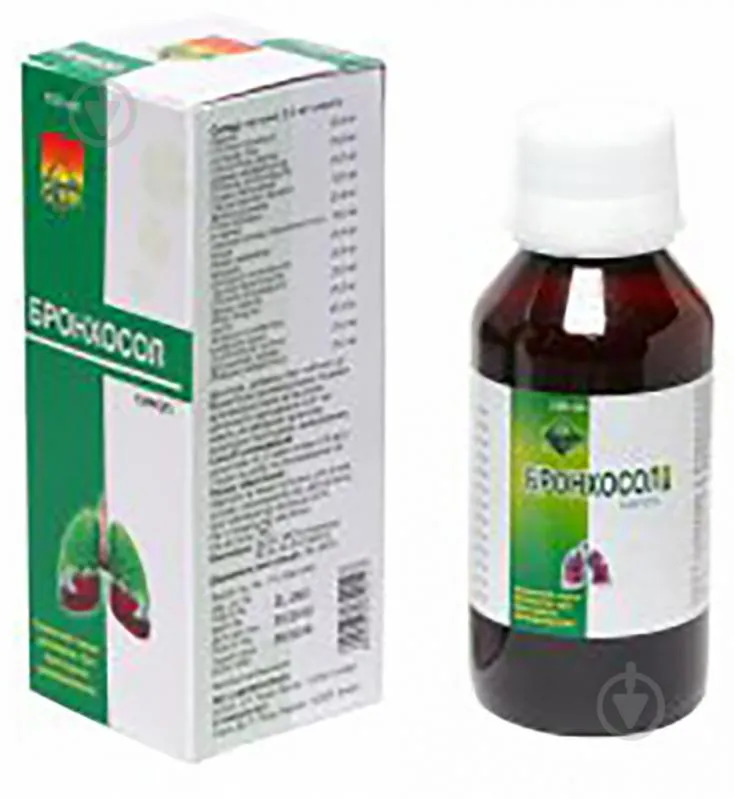
BRONCHOSOL
UkraineThe drug is used as an expectorant for upper respiratory tract inflammation when it is difficult to expectorate phlegm.
Frequently asked questions
How should Bronchosol be taken correctly?
Shake the syrup before use. Dosage depends on age: children aged 4 to 6 years — 2.5 ml 3 times a day; children aged 6 to 12 years — 5 ml 3 times a day; adolescents aged 12 to 18 years — 10 ml 3 times a day; adults — 15 ml 3 times a day. It is recommended to take the last dose no later than 3 hours before bedtime.
What side effects can Bronchosol cause?
Gastrointestinal disorders, nausea, vomiting, diarrhea, or allergic reactions are possible.
Who should not take this drug?
Contraindicated in case of hypersensitivity to the ingredients, thyme, primrose, thymol, as well as to plants of the Lamiaceae family, celery, or birch pollen. It should not be taken in case of bronchial asthma, severe liver or kidney diseases, gastritis, or gastric ulcers. It is prohibited for children with acute croup and children under 4 years of age.
Can the drug be taken with diabetes mellitus?
Since one dose contains approximately 4.2 g of sugar, patients with diabetes mellitus should take this into account when using it.
Can pregnant or breastfeeding women take it?
The safety of use during these periods has not been established; therefore, use is not recommended.
What should be done if symptoms do not subside?
If symptoms do not disappear within 1 week, or if shortness of breath, fever, or purulent sputum occurs, it is necessary to consult a physician.
What are the consequences of overdose?
Overdose may lead to stomach pain, vomiting, or diarrhea.
Instructions for use
INSTRUCTIONS FOR MEDICAL USE OF THE MEDICINAL PRODUCT BROMCHOSOL
Composition:
Active substance: 100 ml of syrup contains 4.360 g of thick compound extract (3:1) from a mixture of thyme herb (Thymus vulgaris L.) and primrose roots (Primula veris L./ Primula elatior L.) (7.6/1) and 19.8 mg of thymol (extraction agent: purified water);
Excipients: sucrose, orange-flavored flavoring, purified water.
Pharmaceutical form. Syrup.
Main physicochemical characteristics: brown-colored liquid with a characteristic odor. A sediment may form during storage.
Pharmacotherapeutic group. Expectorants. Combinations.
ATC code R05C A10.
Pharmacological properties.
Pharmacodynamics.
Pharmacodynamic studies of Bronchosol syrup have not been conducted. The therapeutic effect of the drug is due to the synergistic action of its active ingredients: extract of thyme herb (Thymus vulgaris (L)) and primrose root (Primula veris (L) / Primula elatior (L), as well as thymol. The biologically active components of the drug exhibit secretolytic, spasmolytic, antimicrobial, expectorant, and anti-inflammatory effects.
In vitro studies of Bronchosol demonstrated bactericidal activity against strains of Streptococcus pneumoniae, Streptococcus pyogenes, Staphylococcus aureus, Streptococcus anginosus, Haemophilus influenzae, Klebsiella pneumoniae, and fungicidal activity against strains of the genus Candida. However, antibacterial and antifungal activities have not been confirmed in clinical studies.
Pharmacokinetics.
Data are lacking.
Clinical characteristics.
Indications.
As an expectorant in inflammation of the upper respiratory tract associated with difficulty in sputum clearance.
Contraindications.
- Hypersensitivity to thymol, primula, thyme, or to any other component of the medicinal product.
- Hypersensitivity to plants of the Lamiaceae family (also known as Labiatae), as well as to celery and birch pollen (cross-reactivity possible).
- Contraindicated in children diagnosed with acute croup (acute obstructive laryngitis), including history of such condition.
- Bronchial asthma.
- Severe liver or kidney disease.
- Gastritis, peptic ulcer disease.
Interaction with other medicinal products and other forms of interaction.
Not known.
Special precautions for use.
A single dose of the drug (5 ml) contains approximately 4.2 g of sugar (equivalent to 0.35 carbohydrate exchanges), which should be taken into account in patients with diabetes mellitus. The drug contains sucrose; therefore, patients with rare hereditary disorders related to fructose intolerance, glucose-galactose malabsorption syndrome, or sucrase-isomaltase deficiency should not take this drug.
The drug contains a small amount of ethanol, less than 100 mg per single dose. It is not recommended for patients with symptoms of gastric irritation (nausea) in gastric inflammation and ulcers. Not intended for use in children under 4 years of age.
If symptoms worsen, or if dyspnea, fever, or purulent sputum develop, consult a physician.
Use during pregnancy or breastfeeding.
The safety of using the drug during pregnancy and lactation has not been established. Use is not recommended.
Ability to influence reaction rate when driving or operating machinery.
No effect.
Method of administration and dosage.
Children aged 4 to 6 years: 2.5 ml three times a day.
Children aged 6 to 12 years: 5 ml three times a day.
Adolescents aged 12 to 18 years: 10 ml three times a day.
Adults: 15 ml three times a day.
Not intended for children under 4 years of age.
The last dose should be taken no later than 3 hours before bedtime.
Shake well before use!
If symptoms persist after 1 week of syrup use, consult a doctor.
Children.
The medicine is intended for children aged 4 years and older.
Overdose.
Overdose may cause stomach pain, vomiting, or diarrhea.
Side effects
Reporting of adverse reactions after drug registration is of great importance. It enables continuous monitoring of the benefit-risk balance of this medicinal product. Healthcare and pharmaceutical professionals, as well as patients or their legal representatives, are advised to report all suspected adverse reactions and lack of efficacy through the Automated Pharmacovigilance Information System at the following link: https://aisf.dec.gov.ua.
No adverse effects have been identified so far following the use of Bronchosol syrup.
Possible adverse effects may include gastrointestinal disturbances, nausea, vomiting, diarrhea, and allergic reactions. The frequency of occurrence is unknown.
In case of any adverse reactions, consult a physician.
Shelf life
2 years.
Do not use the medicinal product after the expiry date stated on the packaging.
Storage conditions
Store at a temperature not exceeding 25 °C.
Keep out of reach and sight of children.
Packaging
Bottles of 100 ml and 200 ml. One bottle with a measuring cup in a cardboard box.
Availability classification
Over-the-counter (without prescription).
Manufacturer
Fitofarm Klenka S.A.
Manufacturer's address and place of business
Klenka 1,
63-040 Nowe Miasto nad Wartą,
Poland.
Similar drugs
The original data is available in the language of the country of manufacture.
Data source: State Register of Medicinal Products of Ukraine
Data last verified: August 13, 2026