CAPSIKAM
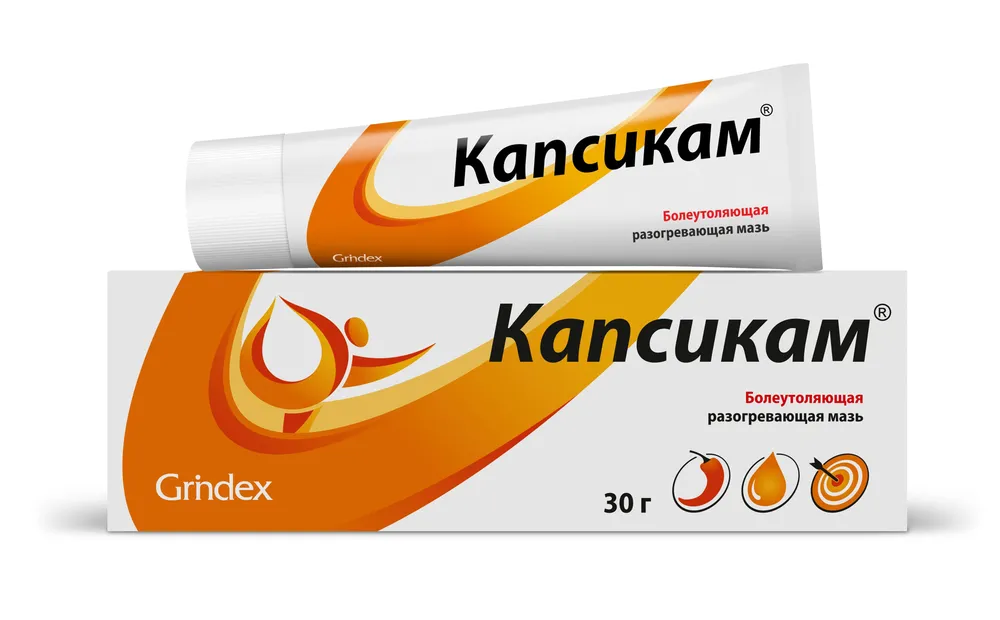
UkraineThe ointment is used to relieve muscle and joint pain, as well as a warming agent in sports medicine.
Frequently asked questions
How to correctly use Capsikam for joint or muscle pain?
Apply 1–3 g of the ointment to the affected area 2–3 times a day using the applicator. To enhance the warming effect, applying a bandage is recommended. After application, hands must be washed with cool water and soap.
What are the possible side effects of Capsikam?
Possible allergic reactions include: itching, swelling, urticaria, rash, irritation, redness, or a burning sensation. If you notice such symptoms, you should discontinue use and consult a physician.
Who should not use this product?
The product is contraindicated for people with hypersensitivity to its components, a tendency toward convulsions or bronchospasm, as well as in the presence of ulcers or skin diseases. The ointment must not be applied to damaged skin, and its use is not recommended during pregnancy, breastfeeding, or for children.
Can I take a hot bath during treatment?
It is not recommended to take a bath or visit a sauna shortly before or after applying the ointment, as this may lead to the opening of pores and an intensification of the burning sensation on the skin.
What should I do if the ointment gets into the eyes or onto mucous membranes?
Care must be taken to prevent the ointment from coming into contact with mucous membranes or eyes to avoid severe irritation.
How can I check if this product is suitable for me?
To avoid a severe reaction, apply a small amount of the ointment to a patch of skin before the first use to test for individual sensitivity.
Instructions for use
Table of contents
- Composition:
- Pharmacological Properties.
- Clinical characteristics.
- Special precautions for use.
- Method of Administration and Dosage
- Adverse Reactions.
- Composition:
- Pharmacological properties.
- Clinical characteristics.
- Special precautions for use.
- Method of Administration and Dosage
- Adverse reactions.
INSTRUCTIONS FOR MEDICAL USE OF THE MEDICINAL PRODUCT KAPSIKAM® (CAPSICAM)
Composition:
Active substances: dimethyl sulfoxide, racemic camphor, turpentine oil, benzyl nicotinate, nonivamide;
1 g of ointment contains 50 mg of dimethyl sulfoxide, 30 mg of racemic camphor, 30 mg of turpentine oil, 20 mg of benzyl nicotinate, 2 mg of nonivamide;
Excipients: cetostearyl alcohol (type A) emulsifying, sodium cetostearyl sulfate, polysorbate 80, bronopol, purified water.
Pharmaceutical form. Ointment.
Main physicochemical properties: white ointment or white with a slightly yellowish tint, with the smell of camphor and turpentine oil.
Pharmacotherapeutic group.
Topically applied agents for joint and muscle pain. ATC code M02AX10.
Pharmacological Properties.
Pharmacodynamics.
Capsicam® is a combination product containing substances that exert a vasodilating and stimulating effect on sensitive nerve endings, resulting in a local irritant, analgesic, and hyperemic action. Local increase in temperature and improved blood circulation have a beneficial effect in rheumatic conditions, contusions, muscle strains, and other sports injuries.
Pharmacokinetics.
The cream is rapidly absorbed, and within a few minutes a burning sensation occurs, accompanied by noticeable skin reddening and a feeling of warmth. Muscle tension and pain sensations decrease. Analgesic effect develops within 30-40 minutes and lasts for 3-6 hours. With repeated application, the effect of the cream persists for 10-14 days.
Clinical characteristics.
Indications.
The drug should be used for muscular and joint pain: as a warming agent in sports medicine.
Contraindications.
- Hypersensitivity to the components of the drug;
- predisposition to seizures, bronchospasm;
- ulcers or skin diseases.
Interaction with other medicinal products and other forms of interaction. Unknown.
Special precautions for use.
Capsicam® may cause allergic reactions; it must not be applied to damaged skin. To avoid severe irritation, care must be taken to prevent the ointment from coming into contact with mucous membranes or eyes.
To prevent adverse reactions or other unpleasant symptoms, a small amount of the ointment should first be applied to the skin to determine individual sensitivity to the drug.
Thermal procedures (such as bathing or visiting a sauna) should be avoided shortly before and after applying the ointment, as this may cause pores to open and consequently lead to a burning sensation on the skin.
Use during pregnancy or breastfeeding.
Do not use during pregnancy or breastfeeding.
Ability to affect reaction rate when driving or operating machinery.
No effect.
Method of Administration and Dosage
For muscle and joint pain, apply 1–3 g of the ointment to the affected area using an applicator, 2–3 times daily depending on the intensity of pain, and cover with a dressing to enhance the warming effect. The total amount of ointment required for a full course of treatment is approximately 50–100 g.
After each procedure, hands should be washed thoroughly with cool water and soap.
When using the ointment as a warming agent in athletes, apply 2–3 g of the ointment to the muscle area using an applicator and rub in with massage movements until mild redness appears. After training, wash the ointment off the skin with cool water.
Children
There is no experience with the use of this medicinal product in children; therefore, its use in this patient group is not recommended.
Overdose
Application of excessive amounts of ointment to the skin may cause skin redness, mild transient itching, or a burning sensation. In such cases, any residual ointment should be washed off the skin.
Accidental ingestion of a small amount of ointment may cause gastrointestinal disturbances such as vomiting and diarrhea; treatment is symptomatic. Accidental ingestion of a large amount of ointment may result in acute poisoning with symptoms including nausea, vomiting, abdominal pain, headache, dizziness, sensation of heat/edema, seizures, respiratory depression, and coma. Patients presenting with severe gastrointestinal or neurological symptoms of poisoning should be closely monitored and treated symptomatically. Induction of vomiting is contraindicated. In case of accidental ingestion of the ointment, immediate medical advice should be sought.
Adverse Reactions.
In patients with increased skin sensitivity to the components of the ointment, itching, swelling, or urticaria may occur; allergic reactions including skin rashes, irritation, burning sensation, and redness are possible. In particular, cetostearyl alcohol and bronopol contained in the ointment may cause local skin reactions (contact dermatitis). In such cases, treatment should be discontinued and the ointment should be washed off the skin. The aforementioned symptoms resolve within 8–12 hours after discontinuation of the ointment.
If adverse effects occur, application of the ointment should be stopped and medical advice should be sought regarding further therapy.
Shelf life: 2 years.
Do not use after the expiry date stated on the packaging.
Storage Conditions.
Store at a temperature not exceeding 25 °C. Do not store in the refrigerator or freezer.
Keep out of reach and sight of children.
Packaging.
15 g, 30 g, and 50 g in aluminum tubes; 1 tube and an applicator per cardboard box.
Release Category.
Over-the-counter (without prescription).
Manufacturer.
JSC "Grindeks".
Manufacturer's address and location of business activity:
53 Krustpils Street, Riga, LV-1057, Latvia.
Marketing Authorization Holder.
JSC "Grindeks".
Address of the Marketing Authorization Holder and/or its representative:
53 Krustpils Street, Riga, LV-1057, Latvia.
Tel./Fax: +371 67083205 / +371 67083505.
E-mail: [email protected]
INSTRUCTIONS
for medical use of the medicinal product
CAPSICAM®
(CAPSICAM)
Composition:
Active ingredients: dimethyl sulfoxide, racemic camphor, turpentine oil, benzyl nicotinate, nonivamide;
1 g of ointment contains 50 mg dimethyl sulfoxide, 30 mg racemic camphor, 30 mg turpentine oil, 20 mg benzyl nicotinate, 2 mg nonivamide;
Excipients: cetostearyl alcohol (type A) emulsifying, sodium cetostearyl sulfate, polysorbate 80, bronopol, purified water.
Pharmaceutical form. Ointment.
Main physicochemical properties: white ointment or white with a slightly yellowish tint, with the odor of camphor and turpentine oil.
Pharmacotherapeutic group.
Topically applied agents for joint and muscle pain. ATC code M02A X10.
Pharmacological properties.
Pharmacodynamics.
Capsicam® is a combination preparation containing substances that exert vasodilating and irritant effects on sensitive nerve endings. As a result, the ointment produces local irritant, analgesic, and hyperemic actions. Local increase in temperature and improved blood circulation exert beneficial effects in rheumatic conditions, contusions, muscle strains, and other sports injuries.
Pharmacokinetics.
The ointment is rapidly absorbed, and within several minutes a burning sensation, noticeable reddening of the skin, and a feeling of warmth develop, accompanied by reduction in muscle tension and pain perception. Analgesic effect begins within 30–40 minutes and lasts for 3–6 hours. With repeated application, the ointment maintains its effect for 10–14 days.
Clinical characteristics.
Indications.
The drug should be used for muscular and joint pain: as a warming agent in sports medicine.
Contraindications.
- Hypersensitivity to the components of the drug;
- predisposition to seizures, bronchospasm;
- ulcers or skin diseases.
Interaction with other medicinal products and other forms of interaction. Unknown.
Special precautions for use.
Capsicam® may cause allergic reactions; it should not be applied to damaged skin. To avoid severe irritation, care must be taken to prevent the ointment from coming into contact with mucous membranes or eyes.
To prevent adverse reactions or other unpleasant symptoms, a small amount of the ointment should first be applied to the skin to determine individual sensitivity to the drug.
Thermal procedures (such as bathing or visiting a sauna) should be avoided shortly before and after applying the ointment, as they may cause pores to open and lead to a burning sensation on the skin.
Use during pregnancy or breastfeeding.
Do not use during pregnancy or breastfeeding.
Ability to influence reaction rate when driving or operating machinery.
No effect.
Method of Administration and Dosage
For muscle and joint pain, apply 1–3 g of the ointment 2–3 times daily to the affected area using an applicator, depending on the intensity of pain. A dressing may be applied to enhance the warming effect. The total amount of ointment used for a full course of treatment is approximately 50–100 g.
After each application, hands should be washed thoroughly with cool water and soap.
When used as a warming agent in athletes, apply 2–3 g of the ointment to the target muscle area using an applicator and rub in with massage movements until slight redness appears. After training, wash the ointment off the skin with cool water.
Children
There is no experience with the use of this medicinal product in children; therefore, its use in this patient group is not recommended.
Overdose
Excessive application of the ointment to the skin may cause redness, mild transient itching, or a burning sensation. In such cases, residual ointment should be washed off the skin.
Accidental ingestion of a small amount of ointment may cause gastrointestinal disturbances such as vomiting and diarrhea; symptomatic treatment is recommended. Accidental ingestion of a large amount of ointment may lead to acute poisoning with symptoms including nausea, vomiting, abdominal pain, headache, dizziness, sensation of warmth/swelling, seizures, respiratory depression, and coma. Patients presenting with severe gastrointestinal or neurological symptoms of poisoning should be closely monitored and treated symptomatically. Induction of vomiting is contraindicated. In case of accidental ingestion of the ointment, immediate medical attention is required.
Adverse reactions.
In case of increased skin sensitivity to the components of the ointment, itching, swelling, or urticaria may occur; allergic reactions including skin rashes, irritation, burning sensation, and redness are possible. In particular, cetylstearyl alcohol and bronopol contained in the ointment may cause local skin reactions (contact dermatitis). In such cases, treatment should be discontinued and the ointment should be washed off the skin. The aforementioned symptoms disappear within 8–12 hours after discontinuation of the ointment.
If undesirable adverse effects occur, the use of the ointment should be discontinued and medical advice should be sought regarding further therapy.
Shelf life. 2 years.
Do not use after the expiry date stated on the packaging.
Storage conditions.
Store at a temperature not exceeding 25 °C. Do not store in refrigerator or freezer.
Keep out of reach of children.
Packaging.
15 g, 30 g, and 50 g in aluminum tubes; 1 tube and an applicator in a cardboard pack.
Classification.
Over-the-counter (without prescription).
Manufacturer.
JSC Tallinn Pharmaceutical Plant.
Manufacturer's address and location of operations.
Tondi TN 33, Kristiine district, Tallinn, Harjumaa county, 11316, Estonia.
Marketing authorization holder.
JSC "Grindeks".
Address of the marketing authorization holder and/or its representative.
Krustpils St. 53, Riga, LV-1057, Latvia.
Tel./Fax: +371 67083205 / +371 67083505.
E-mail: [email protected]
Similar drugs
The original data is available in the language of the country of manufacture.
Data source: State Register of Medicinal Products of Ukraine
Data last verified: August 13, 2026