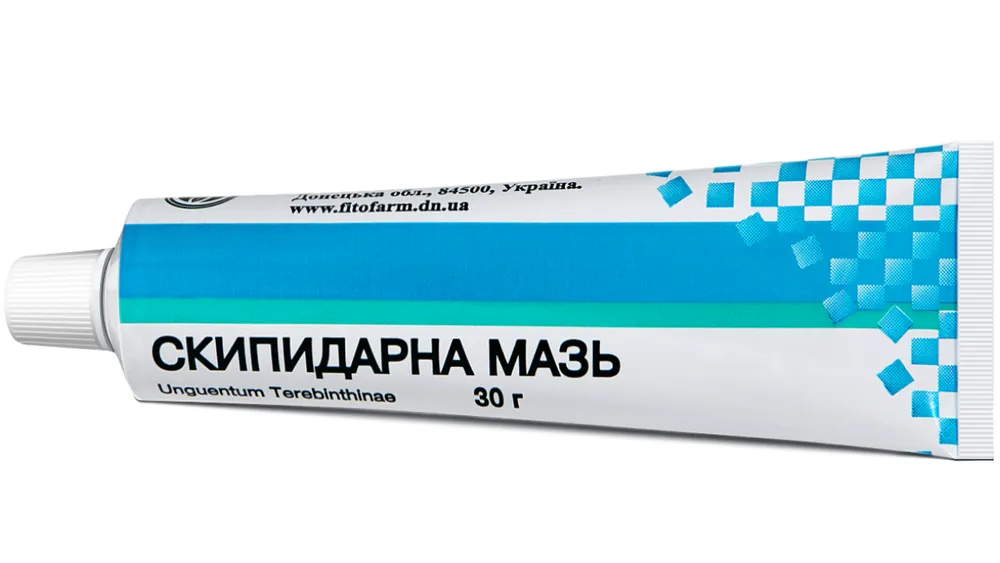
TURPENTINE OINTMENT
UkraineThe drug is used for the complex treatment of neuralgia, myositis, and arthritis.
Frequently asked questions
How should Turpentine ointment be used correctly?
Adults should rub the ointment into the painful areas of the skin 2-3 times a day. The duration of treatment depends on how quickly the symptoms subside.
Who should not use this drug?
Contraindications include severe kidney and liver diseases, any skin diseases, as well as hypersensitivity to the composition of the ointment. The drug is not recommended for children, pregnant women, and breastfeeding women.
What are the possible side effects of Turpentine ointment?
Possible allergic reactions include itching, swelling, redness, burning, or rash. In rare cases, more serious reactions may occur, such as rapid heartbeat, low blood pressure, dizziness, convulsions, or loss of consciousness.
Can the ointment be mixed with other agents?
The ointment must not be combined with iodine solution, as they are chemically incompatible.
What should be done if the ointment gets into the eyes or onto damaged skin?
The ointment must not be applied to damaged skin, and contact with mucous membranes must be avoided. If the ointment gets into the eyes, they must be thoroughly rinsed with plenty of running water.
Instructions for use
INSTRUCTIONS FOR MEDICAL USE OF THE MEDICINAL PRODUCT TURPENTINE OINTMENT (UNGUENTUM TEREBINTHINAE)
Composition:
Active substance: oleoresin turpentine;
1 g of ointment contains: 200 mg of oleoresin turpentine;
Excipients: soft white paraffin, emulsifier T-2, purified water.
Pharmaceutical form. Ointment.
Main physicochemical properties: ointment of white or whitish-yellowish color with the odor of turpentine. The ointment should be homogeneous in appearance.
Pharmacotherapeutic group.
Topical preparations used for joint and muscular pain.
ATC code M02A X10.
Pharmacological properties.
Turpentine ointment exerts distracting, anti-inflammatory, antiseptic, and analgesic effects. The distracting effect is associated with the ability to penetrate through the epidermis and cause reflex changes due to stimulation of skin receptors.
Clinical characteristics.
Indications.
In complex treatment of neuralgias, myositis, arthritis.
Contraindications.
Severe kidney and liver diseases, skin disorders of various etiology, increased sensitivity to the drug.
Special safety precautions.
Avoid contact of the ointment with mucous membranes and eyes! If the ointment accidentally gets into the eyes, they should be thoroughly rinsed with a large amount of running water.
Do not apply to damaged areas of the skin.
Interaction with other medicinal products and other forms of interaction.
Turpentine ointment is chemically incompatible with iodine solution.
Special precautions.
Use during pregnancy or breastfeeding.
It is unknown whether the drug penetrates into breast milk or crosses the placental barrier during pregnancy; therefore, the use of the drug during pregnancy and breastfeeding is contraindicated.
Ability to affect reaction rate when driving or operating machinery.
Caution should be exercised when driving or operating machinery due to the possible occurrence of generalized adverse reactions (see "Adverse reactions").
Method of Administration and Dosage
Apply turpentine ointment externally by rubbing it into the affected painful areas 2–3 times daily in adults. The duration of use is determined by the course of the disease and the therapeutic effect achieved.
The patient should consult a physician if symptoms of the disease do not subside during treatment or if adverse reactions not listed in the instructions for medical use occur.
Children.
There is no experience with the use of the drug in children; therefore, the ointment is not recommended for use in pediatric patients.
Overdose.
Possible development of increased sensitivity to the drug and intensification of adverse effects.
Side effects.
Immune system reactions: allergic reactions of a local nature may occur in case of hypersensitivity to the drug, including itching, swelling, redness of the skin, burning sensation, rash. In individual cases, generalized allergic reactions may occur, including urticaria, rapid heartbeat, decreased blood pressure, dizziness, seizures, loss of consciousness.
Shelf life. 3 years.
Storage conditions.
Store in the original packaging at a temperature not exceeding 25 °C.
Keep out of reach of children.
Packaging. 30 g in tubes.
Supply category. Over-the-counter.
Manufacturer: JSC "FITOPHARM".
Manufacturer's address and location of its business activity:
2 Sybirtseva Street, Bakhmut, Donetsk region, 84500, Ukraine.
Marketing Authorization Holder: JSC "FITOPHARM".
Address of the Marketing Authorization Holder:
12 Almatinska Street, Kyiv, 02092, Ukraine.
Similar drugs
The original data is available in the language of the country of manufacture.
Data source: State Register of Medicinal Products of Ukraine
Data last verified: August 13, 2026