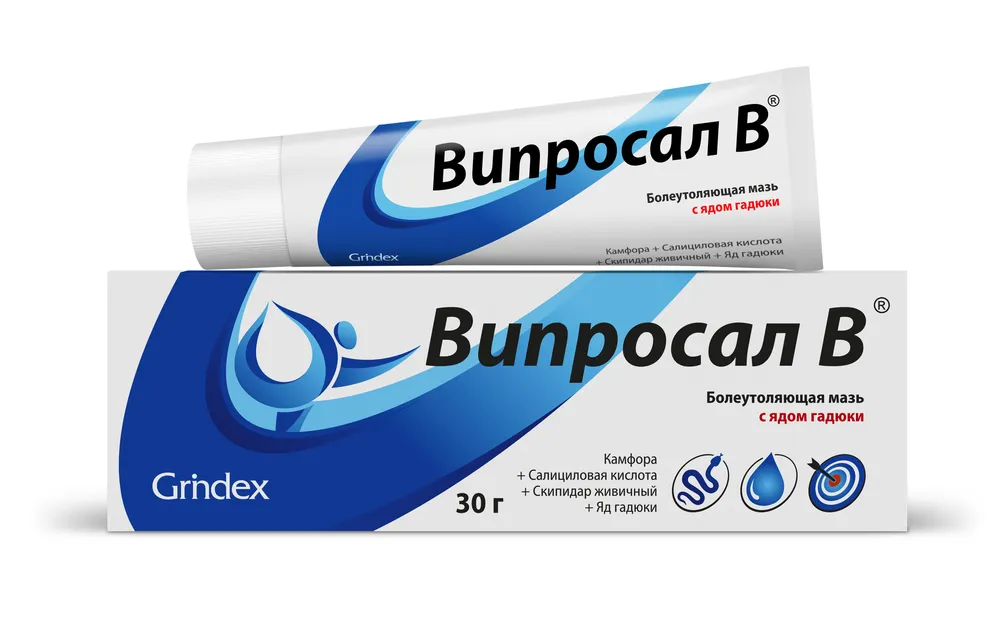
VIPROSAL V®
UkraineThe ointment is used for external application as a remedy for muscle and joint pain.
Frequently asked questions
How to use Viprosal v® correctly?
Apply small amounts of 5–10 g (1–2 teaspoons) to the painful area and rub into the skin 1–2 times daily, depending on the severity of the pain, until it subsides. Do not apply a bandage to the application site; it may only be lightly covered.
What side effects may occur from using the ointment?
Possible allergic reactions include: itching, swelling, urticaria, rash, redness, burning, or contact dermatitis. Headaches, dizziness, or convulsions (due to camphor) may also occur. If such symptoms appear, discontinue treatment and wash off the ointment.
Who should not use this drug?
Contraindicated in cases of hypersensitivity to the ointment components or acetylsalicylic acid, bronchial asthma, whooping cough, tendency toward convulsions or bronchospasm, ulcers and skin diseases, pulmonary tuberculosis, circulatory disorders, severe kidney or liver disease, fever, and general fatigue. The drug is also contraindicated for pregnant and breastfeeding women.
Can the ointment be applied to damaged skin?
No, the ointment must not be applied to damaged skin, and care should be taken to avoid contact with eyes or mucous membranes.
Does the ointment interact with other medicines?
Caution should be exercised when taking coumarin anticoagulants or antiplatelet drugs (including acetylsalicylic acid), as excessive use of salicylates may enhance their effect.
Can the product be used by children?
Experience in use in children is lacking; therefore, use of the drug in children is not recommended.
Instructions for use
INSTRUCTIONS FOR MEDICAL USE OF THE MEDICINAL PRODUCT VIPROSAL B® (VIPROSAL B)
Composition:
Active substances: dried common viper venom, racemic camphor, turpentine oil, salicylic acid;
1 g of ointment contains 0.05 MED of dried common viper venom, 30 mg of racemic camphor, 30 mg of turpentine oil, 10 mg of salicylic acid;
Excipients: white soft paraffin, cetostearyl alcohol, paraffin, sodium cetostearyl sulfate, glycerol, sodium chloride, purified water.
Pharmaceutical form. Ointment.
Main physicochemical characteristics: ointment of white or slightly yellowish-white color with the odor of camphor and turpentine oil.
Pharmacotherapeutic group.
Topical preparations used for joint and muscle pain.
ATC code M02AX10.
Pharmacological properties.
Pharmacodynamics.
The active ingredient of the ointment is the venom of the common viper (Venenum viperae berus), which contains phospholipase, phosphodiesterase, hyaluronidase, and other active substances. Viper venom also contains specific action peptides that cause hemolysis, increase capillary permeability, and affect blood coagulation. When applied locally, viper venom exerts an irritant and analgesic effect.
Other active ingredients of the ointment, by stimulating sensitive nerve endings, produce a local irritant and analgesic effect. In addition to the analgesic effect, camphor, salicylic acid, and turpentine oil possess antiseptic properties, while salicylic acid also has a keratolytic effect.
Pharmacokinetics.
The ointment is rapidly absorbed, and within a few minutes a burning sensation, mild skin hyperemia, and a feeling of warmth develop. Analgesic effect begins within 20–30 minutes and lasts for 1.5–2 hours.
Clinical characteristics.
Indications.
Analgesic for external use in joint and muscle pain.
Contraindications.
- Hypersensitivity to any component of the ointment, acetylsalicylic acid, or other nonsteroidal anti-inflammatory drugs.
- Bronchial asthma.
- Pertussis.
- Predisposition to bronchospasm.
- Predisposition to seizures.
- Skin ulcers and other skin diseases.
- Acute pulmonary tuberculosis.
- Cerebral or coronary circulation disorders.
- Predisposition to angiospasm.
- Severe renal or hepatic dysfunction.
- Fever.
- General fatigue.
Interaction with other medicinal products and other forms of interaction.
Has not been studied. Although adequate controlled interaction trials have not been conducted, excessive topical application of salicylates may potentially enhance the effect of coumarin anticoagulants and antiplatelet agents. Caution is advised if the patient is receiving coumarin anticoagulants or antiplatelet agents, including acetylsalicylic acid.
Special precautions for use.
The ointment must not be applied to damaged skin. To avoid severe irritation, care must be taken to prevent the ointment from entering the eyes or coming into contact with mucous membranes.
A dressing must not be applied over the area where the ointment has been applied; the area may only be lightly covered.
The ointment contains cetostearyl alcohol, which may cause local skin reactions (including contact dermatitis).
Use during pregnancy or breastfeeding.
Contraindicated during pregnancy or breastfeeding.
Ability to influence reaction rate when driving or operating machinery.
Has no effect.
Method of Administration and Dosage
For external use only. Apply small amounts of 5–10 g (1–2 teaspoons) of the ointment to the affected painful area and rub gently into the skin, 1–2 times daily depending on the intensity of pain, until the pain subsides. The duration of treatment depends on the nature and severity of the condition.
Elderly patients. There are no data indicating that elderly patients require a different dosage.
Children.
There is no experience with use in children; therefore, application in this patient group is not recommended.
Overdose.
If the ointment comes into contact with mucous membranes or is applied in excessively large amounts, it may cause severe irritation.
Incorrect use
Accidental ingestion of the ointment may cause gastrointestinal symptoms such as vomiting and diarrhea. Treatment is symptomatic.
Ingestion of large amounts of the ointment may lead to symptoms of acute poisoning, such as nausea, vomiting, abdominal pain, headache, dizziness, sensation of warmth/flushing, seizures, respiratory depression, and coma.
In case of severe gastrointestinal or neurological symptoms of poisoning, medical observation and symptomatic treatment are required. Induction of vomiting is contraindicated.
Side effects.
In case of increased skin sensitivity to the components of the ointment, itching, swelling, or urticaria may occur during use. Allergic reactions may also occur, including contact dermatitis, rash, redness, burning sensation; headache, dizziness; seizures caused by camphor are also possible. In such cases, it is recommended to discontinue treatment and wash the ointment off the skin. The aforementioned symptoms resolve after discontinuation of treatment.
Expiry date. 3 years.
Do not use after the expiry date stated on the packaging.
Storage conditions.
Store at a temperature not exceeding 25 °C. Do not store in refrigerator or freezer.
Keep out of reach of children.
Packaging.
30 g, 50 g, or 75 g in an aluminum tube; 1 tube per cardboard box.
Supply category.
Over-the-counter.
Manufacturer.
AS Tallinn Pharmaceutical Factory.
Manufacturer's address and place of business.
Tondi TN 33, Kristine district, Tallinn, Harju County, 11316, Estonia.
Marketing authorization holder.
JSC "Gryndeks".
Address of the marketing authorization holder.
53 Krustpils Street, Riga, LV-1057, Latvia.
Similar drugs
The original data is available in the language of the country of manufacture.
Data source: State Register of Medicinal Products of Ukraine
Data last verified: August 13, 2026