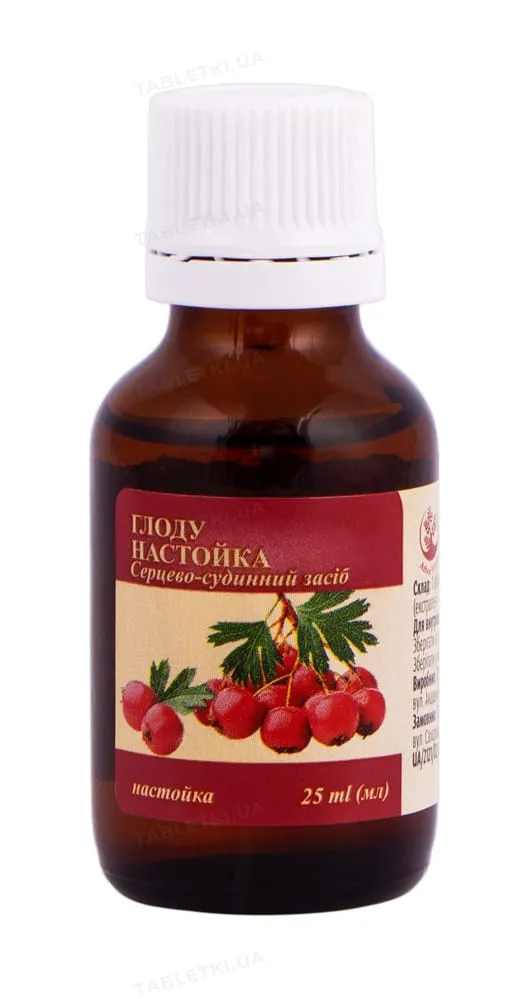
GLODU TINCTURE
UkraineThe preparation is used for functional disorders of the cardiovascular system (neurocirculatory dystonias), as well as an adjunct treatment for mild cardiac rhythm disturbances, such as atrial fibrillation or paroxysmal tachycardia.
Frequently asked questions
How should Glodu tincture be taken correctly?
The preparation should be taken orally before meals. For adults, it is recommended to take 20 drops 3 times a day. For children aged 12 and older, 1 drop per year of age 3 times a day until a stable effect is achieved. The duration of the course is determined by a physician.
What are the possible side effects of Glodu tincture?
Allergic reactions (itching, redness, skin edema), drowsiness, or a significant slowing of the heart rate are possible.
Who should not take this preparation?
Contraindicated in cases of individual hypersensitivity to the components, pronounced low blood pressure (hypotension), and slow heart rate (bradycardia). The preparation is also prohibited for use in pregnant and breastfeeding women, and it is contraindicated for children under 12 years of age.
Can you drive a vehicle during treatment?
Since the preparation may cause drowsiness, one should refrain from driving motor vehicles or operating machinery during its use.
How do other medications affect its use?
The preparation enhances the effects of cardiac glycosides, hypnotics, sedatives, and antihypertensive agents. It is not recommended to combine it with alkaloid salts, third-generation antiarrhythmic agents, and cisapride. Always consult a physician before simultaneous administration with other medications.
What should be done in case of overdose?
A significant overdose may lead to decreased blood pressure, drowsiness, or a slow heart rate. In such cases, it is necessary to discontinue use and seek medical attention for symptomatic therapy.
Instructions for use
INSTRUCTION FOR MEDICAL USE OF THE MEDICINAL PRODUCT HAWTHORN TINCTURE (TINCTURA CRATAEGI)
Composition:
Active substance: hawthorn fruit tincture;
1 bottle contains hawthorn fruit tincture (Tinctura Crataegi) (1 : 10) (extractant ethanol 70%) – 100 ml.
Pharmaceutical form. Tincture.
Pharmaceutical characteristics.
Main physicochemical properties: clear reddish-brown liquid; sediment formation during storage is permissible.
Pharmacotherapeutic group.
Agents used in cardiology. ATC code C01EB04.
Pharmacological properties.
Pharmacodynamics. Biologically active substances contained in hawthorn fruits (flavonoids, choline, acetylcholine, tannins, phytosterols, triterpenic acids) enhance circulation in the coronary vessels and cerebral vessels, increase myocardial sensitivity to cardiac glycosides and reduce its excitability, resulting in a moderate enhancement of cardiac muscle contractions.
Pharmacokinetics. The medicinal product is well absorbed when taken orally. The effect begins within 30 minutes to 1 hour.
Clinical characteristics.
Indications.
Functional disorders of the cardiovascular system (neurocirculatory dystonia). As an auxiliary medicinal agent in mild forms of cardiac arrhythmias (atrial fibrillation, paroxysmal tachycardia).
Contraindications.
Individual hypersensitivity to components of the drug. Marked arterial hypotension and bradycardia. Pregnancy and breastfeeding.
Interaction with other medicinal products and other forms of interaction.
The drug enhances the effects of cardiac glycosides. Concomitant use with alkaloid salts is not recommended due to the possibility of forming negative complexes. The drug should not be used together with third-generation antiarrhythmic agents or cisapride. May enhance the effects of hypnotics, sedatives, and antihypertensive agents.
If simultaneous use with any other medicinal products is necessary, consult a physician.
Special precautions for use
The medication is not recommended to be taken during meals in order to avoid interactions with food components.
Use during pregnancy or breastfeeding.
The medicinal product is contraindicated for use in women during pregnancy and breastfeeding.
Ability to affect reaction speed when driving or operating machinery.
The medication may cause drowsiness; therefore, patients should refrain from driving or operating machinery during treatment.
Dosage and Administration
The tincture is taken orally before meals. Unless otherwise prescribed by a physician, the recommended dose for adults is 20 drops of the tincture 3 times daily. For children aged 12 years and older, the dose is 1 drop per year of age, 3 times daily, until a stable therapeutic effect is achieved (such as normalization of arterial blood pressure, reduction of palpitations, etc.). The duration of treatment is determined individually by the physician.
The patient should consult a doctor if symptoms of the disease do not resolve during treatment or if any adverse reactions occur.
If the bottle is closed with a non-dropper stopper, a medical glass pipette should be used for administration; the dosage remains unchanged.
Children
The tincture is contraindicated in children under 12 years of age.
Overdose
In case of significant overdose, a decrease in arterial blood pressure, drowsiness, and bradycardia may occur. These symptoms require immediate discontinuation of the drug and initiation of symptomatic therapy.
Adverse reactions.
Allergic reactions may occur (redness, itching and skin rash, skin swelling). Rarely observed are drowsiness and significant slowing of heart rate.
If any adverse events occur, consult a physician.
Shelf life.
4 years.
Storage conditions.
Store in a place inaccessible to children, at a temperature not exceeding 25 °C, in the original packaging.
Packaging.
Tincture, 100 ml in glass bottles.
Supply category.
Over-the-counter.
Manufacturer.
TOV "Panacea".
Manufacturer's address and place of business.
Ukraine, 69014, Zaporizhzhia, Volska St., 24.
Similar drugs
| Brand name | Dosage form | Active substance / Dosage | Manufacturer |
|---|---|---|---|
| GLOD-VISHFA | tincture |
|
DKP "Pharmaceutical Factory" LLC |
| GLODU TINCTURE | tincture |
|
LLC "Pharmaceutical Company "Zdorovya" |
| GLODU TINCTURE | tincture |
|
Subsidiary "Mezhiritsky Vitamin Plant" of Public Joint Stock Company "Ukrmedprom" |
| GLODU TINCTURE | tincture |
|
Subsidiary "Mezhiritsky Vitamin Plant" of Public Joint Stock Company "Ukrmedprom" |
| GLODU TINCTURE | tincture |
|
MEDLEV LLC |
| GLODU TINCTURE | tincture |
|
PJSC Pharmaceutical Factory "Viola" |
| GLODU TINCTURE | tincture |
|
Subsidiary "Agrofirm "Yan" of Private Enterprise "Yan" |
| GLODU TINCTURE | tincture |
|
PJSC "Biolik" |
| GLODU TINCTURE | tincture | PJSC "Fitofarm" | |
| GLODU TINCTURE | tincture |
|
Ternofarm LLC |
| GLODU TINCTURE | tincture |
|
PJSC "HIMFARMZAVOD "CHERVONA ZIRKA" |
| GLODYU TINCTURE | tincture |
|
DKP "Pharmaceutical Factory" LLC |
The original data is available in the language of the country of manufacture.
Data source: State Register of Medicinal Products of Ukraine
Data last verified: August 13, 2026