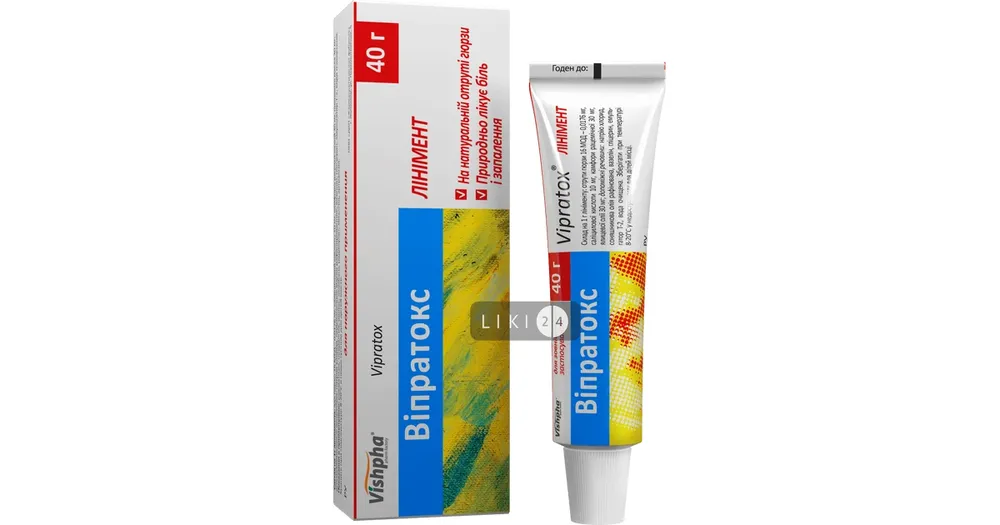
VIPRATOX
UkraineThe drug is used to relieve pain in rheumatism, neuralgia, sciatica, lumbago, radiculitis, as well as muscle pain (myalgia) and joint pain (arthralgia).
Frequently asked questions
How should Vipratox be used correctly?
Before the first use, a small amount of the product should be applied to the skin to test for individual sensitivity. The main application should be done in small portions of 5-10 g and rubbed thoroughly into the skin 1-2 times a day until the pain subsides. The exact duration of the course should be determined by a physician.
What side effects can Vipratox cause?
Possible local allergic reactions include: itching, burning, rash, dryness, skin peeling, irritation, contact dermatitis, or urticaria. An increase in body temperature is also possible.
Who should not use this drug?
Use is contraindicated in cases of hypersensitivity to the components, bronchial asthma, whooping cough, tendency toward convulsions or bronchial spasms, acute pulmonary tuberculosis, cerebral and coronary circulation disorders, severe kidney or liver disease, purulent skin diseases, skin damage at the application site, fever, and general fatigue. The drug is also prohibited for use during pregnancy and breastfeeding.
Can the product be used by children?
Use in children is not recommended, as there is no experience regarding its use in this age group.
With which medicines should caution be exercised?
Caution is required for patients taking anticoagulants (blood-thinning drugs) and antiplatelet agents, including acetylsalicylic acid, as excessive use of salicylates may enhance their effect.
What should be done if the product gets into the mucous membranes or eyes?
The eyes or mucous membranes must be thoroughly rinsed with a large amount of running water.
What symptoms may occur upon accidental ingestion?
Stomach upsets (vomiting, diarrhea) are possible. Ingestion of a large amount may cause signs of acute poisoning: nausea, abdominal pain, headache, dizziness, convulsions, a sensation of heat, respiratory distress, or coma. In such a case, do not induce vomiting; medical attention must be sought immediately.
Instructions for use
INSTRUCTION FOR MEDICAL USE OF THE MEDICINAL PRODUCT VIPRATOX (VIPRATOX)
Composition:
Active ingredients: viper venom 16 MOD, salicylic acid, racemic camphor, fir oil;
1 g of liniment contains viper venom 16 MOD – 0.0176 mg, salicylic acid – 10 mg, racemic camphor – 30 mg, fir oil – 30 mg;
Excipients: sodium chloride, sunflower oil, white soft paraffin, glycerin, emulsifier T-2, purified water.
Pharmaceutical form. Liniment.
Main physicochemical properties: white liniment with a characteristic odour of camphor and fir oil.
Pharmacotherapeutic group.
Medicinal products used locally for joint and muscle pain.
ATC code M02A X10.
Pharmacological Properties.
Pharmacodynamics.
The active ingredient of Vipratoks is the venom of the Levantine viper (Venenum Macrovipera lebetina), which contains phospholipase, phosphodiesterase, hyaluronidase, and other active substances.
The drug's action is due to the toxins present in the viper venom.
Postsynaptic neurotoxins that specifically block nicotinic cholinoreceptors of the subsynaptic membrane of skeletal muscles and certain areas of the central nervous system.
Presynaptic neurotoxins that act on presynaptic nerve endings and promote increased release of mediators.
Membrane-active neurotoxins (polypeptide cardiotoxins and cytotoxins) that actively affect cell membranes, including causing their depolarization.
In addition to the specific action directly dependent on the components of the venom, the therapeutic effect of the drug is associated with reflex responses arising from stimulation of skin receptors, the influence of biogenic substances formed during local action of the drug on tissues, the impact on the body's immunological reactions, as well as stimulation of the "pituitary-adrenal gland" system. When applied locally, the viper venom exerts an irritant and analgesic effect.
Salicylic acid, when applied externally, has antiseptic, irritant, counterirritant, and keratolytic effects, promoting better penetration of active components.
Fir oil, due to its high lipophilicity, easily penetrates through the epidermis and stimulates sensory nerve endings of both superficial and deeper blood vessels.
Due to camphor, the drug exhibits local irritant, analgesic, and anti-inflammatory actions and, by stimulating skin sensory nerve endings, improves tissue trophism.
Pharmacokinetics.
Not studied.
Clinical characteristics.
Indications.
Symptomatic treatment of pain in rheumatism, neuralgia, sciatica, lumbago, radiculitis, myalgia, arthralgia.
Contraindications.
Hypersensitivity to the components of the drug. Bronchial asthma, whooping cough, tendency to bronchospasm, predisposition to seizures, active pulmonary tuberculosis, cerebral and coronary circulation disorders, predisposition to angiospasm, severe renal and hepatic dysfunction, skin infections, skin integrity damage at the site of application, fever, general fatigue.
Special precautions.
Do not apply to skin showing signs of allergic reaction.
Avoid contact of the drug with eyes, open wounds, and mucous membranes. In case of accidental contact with eyes or mucous membranes, rinse thoroughly with large amounts of running water.
Use with caution in elderly patients.
Interaction with medicinal products and other types of interactions.
Not studied. Although adequate controlled interaction trials have not been conducted, excessive use of topical salicylates may potentially enhance the effect of coumarin anticoagulants and antiplatelet agents. Patients receiving coumarin anticoagulants and antiplatelet agents, including acetylsalicylic acid, should use with caution.
Special precautions for use.
Use during pregnancy or breastfeeding.
Contraindicated during pregnancy or breastfeeding.
Ability to influence reaction rate while driving or operating machinery.
The drug does not affect reaction speed when driving or operating machinery.
Dosage and Administration.
To avoid the occurrence of adverse effects, a small amount of the liniment should be applied to the skin in advance to determine individual sensitivity to the drug.
Depending on the size of the affected area, apply small portions of 5–10 g of the liniment and thoroughly rub into the skin 1–2 times daily until the pain syndrome subsides.
The duration of treatment is determined by the physician depending on the severity of the disease course and treatment efficacy.
Children.
There is no experience with use in children; therefore, application in this patient group is not recommended.
Overdose.
Accidental contact with mucous membranes causes severe irritation. Allergic reactions (itching, dermatitis, skin peeling) are possible. It is recommended to discontinue use of the liniment and wash off any residue from the skin. If necessary, symptomatic treatment should be administered.
Incorrect use.
Accidental ingestion of the ointment may cause gastrointestinal symptoms such as vomiting and diarrhea. Treatment is symptomatic.
Ingestion of a large amount of the ointment may lead to symptoms of acute poisoning, such as nausea, vomiting, abdominal pain, headache, dizziness, sensation of warmth/flushing, seizures, respiratory depression, and coma.
Treatment of patients with severe gastrointestinal or neurological symptoms of poisoning is symptomatic. Induction of vomiting is contraindicated.
Side effects.
Possible local allergic reactions (including itching, burning, rash, dryness, peeling, irritation, contact dermatitis, urticaria), increased body temperature.
Shelf life. 3 years.
Do not use the drug after the expiry date stated on the packaging.
Storage conditions.
Store at a temperature not exceeding 25 °C, in a place inaccessible to children.
Packaging.
40 g in a tube in a carton.
Availability category.
Over-the-counter.
Manufacturer.
TOV "DKP "Pharmaceutical Factory".
Manufacturer's address.
4, Korolova St., Stanyshivka village, Zhytomyr district, Zhytomyr region, 12430, Ukraine.
Similar drugs
| Brand name | Dosage form | Active substance / Dosage | Manufacturer |
|---|---|---|---|
| ALOROM | liniment |
mixture of fresh juice of leaves of aloe arborescens, liquid extract of chamomile flowers, liquid extract of fennel flowers, levomenthol and eucalyptus oil
·
478 mg 200 mg 100 mg 1 mg 1 mg per 1 g
|
JSC "Lubnipharm" |
The original data is available in the language of the country of manufacture.
Data source: State Register of Medicinal Products of Ukraine
Data last verified: August 13, 2026