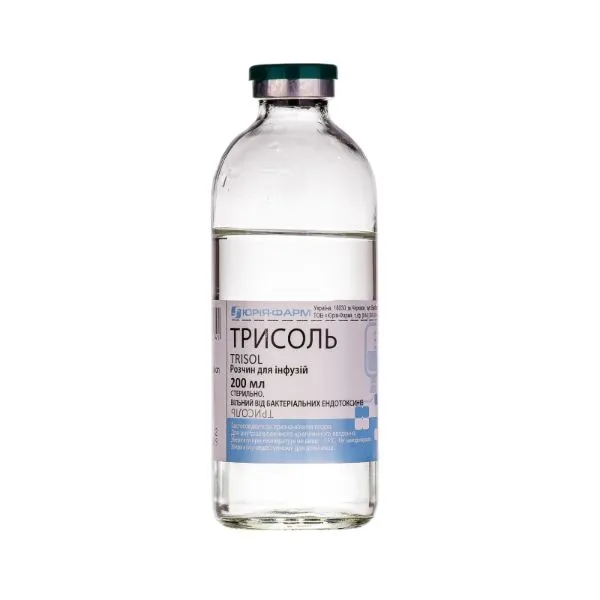
TRISOL
UkraineThe drug is used to restore water-electrolyte balance in acute intestinal infections and other conditions accompanied by dehydration and intoxication.
Frequently asked questions
How should Trisol be taken correctly?
The solution is administered intravenously (bolus or drip) after warming to 36-38 °C. The amount of solution should correspond to the volume of fluid lost. In severe conditions or shock, administration is carried out under strict medical supervision. The maximum daily dose is 3 liters.
Who should not use this drug?
Contraindications include elevated potassium or sodium levels in the blood, severe heart or kidney failure, cerebral or pulmonary edema, metabolic alkalosis, hyperhydration (excess fluid in the body), as well as renal dysfunction.
What are the possible side effects of Trisol?
Possible hypersensitivity reactions (allergy), digestive disorders, as well as electrolyte imbalance (excess sodium, potassium, or fluid in the body), which may lead to edema or alkalosis.
Can this drug be mixed with other medicines?
No negative effect on other drugs has been established; however, the drug must not be mixed with other agents that are incompatible with sodium chloride.
What to do in case of overdose?
It is necessary to stop administration and begin symptomatic treatment prescribed by a physician (for example, administration of glucose or diuretics, and in some cases, hemodialysis).
Instructions for use
INSTRUCTIONS FOR MEDICAL USE OF THE MEDICINAL PRODUCT TRISOLUM (TRISOLUM)
Composition:
Active substances: sodium chloride, potassium chloride, sodium bicarbonate;
100 ml of solution contains 0.5 g of sodium chloride, 0.1 g of potassium chloride, 0.4 g of sodium bicarbonate;
Ionic composition per 1000 ml of preparation: Na+ – 133 mmol, K+ – 13 mmol, Cl¯ – 99 mmol, HCO3¯ – 48 mmol;
Excipient: water for injections.
Pharmaceutical form. Infusion solution.
Main physico-chemical properties: clear, colorless liquid; theoretical osmolarity 293 mosmol/L; pH 8.1–8.9.
Pharmacotherapeutic group. Solutions used for correction of electrolyte balance disorders. Electrolytes.
ATC code B05B B01.
Pharmacological Properties.
Pharmacodynamics.
A saline plasma-substituting solution having detoxifying effects. Prevents blood thickening and the development of metabolic acidosis, reduces hypovolemia, improves microcirculation, functional state of the heart and kidneys, enhances diuresis.
Pharmacokinetics.
The drug remains in the vascular bed for a short period, rapidly transferring into the interstitial space. It is excreted by the kidneys, enhancing diuresis.
Clinical characteristics.
Indications.
Correction of fluid and electrolyte imbalances in acute intestinal infections and other conditions caused by isotonic and hypotonic dehydration and intoxications of various origins.
Contraindications.
Hypersensitivity, hyperkalemia, hypernatremia, severe renal and/or cardiac insufficiency, hyperhydration, cerebral or pulmonary edema, metabolic alkalosis, impaired renal excretory function or conditions threatening its development.
Interaction with other medicinal products and other types of interactions.
No adverse effects have been observed upon interaction with other medicinal products, except for those incompatible with sodium chloride solution as a solvent.
Special precautions for use.
Before administration, warm the solution to 36–38°C. Administer the drug under laboratory monitoring of electrolyte balance. In case of hyperkalemia development, replace Trisole with Disole until electrolyte balance is normalized. Assess the balance between fluid loss and Trisole solution administered every 6 hours. The total volume of administered solution should correspond to the degree of dehydration.
Use during pregnancy or breastfeeding.
There is no experience with the use of the drug during pregnancy or breastfeeding.
Ability to influence reaction rate while driving or operating machinery.
Data regarding the effect of the drug on reaction rate during driving or operating machinery are unavailable, as the drug should be administered exclusively under inpatient conditions.
Administration and Dosage
Trisol solution is administered intravenously either as a bolus or by infusion. Before use, the solution should be warmed to 36–38°C. In severe forms of pathological conditions, administer as a bolus initially, followed by intravenous infusion (40–120 drops per minute over 24–48 hours). In emergency rehydration therapy for hypovolemic shock, administer Trisol solution as a bolus over 1–3 hours. The total volume administered should correspond to the volume of fluid lost. However, during the first hour, the volume administered should generally be 7–10% of body weight.
The drug should be used under monitoring of laboratory parameters and hemodynamic status. The maximum daily dose is 3 L.
In children, administer intravenously (as bolus or infusion) in quantities necessary to restore the lost fluid volume.
Children
Trisol, infusion solution, should be administered to children in emergency conditions according to life indications under medical supervision.
Overdose
Hyperkalemia, hypernatremia, hyperhydration, alkalosis.
Administration of large volumes of the solution may lead to renal function impairment, hypervolemia, hyperkalemia (paresthesia, confusion, paralysis, sudden cardiac arrest), hypernatremia, alkalosis, hyperhydration, and cerebral edema.
Treatment. Discontinue administration and initiate symptomatic therapy: administration of glucose solutions, solutions containing sodium bicarbonate, calcium. Eliminate the drug via hemodialysis. Hyperkalemia is managed by preventing hypercatabolism, discontinuing potassium-sparing diuretics, angiotensin-converting enzyme inhibitors, heparin, and beta-blockers, and avoiding potassium intake through food and medications. Hyperhydration is managed by prescribing diuretics: high-dose furosemide (up to 100 mg daily parenterally) with continuous monitoring of electrolyte levels.
Side effects.
Hypersensitivity reactions are possible in individuals intolerant to any component of the drug; dyspeptic disorders.
Hyperkalemia, hypernatremia, alkalosis, hypervolemia, hyperhydration.
Shelf life. 2 years.
Storage conditions. Store at a temperature not exceeding 25 °C in a place inaccessible to children. Moisture on the inner surface of the bottle is not a contraindication for using the drug.
Incompatibility.
Not established.
Packaging. 200 or 400 ml in bottles.
Prescription status. Prescription only.
Manufacturer. Private Joint Stock Company "Infuziya".
Manufacturer's address and location of business activity.
Ukraine, 21034, Vinnytsia, Voloshkova St., b. 55
or
Ukraine, 23219, Vinnytsia region, Vinnytsia district, village Vinnytski Khutory, Nemirovskе Highway, b. 84A.
Marketing Authorization Holder. Private Joint Stock Company "Infuziya".
Address of the Marketing Authorization Holder.
Ukraine, 04073, Kyiv, Moskovskyi Avenue, b. 21-A.
Similar drugs
| Brand name | Dosage form | Active substance / Dosage | Manufacturer |
|---|---|---|---|
| ACESOL | solution for infusion | PJSC "Infuziya" | |
| DARROW SOLUTION | solution for infusion | PJSC "Infuziya" | |
| DISOL | solution for infusion |
|
PJSC "Infuziya" |
| HARTMANN'S SOLUTION | solution for infusion |
|
PJSC "Infuziya" |
| IONOSTERIL | solution for infusion |
|
Fresenius Kabi Deutschland GmbH |
| ISOSOL | solution for infusion |
|
Subsidiary Enterprise "Farmatreyd" |
| OSMOLIFE | solution for infusion |
|
PJSC "Halychpharm" |
| PLASMALIT | solution for infusion |
|
PJSC "Infuziya" |
| PLASMOVEN® | solution for infusion |
|
PJSC «Pharmaceutical Company «Darnitsa» |
| RINGER LACTATE SOLUTION | solution for infusion |
|
PJSC "Infuziya" |
| RINGER LACTATE SOLUTION | solution for infusion |
|
PJSC "Halychpharm" |
| RINGER MALATE | solution for infusion |
|
Yuria-Pharm LLC |
The original data is available in the language of the country of manufacture.
Data source: State Register of Medicinal Products of Ukraine
Data last verified: August 13, 2026