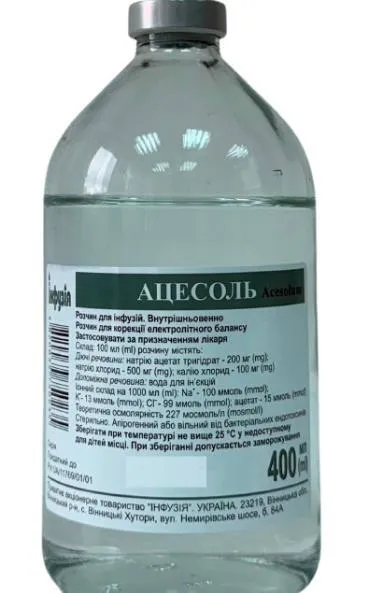
ACESOL
UkraineThe drug is used to correct electrolyte and acid-base balance disturbances, as well as for dehydration and body intoxication occurring in various diseases, including acute dysentery, foodborne toxic infection, and cholera El Tor.
Frequently asked questions
How should Acesol be taken correctly?
The solution is administered intravenously as a bolus or infusion after heating to +36-38 °C. In cases of hypovolemic shock, the drug is administered as a bolus over 1-3 hours (the first hour — in an amount of 7-10% of body weight), after which it is switched to infusion over 24-48 hours at a rate of 40-120 drops per minute. The total volume should correspond to the volume of fluid lost.
Who should not use this drug?
Contraindications include hypersensitivity to the components, conditions with elevated blood potassium or sodium levels, fluid overload (hyperhydration), threat of cerebral or pulmonary edema, as well as severe kidney and liver diseases.
What are the possible side effects of Acesol?
Possible development of elevated potassium levels (hyperkalemia), metabolic disturbances during massive infusions, as well as allergic reactions in case of individual sensitivity to the components.
What to do in case of overdose?
In case of overdose, side effects are intensified. In such a case, Acesol must be replaced with Disol until normal electrolyte balance is restored.
Can the drug be used in children?
There are no restrictions on the use of the drug in children; however, the treatment regimen must be adjusted depending on the child's body weight and laboratory indicators.
How should the treatment process be monitored?
The drug should be used under the control of laboratory tests of electrolyte balance, checking the balance of administered and lost fluid every 6 hours.
Instructions for use
INSTRUCTIONS FOR MEDICAL USE OF THE MEDICINAL PRODUCT Acesolum (Acesolum)
Composition:
Active substances: sodium acetate trihydrate, sodium chloride, potassium chloride;
100 ml of solution contain: sodium acetate trihydrate 200 mg, sodium chloride 500 mg, potassium chloride 100 mg;
Ion composition per 1000 ml of product: Na+ – 100 mmol, K+ – 13 mmol, Cl¯ – 99 mmol, acetate – 15 mmol;
Excipient: water for injections.
Pharmaceutical form. Infusion solution.
Main physicochemical properties: clear colorless liquid, theoretical osmolarity – 227 mosmol/L, pH 6.5–7.5.
Pharmacotherapeutic group. Solutions used for correction of electrolyte balance disorders. Electrolytes.
ATC code B05BB01.
Pharmacological properties.
Pharmacodynamics.
Acesol is an osmotically balanced combined agent.
The solution exerts detoxifying and hemodynamic effects: it reduces hypovolemia, prevents blood concentration and the development of metabolic acidosis, improves capillary circulation, and enhances diuresis.
Pharmacokinetics.
The drug remains in the vascular bed for a short period of time.
It is rapidly eliminated from the vascular compartment and passes into the interstitial and intracellular spaces. It is excreted by the kidneys, increasing diuresis.
Clinical characteristics.
Indications.
Correction of electrolyte and acid-base imbalances as part of intensive care measures, in dehydration and systemic intoxication occurring in various diseases (including acute dysentery, foodborne toxicoinfection, El-Tor cholera).
Contraindications.
Hypersensitivity to the components of the drug. Conditions accompanied by hyperkalemia, hypernatremia, hyperhydration, risk of developing cerebral and pulmonary edema, severe kidney and liver diseases.
Interaction with other medicinal products and other types of interactions.
Not established.
Special precautions.
The drug should be administered under laboratory monitoring of electrolyte balance. Exercise caution when administering to patients with impaired renal excretory function.
Use during pregnancy or breastfeeding.
There is no experience with the use of the drug during pregnancy or breastfeeding.
Ability to influence reaction rate while driving or operating machinery.
There are no data regarding the effect of the drug on reaction speed while driving or operating machinery, as the drug should be used only under hospital conditions.
Administration and Dosage
The balance between fluid input and output must be determined every 6 hours!
Administer intravenously as a bolus or by infusion. Before use, warm the solution to +36–38°C. Emergency rehydration therapy for patients to reverse hypovolemic shock consists of bolus administration of the drug over 1–3 hours. During the first hour, administer an amount equivalent to 7–10% of the patient's body weight. Subsequently, switch from bolus to infusion administration. Continue infusion over 24–48 hours at a rate of 40–120 drops per minute.
The total volume of administered solution should correspond to the volume of fluid lost.
Children.
There are no data regarding restrictions on the use of the drug in children. Dosage regimen should be adjusted according to laboratory parameters and the child's body weight.
Overdose.
Manifested by intensification of adverse effects.
Treatment: replace Acesol with Disol until electrolyte balance is normalized.
Side effects.
Hyperkalemia may occur. Metabolic disturbances are possible during massive infusions. In such cases, replace the drug with Disol until electrolyte balance is normalized. Allergic reactions are possible in case of individual hypersensitivity to any component of the drug.
Shelf life. 5 years.
Storage conditions. Store at a temperature not exceeding 25 °C in a place inaccessible to children. Freezing of the drug does not constitute a contraindication for use, provided the bottle remains hermetically sealed. Non-wetting of the inner surface of the bottle is not a contraindication for the use of the drug.
Incompatibility. Not established.
Packaging. 400 ml in bottles.
Prescription status. By prescription only.
Manufacturer. Private Joint-Stock Company "Infuziya".
Manufacturer’s location and address of its place of business.
55-A Voloshkova Street, Vinnytsia, 21034, Ukraine or 84A Nemirovskе Highway, Vinnytski Khotory, Vinnytsia district, Vinnytsia region, 23219, Ukraine.
Applicant. Private Joint-Stock Company "Infuziya".
Applicant’s and/or applicant’s representative’s location.
21-A Moskovske Avenue, Kyiv, 04073, Ukraine.
Similar drugs
| Brand name | Dosage form | Active substance / Dosage | Manufacturer |
|---|---|---|---|
| DARROW SOLUTION | solution for infusion | PJSC "Infuziya" | |
| DISOL | solution for infusion |
|
PJSC "Infuziya" |
| HARTMANN'S SOLUTION | solution for infusion |
|
PJSC "Infuziya" |
| IONOSTERIL | solution for infusion |
|
Fresenius Kabi Deutschland GmbH |
| ISOSOL | solution for infusion |
|
Subsidiary Enterprise "Farmatreyd" |
| OSMOLIFE | solution for infusion |
|
PJSC "Halychpharm" |
| PLASMALIT | solution for infusion |
|
PJSC "Infuziya" |
| PLASMOVEN® | solution for infusion |
|
PJSC «Pharmaceutical Company «Darnitsa» |
| RINGER LACTATE SOLUTION | solution for infusion |
|
PJSC "Infuziya" |
| RINGER LACTATE SOLUTION | solution for infusion |
|
PJSC "Halychpharm" |
| RINGER MALATE | solution for infusion |
|
Yuria-Pharm LLC |
| RINGER SOLUTION | solution for infusion |
|
PJSC "Halychpharm" |
The original data is available in the language of the country of manufacture.
Data source: State Register of Medicinal Products of Ukraine
Data last verified: August 13, 2026