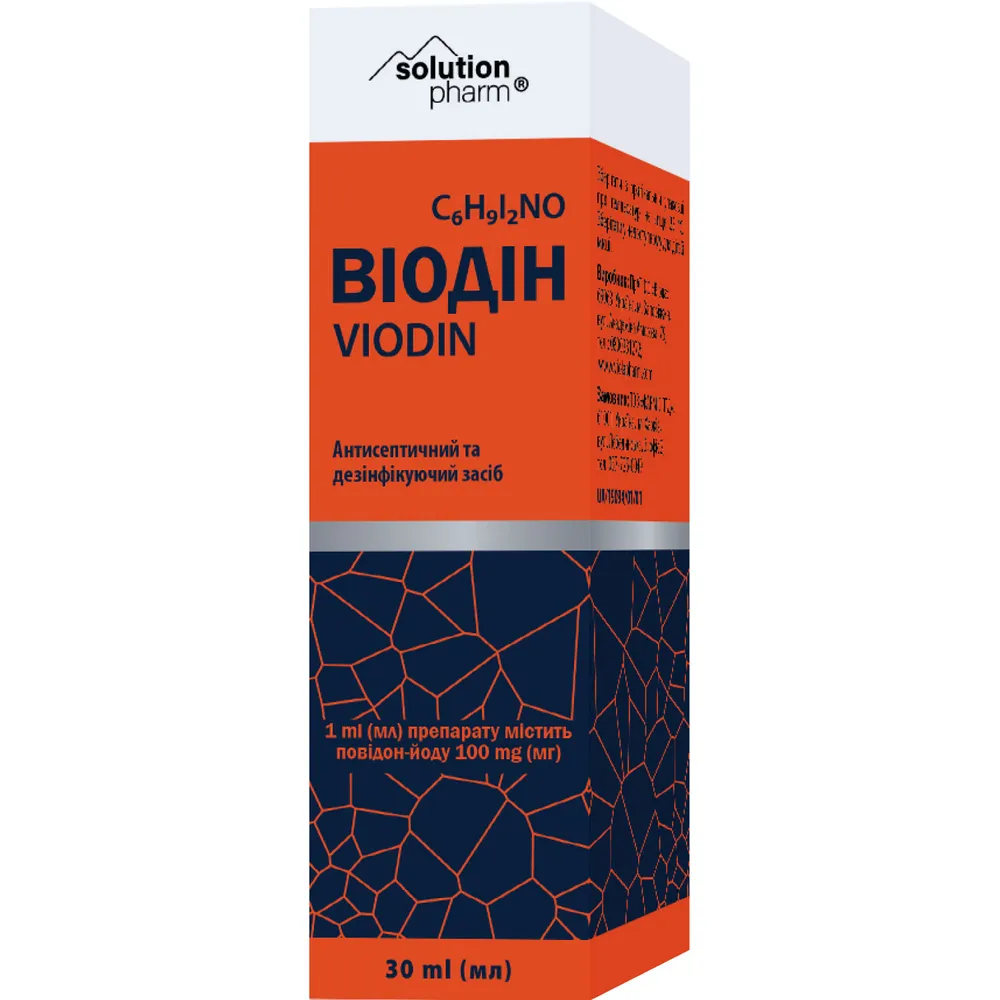
VIODIN
UkraineThe drug is used as an antiseptic for hand disinfection, treatment of mucous membranes (e.g., before surgeries or injections), as well as for antiseptic treatment of wounds and burns.
Frequently asked questions
How to use Viodin correctly?
The drug is intended for external use only. It can be used in undiluted form for treating the skin and hands, or diluted with water or saline for compresses, baths, and wound irrigation. The solution should be diluted immediately before use.
Who should not use this drug?
Contraindications include hypersensitivity to iodine, thyroid dysfunction (e.g., goiter or Hashimoto's thyroiditis), renal failure, dermatitis herpetiformis (Duhring's disease), as well as cases where the patient has undergone treatment or scintigraphy with radioactive iodine for thyroid cancer. The drug should not be used after the second month of pregnancy and during breastfeeding.
What are the possible side effects of using Viodin?
Possible allergic reactions (itching, redness, swelling), contact dermatitis, renal dysfunction, as well as changes in thyroid function (hyperthyroidism or hypothyroidism). In rare cases, severe anaphylactic reactions may occur.
Can the drug be combined with other agents?
Simultaneous use with antiseptics containing octenidine, chlorhexidine, hydrogen peroxide, silver, or mercury is not recommended, as this may reduce efficacy or cause tissue damage. Caution should also be exercised with lithium preparations.
How does the drug affect test results?
Due to its oxidizing properties, Viodin may affect the results of diagnostic tests, such as glucose determination or occult blood in urine or stool, as well as thyroid function test results.
Instructions for use
INSTRUCTIONS for medical use of the medicinal product VIODIN (VIODIN)
Composition:
Active substance: povidone-iodine;
1 ml of the preparation contains povidone-iodine 100 mg;
Excipients: nonoxynol 9, glycerin, anhydrous citric acid, anhydrous sodium hydrogen phosphate, sodium hydroxide, purified water.
Pharmaceutical form. Topical solution 100 mg/mL.
Main physico-chemical properties: dark brown solution with the odor of iodine, free from suspended and precipitated particles.
Pharmacotherapeutic group. Antiseptics and disinfectants. Povidone-iodine.
ATC code D08AG02.
Pharmacological properties.
Pharmacodynamics.
Povidone-iodine is a complex of iodine and the polymer polyvinylpyrrolidone (PVP), which releases iodine over a certain period after application to the skin. Free iodine exerts a strong bactericidal effect and has a broad spectrum of antimicrobial activity against bacteria, viruses, fungi, and protozoa.
Mechanism of action: free iodine provides a rapid bactericidal effect, while the polymer acts as an iodine depot.
Upon contact with skin and mucous membranes, a significant amount of iodine is released from the polymer.
When forming a complex with PVP, iodine largely loses the local irritant properties characteristic of alcoholic iodine solutions; therefore, it is well tolerated by skin, mucous membranes, and affected surfaces.
Iodine reacts with oxidative sulfhydryl (SH–) and hydroxyl (OH–) groups of amino acids that are part of enzymes and structural proteins of microorganisms, inactivating or destroying these proteins. Most microorganisms are destroyed in vitro within less than a minute, with the primary destructive effect occurring within the first 15–30 seconds. During this process, iodine is decolorized, so a change in the intensity of the brown color serves as an indicator of its effectiveness.
The active substance of the drug VIODIN, topical solution, has a broad antimicrobial spectrum of action: it acts against Gram-positive and Gram-negative bacteria (bactericidal), viruses (virucidal), fungi (fungicidal) and fungal spores (sporicidal), as well as against certain protozoa (antiprotozoal).
Due to its mechanism of action, resistance to the drug, including secondary resistance during prolonged use, is not expected.
The drug dissolves in water and is easily washed off with water.
Pharmacokinetics.
Prolonged application of the drug to large wound surfaces or severe burns, as well as to mucous membranes, may lead to absorption of a significant amount of iodine. Usually, prolonged use of the drug results in a rapid increase in blood iodine levels. Concentration returns to baseline within 7–14 days after the last application.
In patients with normal thyroid gland function, increased iodine stores do not cause clinically significant changes in thyroid hormone status.
Absorption and renal excretion of povidone-iodine depend on its molecular weight. Since the molecular weight ranges between 35,000–50,000, retention of the substance is possible.
The volume of distribution is approximately 38% of body weight. The biological half-life after vaginal administration is approximately 2 days. Normal total plasma iodine levels are approximately 3.8–6 µg/dL, and inorganic iodine levels are 0.01–0.5 µg/dL.
The drug is excreted from the body primarily via the kidneys, with a clearance rate of 15 to 60 mL/min, depending on plasma iodine levels and creatinine clearance (normal: 100–300 µg iodine per 1 g creatinine).
Clinical Characteristics.
Indications.
Disinfection of hands and antiseptic treatment of mucous membranes, for example, prior to surgical procedures, gynecological and obstetric procedures, urinary bladder catheterization, biopsy, injections, punctures, blood collection, as well as first aid in case of accidental skin contamination with infected material.
Antiseptic treatment of wounds and burns.
Hygienic and surgical hand disinfection.
Contraindications.
Hypersensitivity to iodine or suspected hypersensitivity, or hypersensitivity to other components of the medicinal product.
Thyroid gland dysfunction (nodular colloid goiter, endemic goiter, and Hashimoto's thyroiditis).
The medicinal product is contraindicated before and after treatment and scintigraphy with radioactive iodine in patients with thyroid carcinoma.
Dermatitis herpetiformis Duhring.
Renal insufficiency.
Interaction with other medicinal products and other types of interactions.
Povidone-iodine complex is active against microorganisms at pH 2–7. Due to its oxidizing properties, povidone-iodine may affect the results of certain diagnostic tests, such as detection of occult blood in feces or urine, or glucose in urine. When povidone-iodine is used, iodine uptake by the thyroid gland may be reduced, which can affect the results of certain diagnostic tests (e.g., thyroid scintigraphy, determination of protein-bound iodine, measurement of radioactive iodine). Povidone-iodine may also interfere with iodine used for thyroid therapy. Medicinal products containing mercury, silver, hydrogen peroxide, or taurolidine may interact with the povidone-iodine complex; therefore, their concomitant use is not recommended. The medicinal product may react with proteins and unsaturated organic compounds, so the effect of povidone-iodine may be counteracted, necessitating an increase in dose.
Simultaneous or immediate sequential use of povidone-iodine with antiseptics containing octenidine may lead to the development of dark necrosis at the application sites.
Povidone-iodine should not be used simultaneously with disinfectants containing chlorhexidine, hydrogen peroxide, taurolidine, silver sulfadiazine, mercury, or alkalis, due to the possible partial reduction of the product's activity.
Concurrent topical application of povidone-iodine and tincture of benzoin leads to a decrease in pH, which may cause a burning sensation, especially if the wound is bandaged.
Concomitant use of povidone-iodine and lithium-containing medicinal products may result in a synergistic hypothyroid effect.
Special precautions for use.
The use of povidone-iodine may reduce iodine uptake by the thyroid gland, which can affect the results of certain diagnostic tests and procedures (thyroid scintigraphy, protein-bound iodine determination, diagnostic procedures involving radioactive iodine), making it impossible to plan iodine-based treatment of thyroid disorders. After discontinuation of povidone-iodine therapy, a break of at least 1–4 weeks is required.
The oxidizing effect of povidone-iodine may lead to false-positive results in diagnostic tests (e.g., toluidine and guaiac tests for hemoglobin, and tests for glucose in feces and urine).
The oxidizing effect of povidone-iodine may cause corrosion of metals, whereas plastics and synthetic materials are generally resistant to povidone-iodine. In individual cases, discoloration may occur, which is usually reversible.
Povidone-iodine is easily removed from textiles and other materials with warm water and soap. Stubborn stains should be treated with ammonia solution or sodium thiosulfate.
The solution is not intended for internal use.
During preoperative skin disinfection, care must be taken to ensure that no residual solution remains under the patient (due to possible skin irritation).
Since the development of hyperthyroidism cannot be ruled out, prolonged use of povidone-iodine (more than 14 days) or its application in large quantities over extensive body surfaces (exceeding 10% of body surface area) in patients (especially elderly patients) with latent thyroid dysfunction should only be permitted after careful assessment of expected benefits versus potential risks. Such patients should be monitored for early signs of hyperthyroidism and appropriate evaluation of thyroid function, even after discontinuation of the drug (up to 3 months).
Discoloration of the solution indicates reduced efficacy of the medicinal product. Light and temperatures above 40°C accelerate the degradation of the active ingredient. The solution is intended for external use only.
Use during pregnancy or breastfeeding.
Povidone-iodine has no teratogenic effect. However, the drug is contraindicated after the second month of pregnancy and during breastfeeding. Iodine crosses the placental barrier and may be excreted in breast milk. Breastfeeding must be discontinued during treatment.
Ability to affect reaction speed when driving vehicles or operating machinery.
Unknown.
Method of Administration and Dosage
The product is intended for topical use, either undiluted or diluted. Do not mix the product with hot water. Only brief warming to body temperature is permitted.
Dosing
Undiluted VIODIN solution is used for disinfection of hands and skin prior to surgical procedures, urinary catheterization, injections, and punctures.
The solution may be applied 2–3 times daily.
Hygienic hand disinfection: 2 applications of 3 mL of undiluted solution, each 3 mL dose remaining on the skin for 30 seconds.
Surgical hand disinfection: 2 applications of 5 mL of undiluted solution, each 5 mL dose remaining on the skin for 5 minutes.
For skin disinfection, the undiluted solution is left on the skin until it dries.
For the above indications, the solution may also be used after dilution with tap water. However, for surgical procedures and for antiseptic treatment of wounds and burns, 0.9% sodium chloride solution or Ringer's solution should be used for dilution.
Recommended dilutions are as follows:
| Indications |
Dilution |
Volume of preparation/volume of diluent |
| Wet compress |
1:5–1:10 |
200 ml–100 ml/1 L |
| Immersion and sitz baths |
1:25 |
40 ml/1 L |
| Preoperative bath |
1:100 |
10 ml/1 L |
| Hygienic bath |
1:1000 |
10 ml/10 L |
| Vaginal douching Intrauterine contraceptive device insertion Perineal irrigation Urological irrigation |
1:25 |
4 ml/100 ml |
| Irrigation of chronic and postoperative wounds |
1:2–1:20 |
50 ml–5 ml/100 ml |
| Orthopedic and trauma irrigation Irrigation during oral cavity surgery |
1:10 |
10 ml/100 ml |
The solution should be diluted immediately before use.
Children.
Povidone-iodine should be used in neonates and children under 1 year of age only when strictly indicated. If necessary, thyroid function should be monitored.
Overdose.
Symptoms of acute iodine intoxication include:
- metallic taste in the mouth, increased salivation, burning sensation or pain in the mouth or throat;
- eye irritation and swelling;
- skin reactions;
- gastrointestinal disturbances and diarrhea;
- impaired kidney function and anuria;
- circulatory insufficiency;
- laryngeal edema with secondary asphyxia, pulmonary edema, metabolic acidosis, hypernatremia.
Prolonged treatment of burn wounds with significant amounts of povidone-iodine may provoke disturbances in electrolyte balance or serum osmolality, leading to impaired kidney function or metabolic acidosis.
Treatment: symptomatic and supportive therapy should be administered, with special attention to electrolyte balance, kidney function, and thyroid function.
In cases of intoxication due to accidental oral ingestion of the medicinal product, immediate administration of food products containing starch or protein (such as starch solution in water or milk) is indicated, followed by gastric lavage with 5% sodium thiosulfate solution. If necessary, intravenous administration of 10 ml of 10% sodium thiosulfate solution at 3-hour intervals may be performed. Monitoring of thyroid function is recommended for early detection of iodine-induced hyperthyroidism.
Side effects.
Laboratory findings: changes in serum electrolyte levels (hypernatremia) and osmolality, metabolic acidosis.
Renal and urinary system disorders: impaired kidney function, acute renal failure.
Skin and subcutaneous tissue disorders: local hypersensitivity skin reactions such as contact dermatitis with psoriasiform red, fine bullous formations; allergic reactions including pruritus, erythema, rash, angioneurotic edema.
If these symptoms occur, the use of the medicinal product should be discontinued.
Endocrine system disorders: hyperthyroidism, hypothyroidism. Prolonged use of povidone-iodine may lead to absorption of a large amount of iodine.
In some cases, iodine-induced hyperthyroidism has been observed following prolonged use of the product, primarily in patients with thyroid gland disorders.
In rare cases, generalized acute reactions with hypotension and/or respiratory distress (anaphylactic reactions) may occur.
Shelf life. 2 years.
Storage conditions.
Store in the original packaging at a temperature not exceeding 25 °C.
Keep out of reach of children.
Packaging.
30 mL in a bottle, 1 bottle stoppered with a dropper cap, in a carton;
100 mL in a bottle, 1 bottle closed with a nozzle and cap, in a carton;
1000 mL in a bottle stoppered with a cap or dropper and cap.
Supply classification. Over-the-counter (without prescription).
Manufacturer.
JSC FF "Viola".
Manufacturer's address and location of its business activity.
75 Amosova Street, Zaporizhzhia, Ukraine, 69063.
Similar drugs
| Brand name | Dosage form | Active substance / Dosage | Manufacturer |
|---|---|---|---|
| BETAVID | solution, topical |
|
PJSC Pharmaceutical Factory "Viola" |
| BETAYOD-ZDOROVYA | solution, topical |
|
Corporation "Zdorovya" LLC (all manufacturing stages, quality control, batch release) |
| BRAUNODIN | solution, topical |
|
B. Braun Melsungen AG (batch release) |
| PECHAYEVSKY IODINE | solution, topical |
|
PJSC "Tekhnolog" |
| POVIDONE-IODINE VAYUM | solution, topical |
|
Yeladum Pharma LLC |
| VITADIN | solution, topical |
|
PJSC Pharmaceutical Factory "Viola" |
The original data is available in the language of the country of manufacture.
Data source: State Register of Medicinal Products of Ukraine
Data last verified: August 13, 2026