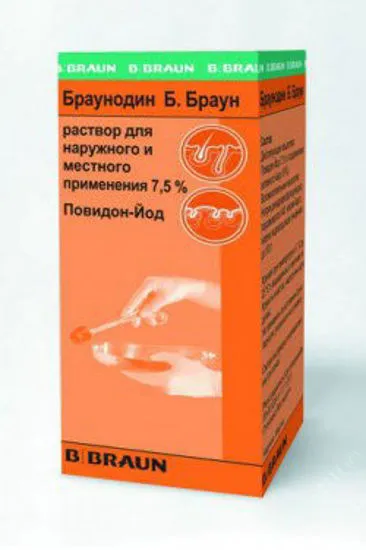
BRAUNODIN
UkraineThe drug is used for the prevention and treatment of infections of the skin and mucous membranes, for the treatment of wounds (e.g., pressure sores or burns), as well as for hand disinfection before surgeries or injections.
Frequently asked questions
How should Braunodin be used correctly?
The drug is applied to the affected area until fully moistened. For wound treatment and hand disinfection, use the undiluted solution, while for washing or baths, it can be diluted with water in proportions from 1:2 to 1:100, depending on the purpose.
Who should not use this drug?
It is contraindicated in individuals with hypersensitivity to iodine, thyroid dysfunction (e.g., hyperthyroidism), renal failure, or dermatitis herpetiformis (Duhring's disease). It should also not be used in newborns weighing less than 1500 g.
What are the possible side effects of Braunodin?
Possible allergic reactions (itching, redness, swelling), thyroid dysfunction (hyperthyroidism or hypothyroidism), and in the event of absorption of large amounts of iodine—renal dysfunction and changes in blood electrolyte levels.
Can the drug be combined with other agents?
It is not recommended to use Braunodin simultaneously with products containing mercury, silver, hydrogen peroxide, or taurolidine. It should also not be applied immediately after antiseptics containing octenidine, as this may cause skin darkening (necrosis).
Can the product be used during pregnancy and breastfeeding?
It is recommended to avoid the use of Braunodin during pregnancy and breastfeeding, as iodine can be actively absorbed and pass to the child.
Instructions for use
INSTRUCTIONS FOR MEDICAL USE OF THE MEDICINAL PRODUCT BRAUNODIN (BRAUNODIN)
Composition:
Active substance: povidone-iodine;
100 mg of solution contains povidone-iodine 7.5 g (with 10% available iodine), equivalent to 0.75 g of active iodine;
Excipients: sodium dihydrogen phosphate dihydrate; macrogol lauryl ether 9 EO; sodium iodate; sodium hydroxide; purified water.
Pharmaceutical form. Topical solution.
Main physicochemical properties: Clear brown-colored solution.
Pharmacotherapeutic group. Antiseptics and disinfectants. Povidone-iodine.
ATC code D08AG02
Pharmacological Properties
Pharmacodynamics
An antiseptic agent that is a complex of iodine and the polymer polyvinylpyrrolidone, effective at pH from 2 to 7. The bactericidal effect is due to free active iodine released from the povidone-iodine complex. Free iodine exerts a rapid bactericidal effect, while the polymer acts as an iodine reservoir, thus maintaining a constant concentration of active iodine.
As a strong oxidizing agent, free iodine reacts at the molecular level with insoluble fatty acids and sulfhydryl (SH) and hydroxyl (OH) groups of amino acids that are part of enzymes and structural proteins of microorganisms, inactivating or destroying these proteins.
The active substance of the medicinal product has a broad antimicrobial spectrum of activity, acting against Gram-positive and Gram-negative bacteria, viruses, fungi—particularly Candida species—and also some protozoa. However, complete inactivation of certain viruses and bacterial spores requires a relatively prolonged exposure time.
The mechanism of action precludes the development of primary resistance to the medicinal product. Additionally, there are no known cases of secondary resistance developing after prolonged use.
When forming a complex with polyvinylpyrrolidone, iodine largely loses the local irritant effects characteristic of alcoholic iodine solutions, and therefore is well tolerated by skin, mucous membranes, and injured surfaces.
Pharmacokinetics
After application of povidone-iodine, some absorption may occur, depending on the site, amount, and duration of application.
When applied to intact skin, only a very small amount of iodine is absorbed. Increased absorption is possible after prolonged use on mucous membranes, large wound surfaces, and burns, particularly following irrigation of body cavities.
Absorption and renal excretion of povidone-iodine depend on its molecular weight.
Molecular weights ranging from 35,000 to 50,000 are primarily retained by the reticuloendothelial system. However, there are no reports of iodine accumulation (storage) or other changes in the body following topical application of povidone-iodine, in contrast to intravenous or subcutaneous administration of povidone-containing medicinal products.
In individuals with a healthy thyroid gland, higher iodine levels do not lead to clinically significant changes in thyroid function.
Under normal iodine metabolism, excess iodine is excreted by the kidneys.
Clinical characteristics.
Indications.
- For the prevention and treatment of infections of intact and damaged skin and mucous membranes.
- For disinfection of the skin and antiseptic treatment of mucous membranes, e.g. prior to surgical procedures, biopsy, injections, punctures, blood collection, and urinary bladder catheterization.
- For antiseptic treatment of wounds (e.g. pressure ulcers, leg ulcers), burns, and infectious dermatoses.
- For hygienic and surgical hand disinfection.
Contraindications.
Hypersensitivity to iodine or hypersensitivity to other components of the medicinal product.
Hyperthyroidism or other thyroid gland function disorders.
Dermatitis herpetiformis Duhring.
Period before and after radioactive iodine therapy.
Renal insufficiency.
Contraindicated in newborns with very low birth weight (less than 1500 g) due to cutaneous absorption of iodine.
Interaction with other medicinal products and other forms of interaction.
The povidone-iodine complex is active against microorganisms within a pH range of 2–7.
Due to its oxidizing properties, povidone-iodine may interfere with certain diagnostic tests, such as tests for occult blood in feces or urine, or urine glucose testing. When povidone-iodine is used, iodine uptake by the thyroid gland may be reduced—this may affect the results of certain diagnostic tests (e.g. thyroid scintigraphy, determination of protein-bound iodine, measurement of radioactive iodine), and interactions with iodine used for thyroid therapy are also possible. Medicinal products containing mercury, silver, hydrogen peroxide, or taurolidine may interact with the povidone-iodine complex; therefore, their concomitant use is not recommended.
The use of povidone-iodine simultaneously or immediately after disinfectants containing mercury may lead to the formation of mercuric iodide, causing acidic burns.
The use of povidone-iodine simultaneously or immediately after antiseptics containing octenidine may lead to the development of dark necrotic lesions at the site of application.
Povidone-iodine may react with proteins and unsaturated organic compounds—this effect may be compensated by increasing its dose.
Prolonged use, especially over large body surfaces, should be avoided in patients receiving lithium therapy (due to the risk of excessive iodine absorption).
Special precautions for use
When used preoperatively for skin disinfection, care should be taken to avoid the solution running under the patient's body, as this may lead to skin irritation (see section "Method of administration").
Patients with mild nodular goiter or with a history of thyroid disease may be treated with Braunodine only after careful assessment of the benefit-risk ratio. This also applies to patients predisposed to hyperthyroidism, i.e. those with autonomous adenomas and/or functional autonomy of the thyroid gland (particularly elderly individuals). Braunodine should not be applied for prolonged periods over large areas (e.g., longer than 14 days on areas exceeding 10% of the body surface), as the risk of iodine-induced hyperthyroidism cannot be completely excluded. After discontinuation of treatment, patients should be monitored for 3 months to detect early signs of hyperthyroidism and to perform appropriate evaluation of thyroid function.
Prolonged and frequent use of the medicinal product should be avoided in patients receiving lithium therapy (**see section "**Interaction with other medicinal products and other forms of interaction").
Prolonged and frequent use of the medicinal product should be avoided in patients with impaired renal function (**see section "**Adverse reactions").
Effect on diagnostic test results
The oxidizing effect of povidone-iodine may cause false-positive results in diagnostic tests (e.g., toluidine and guaiac tests for hemoglobin and glucose in feces and urine).
The use of povidone-iodine may reduce iodine uptake by the thyroid gland and may thus affect the results of certain diagnostic procedures (thyroid scintigraphy, determination of protein-bound iodine, diagnostic procedures involving radioactive iodine), thereby making treatment of thyroid disorders with iodine-containing drugs impossible. After discontinuation of povidone-iodine treatment, a break of at least 1–2 weeks is required before performing a new scintigraphy.
Children
Prolonged and frequent use in newborns should be avoided, as the risk of hypothyroidism cannot be completely excluded. Functional studies of the thyroid gland should be performed after Braunodine application. If hypothyroidism occurs, early treatment with thyroid hormone should be initiated until normal thyroid function is restored.
Care should be taken to prevent accidental ingestion of the medicinal product by children.
The solution is intended for topical use only.
Use during pregnancy or breastfeeding
Pregnancy
Iodine may be particularly actively absorbed following extensive application on mucous membranes or damaged skin and may be transferred to the fetus transplacentally. The use of Braunodine solution during pregnancy is not recommended.
Breastfeeding
Iodine may be actively absorbed following application on mucous membranes or damaged skin and may be excreted in breast milk. Braunodine should not be used during breastfeeding.
Accidental ingestion of Braunodine solution by the infant through contact with treated areas of the mother's body should be avoided during breastfeeding. If iodine ingestion by the infant is suspected, functional testing of the thyroid gland is recommended. In case of hypothyroidism, early treatment with thyroid hormone should be initiated until normal thyroid function is restored.
Effect on fertility
Prolonged use of povidone-iodine for treatment of large wound surfaces and mucous membranes may lead to significant systemic absorption of iodine, which may affect fertility.
Ability to influence reaction speed while driving or operating machinery
No significant effect.
Method of Administration and Dosage
The medicinal product is intended for external use in adults and children with a body weight of at least 1500 g, in both diluted and undiluted forms.
The medicinal product may be diluted with ordinary tap water. If isotonic conditions need to be maintained, physiological saline solution or Ringer's solution may be used.
All solutions of the medicinal product must be used freshly prepared.
Braunodine should be applied to the affected surface until it is completely moistened. The antiseptic film formed during drying of the medicinal product is easily washed off with water.
Note! When treating skin prior to surgery, accumulation of the solution on the surface in direct contact with the patient's skin should be avoided, as this may cause irritation.
In cases of repeated application of Braunodine, the frequency and duration of use will depend on the specific clinical situation. Braunodine may be applied once or several times daily.
The use of povidone-iodine solutions should continue until signs of infection disappear or until the obvious risk of infection is eliminated. If infection recurs after discontinuation of Braunodine solution treatment, therapy may be resumed.
Braunodine, topical solution, should have a brown color. Discoloration of the solution indicates reduced efficacy of the medicinal product.
Dosage
Undiluted solution is used for treatment of hands, skin, and mucous membranes of the patient prior to surgical procedures, biopsy, bladder catheterization, injections, punctures, and blood collection.
Skin disinfection and antiseptic treatment of mucous membranes
When using the medicinal product for disinfection of skin areas with a low number of sebaceous glands, the exposure time is 15 seconds before injection and puncture, and at least 1 minute before joint, body cavity, or hollow organ puncture, as well as before surgical intervention. For disinfection of skin areas rich in sebaceous glands, the exposure time of the medicinal product should be at least 10 minutes. During this time, the skin must remain moistened with the undiluted medicinal product.
Wound treatment
For antiseptic treatment of superficial wounds and burns, Braunodine is applied in undiluted form to affected areas.
Hand disinfection
For hand disinfection, Braunodine is used in undiluted form.
For surgical hand disinfection, 5 mL of the medicinal product as a 7.5% solution is applied to the skin of the hands and rubbed in for 2.5 minutes. Hands must remain moistened with the undiluted medicinal product throughout the entire preoperative preparation period.
For hygienic hand disinfection, 3 mL of the solution is applied to the skin and rubbed in for 1 minute, followed by thorough rinsing with water.
Irrigation and rinsing
Braunodine may be used diluted for antiseptic irrigation, washing, and bathing:
- diluted 1:2 – 1:20 for wound irrigation (e.g., pressure ulcers, acne, gangrene) and prevention of postoperative infection;
- diluted 1:2 – 1:25 for antiseptic washing;
- diluted 1:25 for antiseptic limb baths;
- diluted 1:100 for full-body baths.
Antiseptic irrigations and baths are only supportive hygienic procedures and cannot replace standard preoperative skin disinfection.
The solution should be diluted immediately before use.
Special patient categories
Regular or prolonged use should be avoided in elderly patients, patients predisposed to hyperthyroidism, and patients with impaired renal function.
Children
Povidone-iodine may be used in newborns and children under 1 year of age only under strict indications. Braunodine is contraindicated in newborns with a body weight less than 1500 g.
Regular use in newborns should be avoided. If use is necessary, thyroid gland function should be monitored.
Dosage is the same for both adults and children.
Overdose
Acute iodine intoxication may cause the following characteristic symptoms:
- metallic taste in the mouth, increased salivation, burning sensation or pain in the mouth or throat;
- eye irritation and swelling;
- skin reactions;
- gastrointestinal disturbances and diarrhea;
- impaired kidney function and anuria;
- circulatory failure;
- laryngeal edema with secondary asphyxia, pulmonary edema, metabolic acidosis, hypernatremia.
Prolonged treatment of burn wounds with large amounts of povidone-iodine may provoke disturbances in electrolyte balance or serum osmolality, leading to impaired kidney function or metabolic acidosis.
After accidental oral ingestion of a large amount of povidone-iodine, symptoms of acute iodine intoxication may occur, including abdominal pain and cramps, malaise, vomiting, diarrhea, dehydration, decreased blood pressure with a tendency toward collapse, laryngeal edema, hemorrhage (of mucous membranes and kidneys), cyanosis, kidney damage (necrosis) potentially leading to anuria (within 1–3 days), paresthesia, fever, and pulmonary edema. With excessive iodine intake over a prolonged period, symptoms of hyperthyroidism such as tachycardia, agitation, tremor, and headache may develop.
According to published data, symptoms of intoxication may occur after ingestion of more than 10 g of povidone-iodine.
Treatment: Symptomatic and supportive therapy with special attention to electrolyte balance, kidney function, and thyroid function.
Immediate administration of starch- and protein-containing food (e.g., starch solution in water or milk) is recommended. The patient's stomach should be washed out with a 5% sodium thiosulfate solution or starch suspension.
In cases of toxic ingestion, toxic serum iodine levels may be effectively reduced by peritoneal dialysis or hemodialysis.
Thyroid function should be carefully monitored through clinical testing to rule out iodine-induced hyperthyroidism or to treat this condition at an early stage, depending on the case.
Further treatment should focus on any other symptoms present, such as metabolic acidosis and impaired kidney function.
Treatment of iodine-induced hyperthyroidism
Treatment of iodine-induced hyperthyroidism depends on its form. Mild forms sometimes require no treatment at all, while severe forms may require thionamide therapy (which has only a delayed effect). In the most severe cases (critical thyrotoxic states), intensive therapy, plasmapheresis, or thyroidectomy may be required.
Side effects
The following classification of the frequency of adverse reactions is used:
Very common: ≥ 1/10;
Common: ≥ 1/100 and < 1/10;
Uncommon: ≥ 1/1000 and < 1/100;
Rare: ≥ 1/10000 and < 1/1000;
Very rare: < 1/10000;
Frequency not known: cannot be estimated from the available data.
Immune system disorders
Very rare: anaphylactic reactions up to anaphylactic shock.
Frequency not known: hypersensitivity.
Endocrine system disorders
When large amounts of iodine are absorbed (e.g. during treatment of extensive wounds or burns), the following adverse reactions may occur:
Very rare: iodine-induced hyperthyroidism in predisposed patients (sometimes with symptoms such as tachycardia or restlessness).
Frequency not known: hypothyroidism.
Skin and subcutaneous tissue disorders
Very rare: local skin hypersensitivity reactions, such as delayed-type allergic contact reactions, which may manifest as allergic reactions including itching, erythema, rash, angioneurotic edema, exfoliative dermatitis, dry skin, chemical and thermal skin burns. If these signs occur, the use of the medicinal product should be discontinued.
Frequency not known: changes in serum electrolyte levels (hypernatremia) and osmolality, renal failure, and severe metabolic acidosis.
Renal and urinary disorders
Frequency not known: impaired kidney function, acute renal failure.
Shelf life.
3 years.
Storage conditions.
Store in a place inaccessible to children at a temperature not exceeding 25 °C.
Packaging.
100 ml in polyethylene bottles without secondary packaging;
100 ml in polyethylene bottles, 20 bottles in a cardboard box;
250 ml in polyethylene bottles with spray pump without secondary packaging;
250 ml in polyethylene bottles with spray pump, 20 bottles in a cardboard box.
Prescription status.
Over-the-counter (without prescription).
Manufacturer.
B. Braun Melsungen AG.
Manufacturer's address.
Carl-Braun-Strasse 1, 34212 Melsungen, Germany.
Similar drugs
| Brand name | Dosage form | Active substance / Dosage | Manufacturer |
|---|---|---|---|
| BETAVID | solution, topical |
|
PJSC Pharmaceutical Factory "Viola" |
| BETAYOD-ZDOROVYA | solution, topical |
|
Corporation "Zdorovya" LLC (all manufacturing stages, quality control, batch release) |
| PECHAYEVSKY IODINE | solution, topical |
|
PJSC "Tekhnolog" |
| POVIDONE-IODINE VAYUM | solution, topical |
|
Yeladum Pharma LLC |
| VIODIN | solution, topical |
|
PJSC Pharmaceutical Factory "Viola" |
| VITADIN | solution, topical |
|
PJSC Pharmaceutical Factory "Viola" |
The original data is available in the language of the country of manufacture.
Data source: State Register of Medicinal Products of Ukraine
Data last verified: August 13, 2026