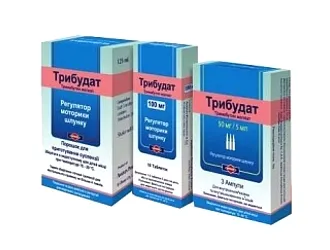
TRIBUDAT
UkraineThe drug is used for irritable bowel syndrome and other digestive tract disorders accompanied by abdominal pain, spasms, a feeling of fullness, bloating, constipation, or diarrhea.
Frequently asked questions
How should Tribudat be taken correctly?
Adults should take 1–2 tablets (100–200 mg) three times a day, swallowing them whole with a glass of water. When treating irritable bowel syndrome, the maximum daily dose may be 600 mg (6 tablets), divided into three doses. A typical course of treatment lasts from 2 to 6 weeks.
What are the possible side effects of Tribudat?
Possible reactions include gastrointestinal (dry mouth, nausea, stomach pain, diarrhea, or constipation), nervous system (drowsiness, dizziness, headache, fatigue), as well as allergic rashes, menstrual cycle disturbances, or urinary retention.
Who should not take this drug?
The drug is contraindicated in people with hypersensitivity to its components, as well as patients with rare disorders related to lactose intolerance (lactase deficiency, galactose intolerance, etc.).
Can the drug be taken during pregnancy or breastfeeding?
Prescribing the drug to pregnant and breastfeeding women is contraindicated. Breastfeeding should be discontinued during treatment.
Can the drug be taken by children?
Due to limited experience in using trimebutine in children, this drug should not be prescribed to them.
How does the drug interact with other substances?
Tribudat may enhance the effects of alcohol and central nervous system depressants. It may also prolong the effects of zotepine and d-tubocurarine.
Does the drug affect the ability to drive a vehicle?
Since the drug may cause drowsiness or dizziness, caution should be exercised. If such symptoms occur, driving a car or operating machinery becomes dangerous.
Instructions for use
INSTRUCTION FOR MEDICAL USE OF THE MEDICINAL PRODUCT TRIBUDAT (TRIBUDAT)
Composition:
Active substance: trimebutine;
One tablet contains trimebutine maleate 100 mg;
Excipients: talc; magnesium stearate; lactose monohydrate; microcrystalline cellulose; povidone K30; sodium croscarmellose; povidone; patented blue (E131).
Pharmaceutical form. Tablets of 100 mg.
Main physicochemical properties: biconvex blue tablets with a score line.
Pharmacotherapeutic group.
Agents used in functional gastrointestinal disorders.
ATC code A03A A05.
Pharmacological properties.
Pharmacodynamics.
Trimebutine is a synthetic agonist of peripheral m, d, and k opioid receptors. Its mechanism of action involves direct effects on the smooth muscle of the gastrointestinal tract and regulation of motility disorders without affecting the central nervous system. Unlike other opioids, trimebutine does not exhibit selectivity for any of the three receptor types, enabling it to either enhance or suppress peristalsis. The normalization of motility begins within 30 minutes after administration.
Pharmacokinetics.
Absorption.
After oral administration, trimebutine is almost completely absorbed.
Maximum concentration is reached within 30 minutes.
Distribution.
Plasma protein binding is approximately 5%. After oral administration, it crosses the placental barrier in an amount of approximately 0.05% and is excreted into breast milk at about 0.04%.
Metabolism.
Trimebutine is metabolized in the liver.
Elimination.
It is eliminated in the form of metabolites via urine.
Clinical characteristics.
Indications.
Irritable bowel syndrome; functional gastrointestinal disorders accompanied by abdominal pain, spasms, feeling of fullness, bloating, constipation, or diarrhea.
Contraindications.
Hypersensitivity to trimebutine or to any of the excipients of the medicinal product.
Interaction with other medicinal products and other forms of interaction.
Concomitant use of zotepine may prolong the anticholinergic effect. Trimebutine prolongs the effect of d-tubocurarine.
Special precautions for use.
The medicinal product Tribudate may cause drowsiness; therefore, it should be used with caution in patients with central nervous system depression.
Tribudate may enhance the sedative effect of medicinal products that depress the central nervous system and of ethanol.
The preparation contains lactose and therefore should not be used in patients with rare hereditary disorders such as galactose intolerance, lactase deficiency, or glucose-galactose malabsorption syndrome.
Use during pregnancy or breastfeeding.
Since data on the use of trimebutine during pregnancy or breastfeeding are lacking, the administration of this medicinal product to women during these periods is contraindicated. Breastfeeding should be discontinued during treatment with this medicinal product.
Ability to affect reaction speed when driving or operating machinery.
If dizziness or drowsiness occurs, patients should refrain from driving or operating machinery.
Dosage and Administration.
Take tablets orally 3 times a day, swallowing whole with a glass of water.
The single dose for adults is 100–200 mg (1–2 tablets).
At the beginning of treatment for irritable bowel syndrome, the maximum daily dose for adults may be increased, if necessary, to 600 mg (6 tablets), divided into 3 doses (2 tablets 3 times daily).
The duration of treatment is determined individually. The usual course of therapy is 2–6 weeks, depending on the severity and course of the disease.
Children.
Experience with the use of trimebutine in children is limited; therefore, the drug should not be prescribed to this age group.
Overdose.
There are no data regarding cases of trimebutine overdose.
Possible intensification of adverse reactions.
Treatment: gastric lavage. Symptomatic therapy.
Adverse Reactions.
Gastrointestinal disorders: dry mouth, taste disturbances, diarrhea, dyspepsia, stomach pain, nausea, constipation.
Nervous system disorders: drowsiness, fatigue, dizziness, restlessness, headache, sensation of cold/heat, hearing impairment.
Immune system disorders: allergic reactions, including skin rashes.
Reproductive system disorders: menstrual cycle disturbances, breast pain.
Urinary system disorders: urinary retention.
Shelf life.
4 years.
Storage conditions.
Store in the original packaging, protected from light, at a temperature not exceeding 30 °C. Keep out of reach of children.
Packaging.
10 tablets per blister pack, 1 or 2 blisters per cardboard box.
Prescription category.
Prescription only.
Manufacturer.
Fulton Medicinale S.p.A.
Manufacturer's address and place of business.
Via G. Marconi, No. 28/9 – 20020 – Arluno (Milan) – Italy
Similar drugs
| Brand name | Dosage form | Active substance / Dosage | Manufacturer |
|---|---|---|---|
| PREOLICA® FORTE | tablets |
|
Biopharm Sp. z o.o. (full-cycle manufacturing) |
| TRIBUDAT | tablets |
|
Fulton Medicinali S.p.A. |
The original data is available in the language of the country of manufacture.
Data source: State Register of Medicinal Products of Ukraine
Data last verified: August 13, 2026