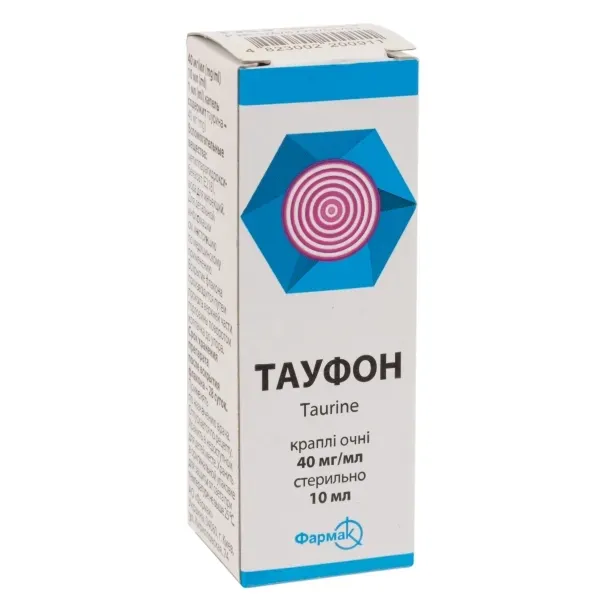
TAUFON
UkraineThe drug is used for dystrophic lesions of the cornea and retina (including hereditary degenerations), for cataracts (age-related, diabetic, traumatic, radiation-induced), to stimulate recovery in corneal injuries, and as an adjunct therapy in open-angle glaucoma.
Frequently asked questions
How should Taufon be used correctly?
Adults are recommended to hold the vial in their palm before use to warm it to body temperature. The dosage depends on the disease: for cataracts, instill 2-3 drops 2-4 times a day for 3 months; for injuries—the same, but for 1 month; for glaucoma—2-3 drops 2 times a day, 20-30 minutes before using timolol.
Are there any contraindications for the drug?
The drug should not be used in case of hypersensitivity to taurine or other its components.
What are the possible side effects of Taufon?
In some people, allergic reactions, conjunctival redness (hyperemia), itching, burning, or stinging in the eyes may occur.
How does the drug interact with other agents?
If you are using other eye drops, allow an interval of 10-15 minutes between them, and apply eye ointments last. When used simultaneously with timolol drops, an additional decrease in intraocular and arterial pressure may be observed.
Can you drive a car after instillation?
The drug may cause temporary blurring or other visual disturbances. If this occurs, you must wait until your vision clears before driving or operating machinery.
Instructions for use
INSTRUCTIONS FOR MEDICAL USE OF THE MEDICINAL PRODUCT TAU-FON
Composition:
Active substance: taurine;
1 ml of solution contains taurine 40 mg;
Excipients: methyl 4-hydroxybenzoate (nipagin) (E 218), purified water.
Pharmaceutical form. Eye drops.
Main physico-chemical properties: colorless transparent liquid.
Pharmacotherapeutic group. Medicinal products used in ophthalmology. ATC code S01XA.
Pharmacological Properties
Pharmacodynamics
Taufon contains taurine – a sulfur-containing amino acid formed in the body during the conversion of cysteine. Taurine participates in the synthesis of structural material, thereby stimulating reparative and regenerative processes in dystrophic eye diseases and/or pathological conditions accompanied by severe disturbances in ocular tissue metabolism, including eye injuries. It promotes normalization of cell membrane functions, optimization of energy and metabolic processes, maintenance of stable electrolyte composition of cellular cytoplasm, and inhibition of synaptic transmission.
Pharmacokinetics
After instillation, the drug penetrates into the interior of the eye, where it exerts its specific effect. When used at therapeutic doses, taurine is practically not absorbed into the systemic circulation.
Clinical characteristics.
Indications.
- Dystrophic lesions of the cornea and retina, including inherited tapetoretinal degenerations;
- Cataracts (age-related, diabetic, traumatic, radiation);
- As a means of stimulating reparative processes in corneal injuries;
- Open-angle glaucoma (as an additional agent).
Contraindications. Hypersensitivity to taurine or to any of the excipients.
Interaction with other medicinal products and other forms of interaction. When used concomitantly with timolol eye drops, a potentiated reduction in intraocular and arterial pressure is observed.
When administering multiple ophthalmic medicinal products, they should be instilled with an interval of 10–15 minutes. Ophthalmic ointments should be applied last.
Special precautions for use.
In open-angle glaucoma, the drug should be administered in combination with timolol, 20–30 minutes before instilling timolol.
Use during pregnancy or breastfeeding. The efficacy and safety of the drug during pregnancy or breastfeeding have not been studied.
Effect on the ability to drive or operate machinery. The effect of the drug on human performance during driving or operating machinery has not been studied.
As with other topically applied ophthalmic drugs, transient blurred vision or other visual disturbances may affect the ability to drive or operate machinery. If blurred vision occurs after instillation, patients should wait until vision clears before driving or operating machinery.
Method of Administration and Dosage
The medication is intended for adult use. Before administration, it is recommended to hold the bottle in the palm of the hand to warm it to body temperature.
For the treatment of cataracts: administer 2–3 drops 2–4 times daily. The treatment duration is 3 months. Repeat the course after a 1-month interval.
For injuries: use 2–3 drops 2–4 times daily for 1 month.
For the treatment of tapetoretinal degeneration and other dystrophic disorders of the retina, and penetrating corneal injuries: administer 0.3 ml of the 4% solution by subconjunctival injection once daily for 10 days. Repeat the treatment course after 6–8 months.
For open-angle glaucoma: instill 2–3 drops into the conjunctival sac twice daily, 20–30 minutes prior to timolol administration. The treatment duration is determined individually by the physician.
Children. The efficacy and safety of the medication in children have not been studied.
Overdose. Cases of overdose have not been reported.
Side effects.
Allergic reactions, conjunctival hyperemia, itching, burning, and eye irritation may occur in individual patients.
Shelf life. 4 years.
The shelf life of the solution after opening the vial is 14 days.
Storage conditions. Store at a temperature not exceeding 25 °C in the original packaging.
Keep out of reach of children.
Packaging. 5 ml in vials No. 3 with dropper cap in a carton; 10 ml in a vial with dropper cap in a carton.
Prescription status. Prescription only.
Manufacturer.
Limited Liability Company "Experimental Plant "GNCLC".
Limited Liability Company "FARMEKS GROUP".
Manufacturer's address and place of business.
Ukraine, 61057, Kharkiv region, Kharkiv, Vorobiova Street, 8.
(Limited Liability Company "Experimental Plant "GNCLC")
Ukraine, 08301, Kyiv region, Boryspil, Shevchenka Street, 100.
(Limited Liability Company "FARMEKS GROUP")
Similar drugs
| Brand name | Dosage form | Active substance / Dosage | Manufacturer |
|---|---|---|---|
| OFTAN® CATACHROM | drops, ophthalmic | Santen AG (manufacturer responsible for batch release) | |
| OKOFERON® | drops, ophthalmic |
|
FZ "STADA" LLC |
| TAUFON | drops, ophthalmic |
|
Farmak JSC |
| THIOTRIAZOLIN | drops, ophthalmic |
|
PJSC "Kyivmedpreparat" |
| THIOTRIAZOLIN | drops, ophthalmic |
|
LLC "Research Plant "GNCLS" (all manufacturing stages, quality control, batch release) |
The original data is available in the language of the country of manufacture.
Data source: State Register of Medicinal Products of Ukraine
Data last verified: August 13, 2026