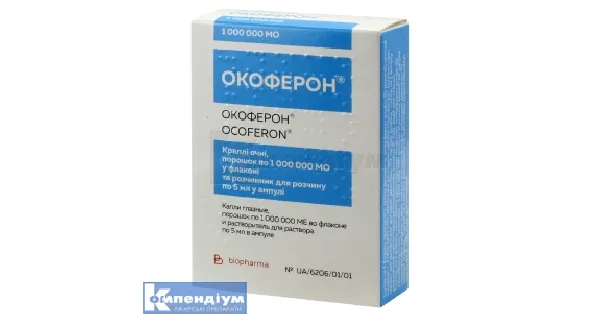
OKOFERON®
UkraineThe drug is used to treat viral eye infections, specifically herpes infection.
Frequently asked questions
How should Okoferon® be used correctly?
Before use, the powder must be dissolved in 5 ml of solvent. Then, instill 2 drops into the conjunctival sac of the affected eye every 2 hours (at least 6 times a day). When symptoms become less pronounced, the dose may be reduced to 1 drop. The course of treatment usually lasts 7–10 days.
Can this drug be combined with other eye drops?
Yes, but to avoid interaction, other ophthalmic products should be instilled either 30 minutes before or 30 minutes after using this drug.
Who should not use the drug?
The drug is contraindicated in individuals with hypersensitivity to its components. Experience in use in children, pregnant women, and breastfeeding women is unavailable.
What are the possible side effects of Okoferon®?
In rare cases, local allergic reactions, swelling and redness of the eyelids, itching, or facial redness may occur. These symptoms usually disappear after discontinuation of use. Additionally, the solvent may cause an allergy or, in exceptional cases, bronchospasm.
Does the drug affect the ability to drive a vehicle?
Since local reactions are possible in rare cases, it is not recommended to drive or operate machinery immediately after instillation.
Instructions for use
INSTRUCTION FOR MEDICAL USE OF THE MEDICINAL PRODUCT OCOFERON® (OCOFERON®)
Composition:
Active substance: 1 vial of the preparation contains 1,000,000 IU of recombinant human alpha-2b interferon;
Excipients: sodium hydrogen phosphate dodecahydrate, sodium dihydrogen phosphate dihydrate, dextran-70, sodium chloride;
Solvent for Ocoferon®: 1 ampoule of solvent (5 ml) contains methyl 4-hydroxybenzoate (nipagin) (E 218) – 5 mg, water for injections.
Pharmaceutical form. Eye drops, powder.
Main physicochemical characteristics: white porous lyophilized mass.
Pharmacotherapeutic group.
Agents used in ophthalmology. ATC code S01XA.
Pharmacological properties.
Pharmacodynamics.
The drug exhibits immunomodulatory and antiviral activity.
Interferon alfa-2b interacts with specific receptors on the cell surface. This interaction activates processes that inhibit viral replication within the cell and slow down cell proliferation. Immunomodulatory effects: interferon alfa-2b stimulates phagocytic activity of macrophages, as well as cytotoxic activity of T-cells and natural killer cells.
Pharmacokinetics.
Not studied.
Clinical characteristics.
Indications.
Viral eye infections (herpetic infection).
Contraindications.
Hypersensitivity to the components of the drug.
Interaction with other medicinal products and other forms of interaction.
To avoid possible physicochemical interactions between Ocoferon® and other ophthalmic agents, it is advisable to administer it either 30 minutes before or 30 minutes after instillation of other medicinal products into the eye.
Special precautions for use
As a solvent, methylparahydroxybenzoate is used, which may cause allergic reactions, including delayed-type reactions, and in rare cases – bronchospasm.
Treatment should be initiated at the first signs of viral eye infection. The drug has no systemic effect. In viral infections, Ocoferon**®** should be used in combination with recombinant human alpha-2b interferon preparations for systemic use (injections, suppositories).
Use during pregnancy or breastfeeding
There is no experience with the use of the drug during pregnancy or breastfeeding.
Ability to influence reaction rate when driving or operating machinery
Since local reactions may occur in rare cases after administration of the drug, it is not recommended to drive or operate machinery immediately after use.
Method of Administration and Dosage.
Before use, dissolve Okoferon® in 5 ml of solvent (0.1 % nipagin solution). 1 ml of the ready solution contains 200,000 IU of recombinant human alpha-2b interferon.
Instill 2 drops into the conjunctival sac of the affected eye every 2 hours, but no less than 6 times daily. As symptoms decrease, the instillation volume may be reduced to 1 drop. The treatment course lasts 7–10 days.
Children.
There is no experience of use in children.
Overdose.
Not observed.
Side effects.
In rare cases, local reactions are possible, including local allergic reactions, eyelid edema and hyperemia, itching, facial hyperemia, which disappear after discontinuation of the drug.
Shelf life. 2 years.
Storage conditions. Store in the original packaging to protect from light at a temperature between 2 and 8°C. Keep out of reach of children. Shelf life after opening the vial – 28 days.
Packaging. 1,000,000 IU of the drug in a glass vial. 5 ml of solvent in a glass ampoule. A polyethylene dropper cap and a Pasteur pipette are provided.
Availability. Over-the-counter.
Manufacturer. LLC "FZ "STADA", Ukraine.
Manufacturer's location and address of business activity.
Ukraine, 09100, Bila Tserkva, Kyiv region, Kyivska St., 37.
Similar drugs
| Brand name | Dosage form | Active substance / Dosage | Manufacturer |
|---|---|---|---|
| OFTAN® CATACHROM | drops, ophthalmic | Santen AG (manufacturer responsible for batch release) | |
| TAUFON | drops, ophthalmic |
|
LLC "Research Plant "GNCLS" (all manufacturing stages, quality control, batch release) |
| TAUFON | drops, ophthalmic |
|
Farmak JSC |
| THIOTRIAZOLIN | drops, ophthalmic |
|
PJSC "Kyivmedpreparat" |
| THIOTRIAZOLIN | drops, ophthalmic |
|
LLC "Research Plant "GNCLS" (all manufacturing stages, quality control, batch release) |
The original data is available in the language of the country of manufacture.
Data source: State Register of Medicinal Products of Ukraine
Data last verified: August 13, 2026