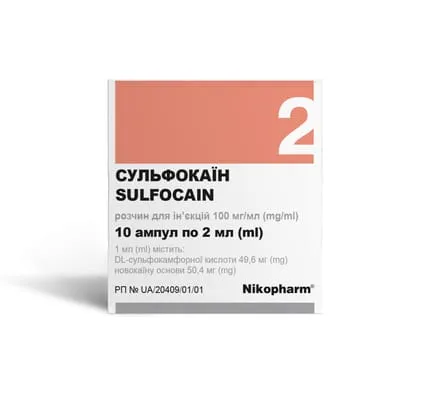
SULFOCAINE
UkraineThe drug is used in acute and chronic respiratory failure, acute heart failure in elderly people, respiratory depression due to pneumonia or other infections, as well as in cardiogenic and anaphylactic shock. It is also applied in alcohol poisoning or mild forms of sleeping pill poisoning.
Frequently asked questions
How should Sulfocaine be taken correctly?
For adults, a single dose of 2 ml is administered subcutaneously, intramuscularly, or intravenously (slowly or as a drip). If necessary, the drug can be administered 2–3 times a day, but the maximum daily dose must not exceed 12 ml. In acute conditions, intravenous administration is used, while in chronic conditions, subcutaneous or intramuscular administration is used. A 0.9% sodium chloride solution is used for dilution.
Who should not use this drug?
The drug is contraindicated in people with hypersensitivity to camphor, novocaine, or other components of the product, as well as in patients with epilepsy or a tendency to seizures. This drug is not used in children. Pregnant women should not use it, and breastfeeding must be discontinued during use.
What are the possible side effects of Sulfocaine?
Possible reactions include: headache, dizziness, tremor, convulsions, arrhythmia, changes in arterial blood pressure, chest pain, skin rash, itching, or edema. Digestive disorders, stomatitis, or involuntary urination may also occur.
Can the drug be combined with other medicines?
Interactions with many agents are possible. For example, it may weaken the effect of drugs that depress the central nervous system or anticholinesterase agents. When combined with MAO inhibitors, the risk of high arterial blood pressure increases, and when combined with cardiac glycosides, diuretics, analgesics, and steroids, the effect of the drug itself is enhanced. When using succinylcholine, neuromuscular blockade may be prolonged.
What should be done in case of overdose?
Symptoms of overdose include headache, dizziness, facial flushing, delirium, or convulsions. In such cases, treatment with anticonvulsants, antipsychotics, or sedatives is required.
Instructions for use
INSTRUCTION FOR MEDICAL USE OF THE MEDICINAL PRODUCT SULFOCAINE (SULFOCAINE)
Composition:
Active substances: DL-sulfocamphoric acid, novocaine;
1 ml of solution contains: DL-sulfocamphoric acid 49.6 mg, novocaine base 50.4 mg;
Excipient: water for injections.
Pharmaceutical form. Injection solution.
Main physicochemical properties: clear, colorless or slightly yellowish liquid.
Pharmacotherapeutic group. Cardiovascular agents. Other cardiovascular agents.
ATC Code C01EB.
Pharmacological Properties
Pharmacodynamics
Sulfocaine belongs to the group of analeptic medicinal agents. Its mechanism of action is due to stimulation of the central nervous system, primarily the centers of the medulla oblongata, both directly and via the carotid sinus. The medicinal product Sulfocaine exerts a tonic effect on the respiratory and vasomotor centers, enhances metabolic processes in cardiac muscle, and increases its sensitivity to sympathetic nerve influences. Sulfocaine affects blood vessels—resulting in redistribution of blood flow, constriction of blood vessels in abdominal organs, increased venous vessel tone, slight increase in blood flow to the heart, improved coronary circulation, and enhanced blood supply to the brain and lungs. The cardiotonic effect is associated with adrenosensitizing action, intensified respiratory processes, and enhanced glycolysis related to phosphorylation of macroergic compounds.
Pharmacokinetics
The medicinal product Sulfocaine is rapidly absorbed following subcutaneous, intramuscular, and intravenous administration. In the body, it undergoes metabolism involving oxidation and conjugation with glucuronic acid. Metabolites are primarily excreted by the kidneys, and the urine has the odor of the medicinal product. Partly, the drug is eliminated through exhaled air via the respiratory tract and with bile.
Clinical characteristics.
Indications.
Acute and chronic respiratory failure; acute heart failure in geriatrics; respiratory depression in pneumonia and other infectious diseases; cardiogenic and anaphylactic shock; alcohol intoxication, mild forms of intoxication with sedatives.
Contraindications.
Hypersensitivity to camphor, procaine, or other components of the drug; epilepsy, predisposition to convulsive states.
Interaction with other medicinal products and other forms of interaction.
Concomitant use of the medicinal product Sulfocamphocaine with other medicinal products may result in:
with drugs that depress the central nervous system – weakening of their effects;
with anticholinesterase agents – reduced effect of the latter;
with suxamethonium – prolonged neuromuscular blockade caused by suxamethonium;
with MAO inhibitors – increased risk of arterial hypertension;
with cardiac glycosides, diuretics, analgesics, steroid hormones – enhanced analeptic effect of sulfocamphocaine.
The drug may occasionally be prescribed to reduce side effects during chemotherapy with 5-fluorouracil.
Alcohol consumption is not recommended during treatment with this medicinal product.
Special precautions for use.
Use with caution in patients with arterial hypotension (due to the hypotensive effect of novocaine).
Use during pregnancy or breastfeeding.
There is no objective evidence-based medical data on the use of the medicinal product Sulphocaine during pregnancy; therefore, the drug should not be used during pregnancy. Penetration of the medicinal product Sulphocaine into breast milk cannot be excluded; hence, breastfeeding must be discontinued during its use.
Ability to influence reaction speed when driving or operating machinery.
During treatment, caution should be exercised when driving vehicles or operating complex machinery. If dizziness occurs, potentially hazardous activities requiring increased attention and psychomotor reaction speed should be avoided.
Dosage and Administration
Administer the medicinal product Sulphocaine subcutaneously, intramuscularly, or intravenously (slowly, as bolus or by infusion) to adults at a single dose of 2 ml. For dilution, use 0.9% sodium chloride solution. If necessary, the medicinal product may be administered 2–3 times daily. The maximum daily dose for adults is 12 ml.
In acute cases, administer the medicinal product intravenously.
In chronic respiratory insufficiency and cardiac insufficiency, administer intramuscularly or subcutaneously. The treatment course may last 20–30 days.
Children.
Do not administer the medicinal product to children.
Overdose.
Symptoms: headache, dizziness; in acute poisoning – facial flushing, pathological motor activity, delirium, epileptiform seizures.
Treatment: antipsychotic and anticonvulsant agents. In cases of mild psychomotor agitation – tranquilizers or sedatives.
Adverse Reactions
Gastrointestinal disorders: Dyspeptic disorders.
Nervous system disorders: Headache, dizziness, tremor, paresthesia, seizures.
Cardiovascular system disorders: Decreased or increased blood pressure, palpitations, chest pain.
Blood and lymphatic system disorders: Methemoglobinemia.
Immune system disorders: Hypersensitivity reactions, including angioneurotic edema, anaphylactic shock, skin rashes, pruritus, hyperemia, urticaria.
General disorders and administration site conditions: Hyperemia, rashes, and pruritus at the injection site.
Other: Chills, involuntary urination.
Reporting of suspected adverse reactions
Reporting suspected adverse reactions after marketing authorization is of great importance. It allows continuous monitoring of the benefit-risk balance of the medicinal product. Healthcare professionals and patients, as well as their legal representatives, should report all suspected adverse reactions and lack of efficacy via the Automated Pharmacovigilance Information System at the following link: https://aisf.dec.gov.ua.
Shelf life. 2 years.
Storage conditions. Store in the original packaging at a temperature not exceeding 25 °C. Keep out of reach of children.
Packaging. 2 ml in an ampoule. 10 ampoules in a cardboard pack.
Prescription status. Prescription only.
Manufacturer. LLC "FARMASEL".
Manufacturer's address and location of its business activities.
3, Vul. Prorizna, Kvitneve, Brovary District, Kyiv Oblast, 07408, Ukraine.
Similar drugs
| Brand name | Dosage form | Active substance / Dosage | Manufacturer |
|---|---|---|---|
| CYTOCHROME-C | solution for injection |
|
Biolik Pharma LLC |
| MEXICOR | solution for injection |
|
PJSC "Lekhim-Kharkiv" |
| RIBOXIN | solution for injection |
|
PJSC "Halychpharm" |
| RIBOXIN-DARNITSA | solution for injection |
|
PJSC «Pharmaceutical Company «Darnitsa» |
| SULFOCAMPHOCAINE-DARNITSA | solution for injection |
|
PJSC «Pharmaceutical Company «Darnitsa» |
The original data is available in the language of the country of manufacture.
Data source: State Register of Medicinal Products of Ukraine
Data last verified: August 13, 2026