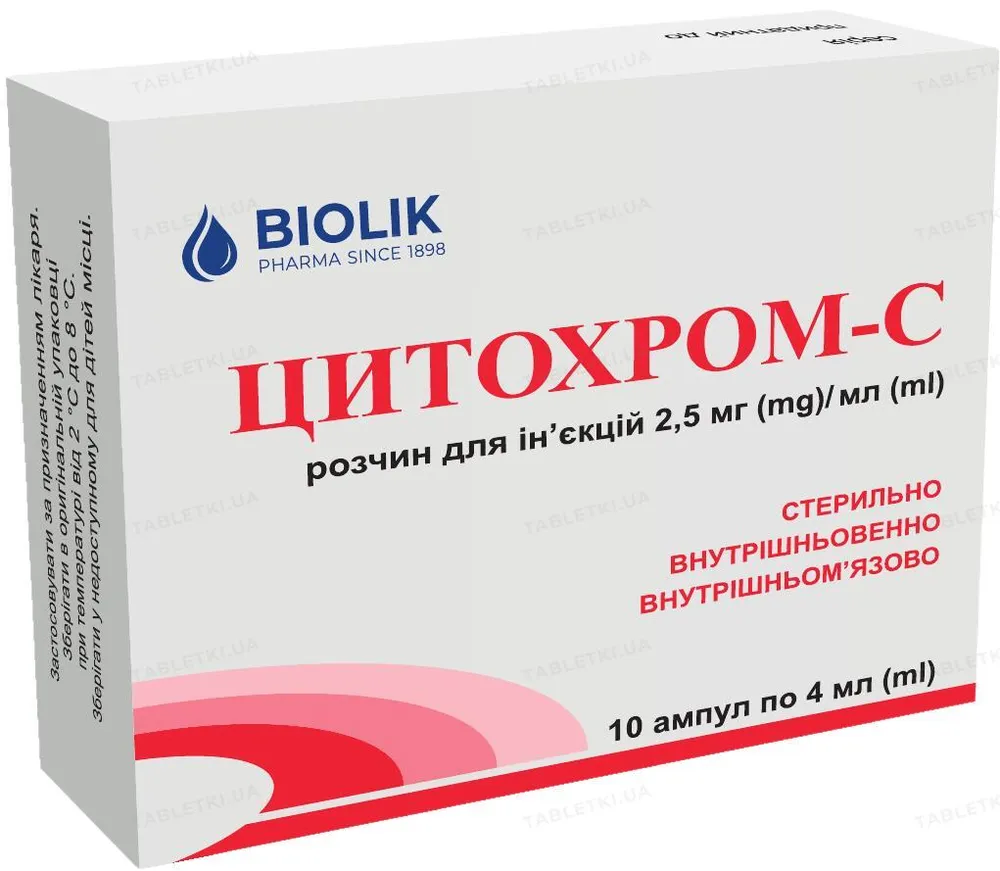
CYTOCHROME-C
UkraineThe drug is used to improve tissue respiration in cardiac diseases (ischemic heart disease, infarction, rhythm disorders), before and after heart surgeries, in cases of newborn asphyxia, bronchial asthma, viral hepatitis with hepatic coma, senile retinal degeneration, as well as in cases of poisoning by sleeping pills or carbon monoxide.
Frequently asked questions
How should Cytochrome-c be taken correctly?
The method of administration depends on the disease: for heart diseases, it is administered via intravenous drip over 6-8 hours; for asthma, it is administered intramuscularly; for severe conditions (shock, coma, poisoning), it is administered via rapid intravenous bolus. Dosage and duration of the course must be determined by a physician depending on the diagnosis.
What are the possible side effects of Cytochrome-c?
Possible allergic reactions (rash, edema, urticaria, anaphylactic shock), local reactions at the injection site (itching, swelling), cardiac disturbances (tachycardia, decreased blood pressure), respiratory problems (bronchospasm), dizziness, headache, drowsiness, as well as nausea, vomiting, or abdominal pain.
Who should not use this drug?
The drug should not be used by individuals with an increased hypersensitivity to its components.
Can the drug be taken during pregnancy or breastfeeding?
Before use, it is necessary for a physician to weigh all the risks and benefits for pregnant or breastfeeding women.
How does the drug interact with other medicines?
Cytochrome-c reduces the toxicity of cardiac glycosides and enhances their effect.
Can I drive a car during treatment?
Since the effect on reaction speed has not been studied, if you experience dizziness while taking the drug, you should refrain from driving vehicles or operating machinery.
Instructions for use
INSTRUCTIONS FOR MEDICAL USE OF THE MEDICINAL PRODUCT CYTOCHROME-C (CYTOCHROME-C)
Composition:
Active substance: cytochrome-C;
1 ml of solution contains cytochrome-C 2.5 mg;
Excipients: sodium chloride, water for injections.
Pharmaceutical form. Injection solution.
Main physicochemical properties: transparent reddish-brown liquid.
Pharmacotherapeutic group. Cardiovascular drugs.
ATC code C01EB.
Pharmacological properties.
Pharmacodynamics.
The drug belongs to the group of antihypoxic agents and is an enzyme involved in tissue respiration processes. The iron contained in the prosthetic group of Cytochrome C is capable of reversibly transitioning from the oxidized to the reduced form. Administration of the drug increases its concentration in tissues, normalizes and accelerates redox reactions, enhances oxygen utilization, and reduces hypoxia. Cytochrome C possesses cytoprotective, antihypoxic, and antioxidant properties.
Pharmacokinetics.
Not studied.
Clinical characteristics.
Indications. As part of combination therapy, as an agent improving tissue respiration in the following conditions:
- chronic ischemic heart disease and myocardial infarction;
- recurrent ventricular fibrillation or tachycardia;
- before and after surgical correction of congenital and acquired heart defects (for prevention of shock);
- neonatal asphyxia;
- remission period of bronchial asthma, asthmatic states;
- viral hepatitis complicated by hepatic coma;
- senile retinal degeneration;
- poisoning with hypnotics, carbon monoxide.
Contraindications.
Individual hypersensitivity to the components of the drug.
Interaction with other medicinal products and other forms of interaction.
The drug reduces the toxicity of cardiac glycosides and enhances their positive inotropic effect.
Special precautions for use.
This medicinal product contains less than 1 mmol (23 mg)/dose of sodium, i.e. it is practically sodium-free.
Use during pregnancy or breastfeeding.
The benefit-risk ratio should be carefully considered before administering this drug to these patient groups.
Ability to influence reaction rate when driving or operating machinery.
Not studied. If dizziness occurs during treatment with Cytrochrome-C, patients should refrain from driving or operating machinery.
Administration and Dosage
Depending on the pathology and severity of the condition, the drug may be administered intravenously by bolus injection, intravenous infusion, or intramuscularly.
In cardiac diseases, administer the drug by intravenous infusion (30–40 drops per minute) in 200 mL of 0.9% sodium chloride injection solution or 5% glucose solution over 6–8 hours. The daily dose for adults is 12–32 mL of the drug.
In the postoperative period (after surgery for congenital and acquired heart defects), administer the drug intravenously by bolus injection twice daily at 4 mL (10 mg) per injection. In severe conditions (trauma, shock, hepatic coma, poisoning with hypnotics or carbon monoxide), administer the drug intravenously by bolus injection to adults at a dose of 20–40 mL (50–100 mg). In neonatal asphyxia, administer the drug into the umbilical vein within the first 2 minutes after birth at a dose of 4 mL (10 mg).
In bronchial asthma, administer Cytochrome-C intramuscularly twice daily at 2–4 mL (5–10 mg) per injection. Treatment course: 14–25 days.
In other cases, administer the drug slowly by intravenous bolus injection or intramuscularly to adults at a dose of 4–8 mL, 1–2 times daily. Treatment course: 10–14 days.
Children
The drug may be used in children from birth, according to clinical indications.
Overdose
Possible manifestations of hypersensitivity may occur, requiring discontinuation of the drug and initiation of symptomatic therapy.
Adverse reactions.
General disorders and administration site reactions: chills with fever (with rapid intravenous administration of Cytochrome C solution), acrocyanosis, cyanosis, chest discomfort, general weakness, feeling of warmth, swelling, hoarseness; reactions at the injection site, including itching, swelling.
Cardiac disorders: tachycardia.
Vascular disorders: arterial hypotension.
Immune system disorders: allergic reactions, including anaphylactic reactions.
Skin and subcutaneous tissue disorders: hyperemia, erythema, itching, urticaria, rash (including confluent), angioneurotic edema, including facial swelling.
Respiratory, thoracic and mediastinal disorders: bronchospasm, dyspnea.
Nervous system disorders: somnolence, dizziness, headache.
Gastrointestinal disorders: abdominal distension, vomiting, nausea, epigastric and lower abdominal pain.
Shelf life. 2 years.
Storage conditions.
Store in the original packaging at a temperature between 2 °C and 8 °C. Keep out of reach of children.
Incompatibilities. The medication must not be mixed in the same syringe with other medicinal products.
Packaging.
4 ml in an ampoule; 5 or 10 ampoules per pack, or 5 ampoules in a blister, 1 or 2 blisters per pack.
Prescription category. Prescription only.
Manufacturer.
LLC "BIOLIK PHARMA".
Manufacturer's address and location of activity.
Legal entity address:
70 Pomirky, Kharkiv, Kharkiv region, 61070, Ukraine.
Address of the place of business activity:
Pomirky-70, building without number, Kharkiv, Kharkiv region, 61070, Ukraine.
Similar drugs
| Brand name | Dosage form | Active substance / Dosage | Manufacturer |
|---|---|---|---|
| MEXICOR | solution for injection |
|
PJSC "Lekhim-Kharkiv" |
| RIBOXIN | solution for injection |
|
PJSC "Halychpharm" |
| RIBOXIN-DARNITSA | solution for injection |
|
PJSC «Pharmaceutical Company «Darnitsa» |
| SULFOCAINE | solution for injection |
|
Farmasel LLC |
| SULFOCAMPHOCAINE-DARNITSA | solution for injection |
|
PJSC «Pharmaceutical Company «Darnitsa» |
The original data is available in the language of the country of manufacture.
Data source: State Register of Medicinal Products of Ukraine
Data last verified: August 13, 2026