RIBOXIN
UkraineThe drug is used for the complex treatment of ischemic heart disease (following myocardial infarction or in cases of angina pectoris), cardiac rhythm disorders, cardiomyopathies, myocarditis, as well as liver diseases (hepatitis, cirrhosis, fatty dystrophy) and uroporphyria.
Frequently asked questions
How should Riboxin be taken correctly?
Tablets should be taken orally before meals, without chewing, and swallowed with a sufficient amount of water. The daily dose for adults ranges from 600 to 2400 mg (3–12 tablets). During the first few days, 1 tablet is typically taken 3–4 times a day, with a gradual increase in dose if the drug is well tolerated. The course of treatment lasts from 4 weeks to 3 months.
What side effects can Riboxin cause?
Possible side effects include cardiac disturbances (tachycardia, decreased blood pressure, dizziness, nausea), allergic reactions (rash, itching, urticaria), metabolic disturbances (increased uric acid levels, which may trigger gout flares), and general weakness.
Who should not take this drug?
Use is contraindicated in cases of hypersensitivity to the components of the drug, gout, hyperuricemia, and renal failure. The drug is also not recommended for children, pregnant women, and breastfeeding women.
Can the drug be combined with other medicines?
Riboxin can be used in conjunction with cardiac glycosides, anabolic drugs, nitroglycerin, nifedipine, furosemide, spironolactone, and beta-blockers. However, it enhances the effect of heparin and may weaken the effect of agents that lower uric acid levels. A precipitate forms when mixed with tannin.
What should be done if an allergic reaction occurs?
If itching or skin redness occurs during treatment, the use of the drug must be discontinued.
Instructions for use
INSTRUCTIONS FOR MEDICAL USE OF THE MEDICINAL PRODUCT RIBOXIN (RIBOXIN)
Composition:
Active substance: riboxin (inosine);
1 tablet contains riboxin (inosine) – 200 mg;
Excipients: potato starch, microcrystalline cellulose, hypromellose (hydroxypropylmethylcellulose), sodium croscarmellose, povidone 25, magnesium stearate, talc, titanium dioxide (E 171), polyethylene glycol 6000 (macrogol 6000), polysorbate 80, quinoline yellow (E 104).
Pharmaceutical form. Film-coated tablets.
Main physico-chemical properties: round, film-coated tablets of light yellow to yellow color, with convex upper and lower surfaces. When examined under a magnifying glass, the cross-section reveals a core surrounded by a single continuous layer.
Pharmacotherapeutic group. Cardiology preparations. Inosine.
ATC code C01EB.
Pharmacological Properties
Pharmacodynamics
Riboxin is an anabolic agent exerting anti-hypoxic and anabolic effects.
It is a precursor of ATP and directly participates in glucose metabolism, promoting activation of metabolism under hypoxic conditions and in the absence of ATP. The drug activates metabolism of pyruvic acid to ensure normal tissue respiration and promotes activation of xanthine dehydrogenase. Riboxin positively influences myocardial metabolism, in particular improves cellular energy balance, stimulates nucleotide synthesis, and increases the activity of certain enzymes in the Krebs cycle. The drug normalizes myocardial contractile activity in diastole due to its ability to bind calcium ions that enter cells during excitation, and enhances tissue regeneration (especially of the myocardium and gastrointestinal mucosa).
Pharmacokinetics
Well absorbed in the gastrointestinal tract. Metabolized in the liver with formation of glucuronic acid, followed by its oxidation. Excreted in small amounts by the kidneys.
Clinical characteristics.
Indications.
Complex treatment of ischemic heart disease (post-myocardial infarction condition, angina pectoris), cardiac arrhythmias, intoxication with cardiac glycosides, treatment of cardiomyopathies of various etiologies, myocardial dystrophies (due to severe physical exertion, infectious and endocrine causes), myocarditis; liver diseases (hepatitis, liver cirrhosis, fatty liver dystrophy); uroporphyria.
Contraindications.
Hypersensitivity to the active substance or to other components of the drug. Gout, hyperuricemia, renal failure.
Interaction with other medicinal products and other types of interactions.
When used with cardiac glycosides, inosine prevents the development of arrhythmias and enhances inotropic action.
Inosine can be used simultaneously with anabolic agents (potassium orotate, methandrosteneolone), nitroglycerin, nifedipine, furosemide, spironolactone.
When inosine is used concomitantly with beta-adrenoblockers, the efficacy of inosine is not reduced.
Riboxin prolongs the duration of heparin's effect.
Forms a precipitate with tannin.
Weakens the effects of hypouricemic agents when used together with them.
Special precautions for use.
If itching or skin hyperemia occurs, treatment with the drug should be discontinued.
During treatment, it is necessary to regularly monitor blood and urine urea levels.
In renal insufficiency, administration of the drug is advisable only when, in the physician's opinion, the expected benefit outweighs the probable risk of use.
Use during pregnancy or breastfeeding.
Due to insufficient safety data in this patient group, Riboxin should not be used during pregnancy or breastfeeding.
Ability to influence reaction rate when driving or operating machinery.
The drug has no negative effect on the ability to drive a vehicle or operate complex machinery.
Method of administration and dosage.
Tablets should be taken orally, before meals, without chewing, and with sufficient amount of water. The daily dose is determined individually and amounts to 600–2400 mg (3–12 tablets) for adults.
During the first days of treatment, the daily dose for adults is 600–800 mg (1 tablet 3–4 times daily). If the drug is well tolerated, the dose should be gradually increased over 2–3 days from 1200 mg (2 tablets 3 times daily) to 2400 mg.
Duration of treatment course – from 4 weeks to 1.5–3 months.
In uroporphyrinuria, the daily dose is 800 mg (1 tablet 4 times daily), and the duration of treatment course is 1–3 months.
Children.
Should not be used in children due to lack of safety data.
Overdose.
Symptoms: intensification of adverse effects, allergic reactions, nausea, diarrhea, abdominal pain.
Treatment: discontinuation of the drug and symptomatic therapy.
Adverse reactions.
Cardiac disorders: tachycardia, arterial hypotension, which may be accompanied by headache, dyspnea, dizziness, nausea, vomiting, sweating.
Immune system, skin and subcutaneous tissue disorders: allergic/anaphylactic reactions, including rash, pruritus, skin hyperemia, urticaria, anaphylactic shock.
Metabolism and nutritional disorders: hyperuricemia, increased blood uric acid levels; with prolonged treatment – gout flare-up.
Other: general weakness.
Shelf life. 3 years.
Storage conditions.
Store in the original packaging at a temperature not exceeding 25 °C.
Keep out of reach of children.
Packaging.
10 tablets in blisters;
10 tablets in a blister; 5 blisters in a cardboard pack;
10 tablets in a blister; 90 blisters in a cardboard box.
Prescription status. Prescription only.
Manufacturer.
JSC "Tekhnoloh" (JSC "TEKHNOLOH").
Manufacturer's name and address of place of business.
8 Staroproryzna Street, Uman, Cherkasy Region, 20300, Ukraine.
Similar drugs
| Brand name | Dosage form | Active substance / Dosage | Manufacturer |
|---|---|---|---|
| RIBOXIN | tablets, film-coated |
|
PJSC "Halychpharm" |
| RIBOXIN-BHPHZ | tablets, film-coated |
|
PJSC "Scientific and Production Center "Borshchahivskyy Chemical and Pharmaceutical Plant" |
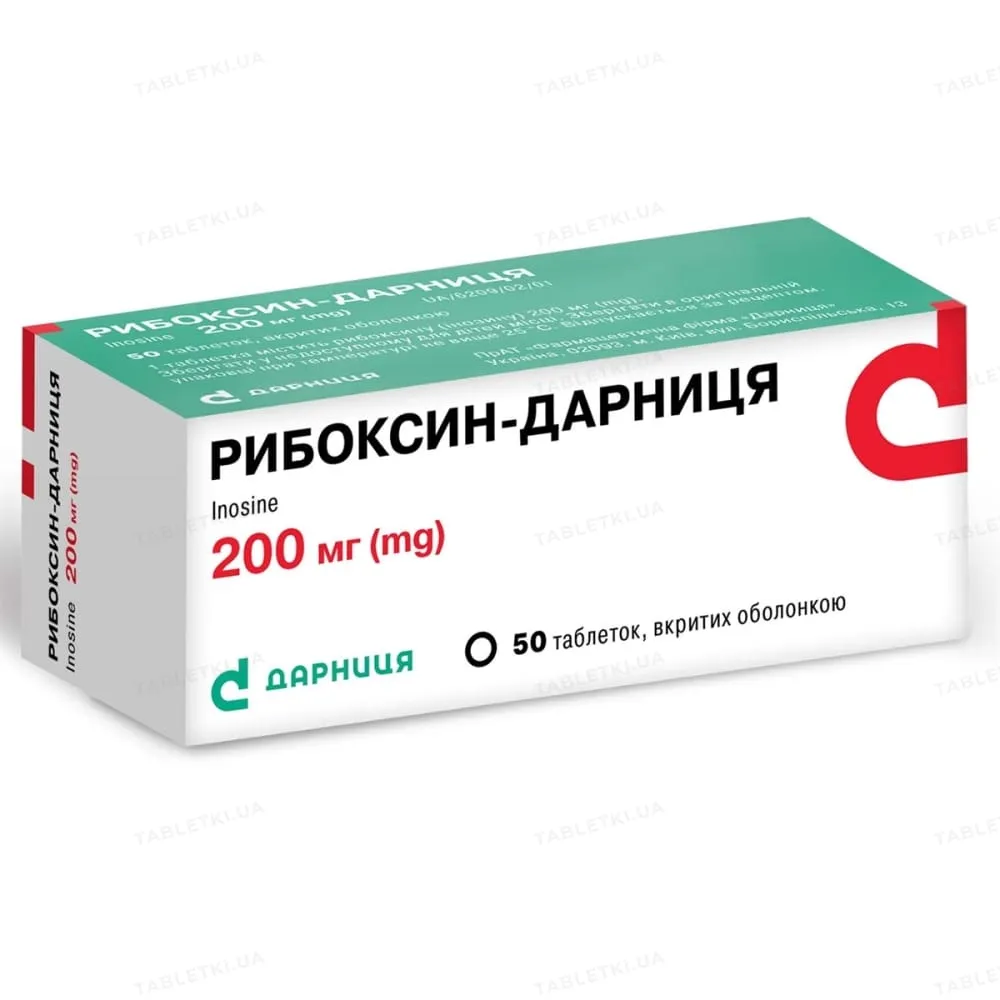
| RIBOXIN-DARNITSA | tablets, film-coated |
|
PJSC «Pharmaceutical Company «Darnitsa» |
| RIBOXINE | tablets, film-coated |
|
JSC "Kyiv Vitamin Plant" |
The original data is available in the language of the country of manufacture.
Data source: State Register of Medicinal Products of Ukraine
Data last verified: August 13, 2026