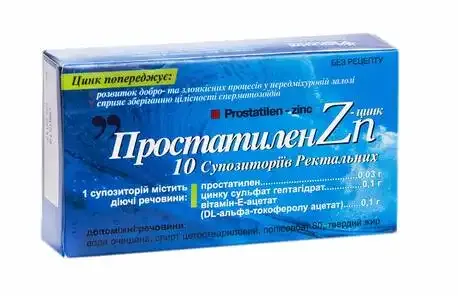
PROSTATILEN-ZINC
UkraineThe drug is used for the treatment and prevention of chronic prostatitis, benign prostatic hyperplasia, as well as for sexual disorders, male infertility, and complications following prostate surgery.
Frequently asked questions
How should Prostatilen-zinc be taken correctly?
Adults should administer one suppository deep into the rectum. For treatment, 1 suppository 2 times a day (morning and evening) is usually prescribed for 5–10 days. For prevention, 1 suppository is used once a day. The duration of the course is determined by a physician; if necessary, treatment can be repeated after 1–6 months.
Who should not use this drug?
Contraindications include hypersensitivity to the components of the drug or to bovine proteins, renal failure, myocardial infarction, and cardiosclerosis. The drug is not prescribed for women and children.
What are the possible side effects of Prostatilen-zinc?
Possible allergic reactions include itching, skin redness, rash, or a burning sensation at the site of administration. With long-term use of large doses, dizziness, blurred vision, nausea, headache, weakness, fatigue, as well as the risk of bleeding or reduced blood clotting may occur.
Can the drug be combined with other medicines?
It must not be used together with iron or silver preparations, indirect-acting anticoagulants (e.g., dicumarol), or alkaline agents. The Vitamin E in the composition may enhance the effect of anti-inflammatory drugs (e.g., ibuprofen, diclofenac) and alter the effect of other medicines, so it is important to take this into account when taking other medications.
Does the drug affect the ability to drive a vehicle?
In some patients, the drug may cause dizziness and blurred vision; therefore, it is recommended to avoid activities that require high concentration and speed, particularly driving vehicles.
Instructions for use
INSTRUCTIONS FOR MEDICAL USE OF THE MEDICINAL PRODUCT PROSTATILEN-ZINC
Composition:
Active substances: prostatilen, zinc sulfate heptahydrate, vitamin E acetate (DL-alpha-tocopheryl acetate);
1 suppository contains prostatilen 30 mg (0.03 g), zinc sulfate heptahydrate 100 mg (0.1 g), vitamin E acetate (DL-alpha-tocopheryl acetate) 100 mg (0.1 g);
Excipients: purified water, cetostearyl alcohol, polysorbate 80, hard fat.
Pharmaceutical form. Rectal suppositories.
Main physicochemical properties: suppositories are white with a yellowish or greyish tint, bullet-shaped. A surface film on the suppository is permissible.
Pharmacotherapeutic group. Agents used in benign prostatic hyperplasia. ATC code G04CX.
Pharmacological Properties
Pharmacodynamics
A combination drug used for the treatment of prostate gland disorders. Prostatislen, included in the suppository formulation, exerts organotropic action on the prostate gland (prostate-protective effect), exerts anti-inflammatory action by reducing glandular edema and leukocyte infiltration, improves microcirculation and platelet-vascular hemostasis, and positively influences functional activity of spermatozoa. Prostatislen also stimulates the activity of the humoral immune system and certain body resistance factors, and affects the tone of urinary bladder muscles, including detrusor muscle tone.
Zinc prevents the development of benign and malignant processes in the prostate gland, supports the integrity of spermatozoa, enhances libido, acts as a factor of immune defense, and is essential for the maturation of specific immune cells, cytokine synthesis, and overall body resistance. Zinc deficiency, commonly observed in elderly individuals, leads to impotence, regression of male sexual glands and testes, and reduced sperm count.
Vitamin E maintains the biological activity of spermatozoa, possesses anticoagulant properties, prevents intravascular blood coagulation due to its ability to bind prothrombin, and also exerts anti-inflammatory and pronounced antioxidant effects, thus preventing the development of atherosclerosis.
Pharmacokinetics
The components of the drug are effectively absorbed in the intestine. Vitamin E in the blood binds to lipoproteins and partially to albumin, and is deposited in the adrenal glands, pituitary gland, testes, adipose and muscle tissues, and liver. It is mainly excreted with bile. Zinc does not accumulate and is excreted in feces (85%), as well as in urine and sweat. Information regarding the pharmacokinetics of Prostatislen is unavailable. Rectal administration of the drug ensures its effective delivery into the local circulation of pelvic organs and male reproductive organs.
Clinical characteristics.
Indications.
Treatment and prevention of chronic prostatitis, benign prostatic hyperplasia; postoperative complications following prostate surgery, as well as sexual disorders and male infertility.
Contraindications.
Hypersensitivity to the components of the drug, renal insufficiency, myocardial infarction, cardiosclerosis. Hypersensitivity to bovine proteins.
Interaction with other medicinal products and other types of interactions.
Should not be used concomitantly with iron preparations, silver preparations, or agents creating an alkaline environment (sodium bicarbonate, trisamin), and indirect-acting anticoagulants (dicoumarol, neodicoumarol).
Vitamin E enhances the effect of steroid and non-steroidal anti-inflammatory drugs (sodium diclofenac, ibuprofen, prednisolone); reduces the toxic effects of cardiac glycosides (digoxin, digitoxin) and of vitamins A and D. High-dose vitamin E administration may cause vitamin A deficiency in the body. Vitamin E and its metabolites exert antagonistic effects on vitamin K. Vitamin E increases the efficacy of antiepileptic drugs in patients with epilepsy. Cholestyramine, colestipol, and mineral oils reduce the absorption of vitamin E.
Special precautions for use
Use with caution in patients with atherosclerosis and increased risk of thromboembolism.
When using the drug, it is necessary to strictly follow the dosage and duration of treatment prescribed by a physician to prevent overdose and the development of vitamin E hypervitaminosis.
When using high doses of the drug for a prolonged period, blood coagulation time should be monitored.
Use during pregnancy or breastfeeding
The drug is not intended for use in women.
Ability to influence reaction rate when driving or operating machinery
There are no specific data regarding the effect of the drug on the ability to drive or operate machinery. However, in some patients, the drug may cause dizziness and blurred vision; therefore, during therapy, it is recommended to avoid activities requiring increased attention and rapid reactions (including driving vehicles and operating machinery).
Method of Administration and Dosage
Before using the suppository, it is necessary to:
- tear off one suppository in its primary packaging along the perforation line of the blister pack;
- then pull the edges of the film in opposite directions to tear it apart and remove the suppository from its primary packaging.
Adults should insert the suppository deeply into the rectal passage.
For therapeutic purposes, use 1 suppository twice daily (in the morning and evening) for 5–10 days.
For prophylactic purposes, use 1 suppository once daily.
The duration of treatment is determined by the physician depending on the nature and severity of the disease, the therapeutic effect achieved, and the type of therapy (monotherapy or combined treatment). If necessary, the treatment course may be repeated after 1–6 months.
Children. The drug must not be used in children.
Overdose.
Cases of overdose with suppositories containing prostapine have not been reported. In case of overdose with zinc sulfate, symptoms may include fever, impaired lung function, dehydration, electrolyte imbalance in blood plasma, and renal failure.
When high doses of the drug are taken (over 400 mg daily for a prolonged period), possible adverse effects include dyspeptic disorders, fatigue, general weakness, headache, creatinuria, increased creatine kinase activity, elevated cholesterol and triglyceride levels, decreased serum concentrations of thyroxine and triiodothyronine, and increased urinary excretion of estrogens and androgens. There is no specific antidote. Treatment is symptomatic.
Side effects.
Allergic reactions, including itching, skin hyperemia, skin rashes, changes at the site of administration, including burning sensation. With prolonged use of high doses of vitamin E, symptoms of decreased blood coagulation are possible, gastrointestinal bleeding, liver enlargement, creatinuria, appearance of fatigue, weakness, headache, nausea, dizziness, blurred vision.
Shelf life.
3 years.
Storage conditions.
Store at a temperature not exceeding 25 °C.
Keep out of reach of children.
Packaging.
5 suppositories in a blister pack, 1 or 2 blisters per carton.
Prescription status.
Over-the-counter.
Manufacturer.
Private Joint-Stock Company "Lekhym-Kharkiv".
Manufacturer's location and address of business activity.
36 Severina Pototskogo Street, Kharkiv, Kharkiv Region, 61115, Ukraine.
Similar drugs
| Brand name | Dosage form | Active substance / Dosage | Manufacturer |
|---|---|---|---|
| PROSTATILEN | suppositories, rectal |
|
PJSC "Lekhim - Kharkiv" |
| SUPPOSITORIES WITH PUMPKIN SEED OIL | suppositories, rectal |
|
PJSC "Monfarm" |
The original data is available in the language of the country of manufacture.
Data source: State Register of Medicinal Products of Ukraine
Data last verified: August 13, 2026