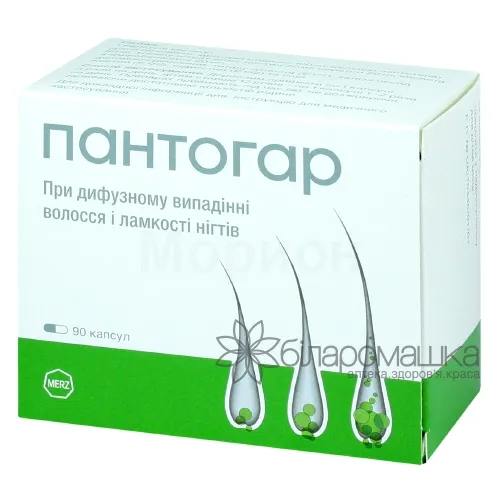
PANTOGAR
UkraineThe drug is used for diffuse hair loss (when the causes are unknown), changes in hair structure (if it has become thin, brittle, dull, or sun-damaged), as well as for the prevention of premature graying. It also helps with nail growth disorders (brittleness, splitting).
Frequently asked questions
How should Pantogar be taken correctly?
Capsules should be taken during meals, without chewing, and swallowed with a sufficient amount of water. For adults, it is recommended to take 1 capsule 3 times a day, and for children aged 12 and older, 1-2 capsules once a day. The average duration of the course is 3-6 months.
What side effects can Pantogar cause?
Possible reactions include: headache, dizziness, rapid heartbeat, nausea, vomiting, abdominal pain, flatulence, heartburn, or diarrhea. Occasionally, rash, skin itching, redness, or increased sweating may also be observed. In case of any adverse reactions, you should discontinue use and consult a physician.
Who should not take this drug?
The drug should not be used in case of hypersensitivity to any of its components. It is not recommended for children under 12 years of age due to a lack of sufficient experience in use for this age group.
Can the drug be taken with other medicines?
If you are already taking medications containing sulfanilamide, you must consult a physician before starting Pantogar.
Can the drug be taken during pregnancy or breastfeeding?
Use during pregnancy and lactation is only possible after a thorough assessment by a physician of the benefit-risk ratio, as the effect on child development has not been fully studied.
Instructions for use
INSTRUCTIONS FOR MEDICAL USE OF THE MEDICINAL PRODUCT PANTOGAR (PANTOGAR®)
Composition:
Active ingredients: medical yeast, calcium pantothenate, thiamine nitrate, cystine, keratin, 4-aminobenzoic acid;
1 capsule contains: medical yeast 100 mg; calcium pantothenate 60 mg; thiamine nitrate 60 mg; cystine 20 mg; keratin 20 mg; 4-aminobenzoic acid 20 mg;
Excipients: microcrystalline cellulose, povidone, colloidal anhydrous silicon dioxide, talc, magnesium stearate, gelatin, titanium dioxide (E 171), iron oxide yellow (E 172), indigotine (E 132).
Pharmaceutical form. Capsules.
Main physicochemical properties: hard gelatin capsules size 1 with dark green opaque cap and ivory-colored opaque body; capsule contents – fine beige-brown powder with a faint yeast odor.
Pharmaco-therapeutic group. Combined vitamin preparations. ATC code: A11JC.
Pharmacological Properties
Pharmacodynamics
The active ingredients of the drug belong to the following therapeutic groups: vitamins, dietary supplements, amino acids, proteins.
Thiamine nitrate, calcium pantothenate, and other vitamins present in nutritional yeast are essential for maintaining optimal regulation of metabolism in the body.
Insufficient intake of these vitamins by the body leads to deficiency symptoms.
Keratin is the main component of hair and nails; cystine and 4-aminobenzoic acid are also substances that strengthen hair and nails.
Pantogar reduces hair loss caused by various factors, improves hair structure, and increases its resistance to mechanical and chemical damage. Pantogar promotes nail growth and enhances their strength.
Pharmacokinetics
Pharmacokinetic studies of Pantogar have not been conducted. Vitamins are absorbed in the upper gastrointestinal tract. Amino acid components derived from keratin hydrolysis (L-cystine and 4-aminobenzoic acid) are absorbed via passive diffusion and/or specific transport systems.
Clinical characteristics.
Indications.
Diffuse hair loss (hair loss of unknown origin).
Degenerative changes in hair structure (thin, coarse, brittle, lifeless, dull, colorless hair).
Hair damaged by sunlight or UV radiation.
Prevention of premature graying.
Nail growth disorders (brittleness, splitting, inflexibility).
Contraindications.
Hypersensitivity to any component of the product.
Interaction with other medicinal products and other forms of interaction.
When used concomitantly with drugs containing sulfonamides, consult a physician.
Special precautions for use.
Use during pregnancy or breastfeeding.
Animal studies are insufficient to determine effects on pregnancy, embryo/fetal development, offspring development, and postnatal development. Risk to humans is unknown. PANTOGAR should be prescribed during pregnancy and lactation only after careful assessment of the benefit and potential risk.
Ability to influence reaction rate when driving vehicles or operating machinery.
No influence.
Method of Administration and Dosage.
For oral use.
The medication should be taken during meals, without chewing, and with sufficient amount of liquid.
Adults should take 1 capsule three times a day; children aged 12 years and older – 1–2 capsules once daily.
The average duration of treatment is 3–6 months. If necessary, the treatment course may be prolonged or repeated.
Children.
Due to insufficient experience of use in younger children, the medication should not be administered to children under 12 years of age.
Overdose.
Symptoms of overdose are unknown.
Side effects
The adverse reactions listed below are classified by organ systems and frequency of occurrence. Frequency categories: very common ≥ 1/10, common ≥ 1/100 and < 1/10, uncommon ≥ 1/1000 and < 1/100, rare ≥ 1/10,000 and < 1/1000, very rare < 1/10,000, or frequency not known if the frequency cannot be estimated from available data.
Nervous system disorders
Frequency not known: headache, dizziness.
Cardiovascular system disorders
Rare: tachycardia, accelerated pulse.
Frequency not known: rapid heartbeat (palpitations).
Gastrointestinal disorders
Frequency not known: nausea, vomiting, abdominal pain, flatulence, heartburn, diarrhea.
Skin and appendages disorders
Rare: urticaria, rash, pruritus.
Frequency not known: skin redness.
Immune system disorders
Rare: hypersensitivity reactions such as increased sweating.
If any adverse reactions occur, discontinue use of the medicinal product and consult a physician.
Shelf life. 3 years.
Do not use after the expiry date stated on the packaging.
Storage conditions.
Store at temperatures not exceeding 25 °C. Keep out of reach and sight of children.
Packaging.
15 capsules in a blister pack, 6 blisters in a cardboard box.
Classification of supply.
Over-the-counter (without prescription).
Manufacturer.
Asino Pharma AG / Acino Pharma AG.
Manufacturer's address and location of operations.
Birsweg 2, 4253 Liesberg, Switzerland / Birsweg 2, 4253 Liesberg, Switzerland.
Similar drugs
| Brand name | Dosage form | Active substance / Dosage | Manufacturer |
|---|---|---|---|
| CARDONAT | capsules |
|
Joint Ukrainian-Spanish Enterprise "Sperko Ukraine" |
The original data is available in the language of the country of manufacture.
Data source: State Register of Medicinal Products of Ukraine
Data last verified: August 13, 2026