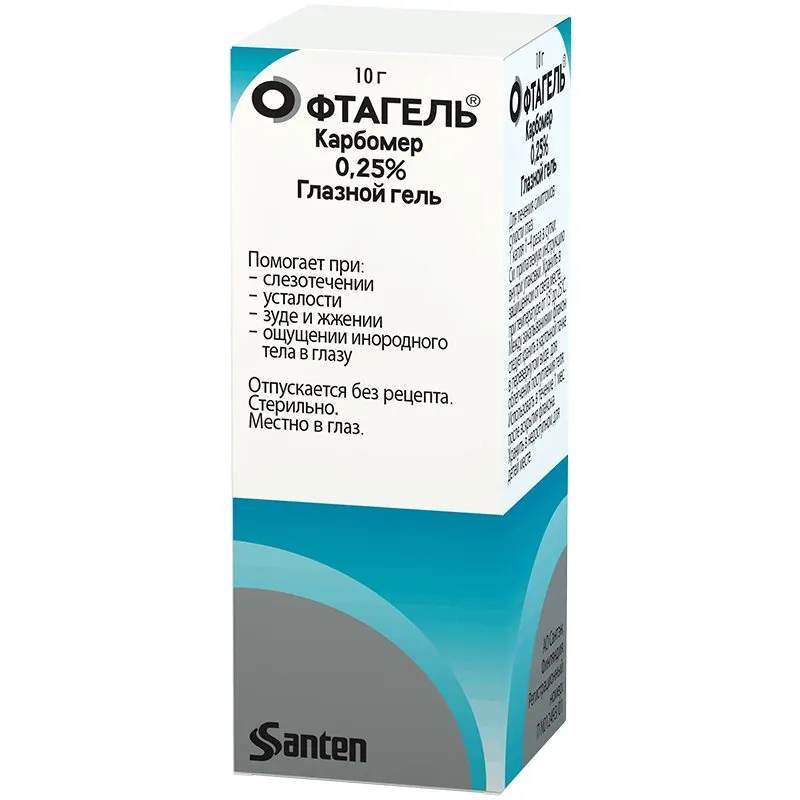
OFTAGEL
UkraineThe drug is used for the symptomatic treatment of dry eye syndrome and dry keratoconjunctivitis.
Frequently asked questions
How to use Oftagel correctly?
Instill 1 drop into each eye 1 to 4 times daily.
Can the drug be used together with other eye drops?
If you are using multiple eye products, wait at least 15 minutes between applications. Oftagel eye gel should always be applied last.
Can contact lenses be worn during the use of the gel?
Lenses must be removed before use. After instillation, you should wait at least 15 minutes before putting them back in, as the preservative in the formulation may be absorbed by soft lenses and change their color.
What are the possible side effects of Oftagel?
Immediately after application, temporary blurred vision, mild burning, stinging, or eye irritation may occur. Eye pain, redness, and local allergic reactions may also occur.
Does the drug affect the ability to drive?
Vision may become blurred immediately after instillation. You should wait until your vision has cleared completely before driving or operating machinery.
Who should not use this drug?
The drug is contraindicated in individuals with hypersensitivity to any of its components.
Instructions for use
Table of contents
INSTRUCTIONS FOR MEDICAL USE OF THE MEDICINAL PRODUCT OFTAGEL® (OFTAGEL®)
Composition:
Active substance: 1 g of ophthalmic gel contains 2.5 mg of carbomer 974P;
Excipients: benzalkonium chloride, sorbitol, lysine monohydrate, sodium acetate, polyvinyl alcohol, water for injections.
Pharmaceutical form. Ophthalmic gel.
Main physicochemical characteristics: almost colorless or slightly opalescent gel.
Pharmacotherapeutic group. Ophthalmological agents. Artificial substitutes of tear fluid. ATC code S01XA20.
Pharmacological properties.
Pharmacodynamics
Carbomer is a high molecular weight carbomer vinyl polymer that increases the viscosity of tear fluid and is commonly used in eye drops intended for the treatment of dry eye. One drop of the preparation forms a protective and moisturizing film on the cornea.
Pharmacokinetics
The effect of carbomer lasted from 12.5 to 45 minutes. Due to the high molecular weight and cross-linked polymeric structure of carbomer, it is unlikely that carbomer penetrates into ocular tissues or accumulates in them.
Clinical characteristics.
Indications.
Symptomatic treatment of dry keratoconjunctivitis and dry eye syndrome.
Contraindications.
Hypersensitivity to any component of the medicinal product.
Interaction with other medicinal products and other forms of interaction.
If several ophthalmic medicinal products for topical use are administered simultaneously, they should be instilled with an interval of at least 15 minutes one after another, with Oftagel® eye gel always being instilled last.
Special warnings.
Benzalkonium chloride
Oftagel® eye gel contains the preservative benzalkonium chloride. Benzalkonium chloride may cause eye irritation with prolonged use, particularly in patients with dry eye and in patients who may have impaired corneal integrity.
Use of contact lenses
Benzalkonium chloride may be absorbed by soft contact lenses and may alter the color of contact lenses. Contact lenses should be removed before instillation and at least 15 minutes should be waited before reinsertion.
Use during pregnancy or breastfeeding.
No adequate controlled studies on the use of Oftagel® eye gel in pregnant women have been conducted. The medicinal product should be used during pregnancy or breastfeeding only if the expected benefit to the mother outweighs the potential risk to the fetus or infant.
Ability to influence reaction rate while driving or operating machinery.
Oftagel® eye gel may temporarily impair visual acuity. Immediately after instillation, blurred vision may occur; therefore, it is necessary to wait some time and refrain from driving or operating machinery until vision clears completely.
Dosage and Administration.
Instill 1 drop into each eye 1–4 times daily.
Children.
The safety and efficacy of Oftagele® in children at the recommended adult dose have been established based on clinical experience; however, clinical trial data are lacking.
Overdose.
There is no information regarding adverse effects of overdose.
Side Effects.
Immediately after instillation, transient blurred vision, slight burning, brief sensation of stinging, or local eye irritation may occur.
Eye pain, hyperemia, and local hypersensitivity reactions have been reported.
Shelf Life.
2.5 years.
The shelf life after first opening the bottle is 1 month.
Storage Conditions.
Store in a place protected from light, at a temperature not exceeding 25 °C.
Keep out of reach of children.
Between administrations, store the bottle in the cardboard box in an inverted position to facilitate gel delivery.
Packaging.
10 g in a bottle. 1 bottle in a cardboard box.
Prescription Status.
Over-the-counter (without prescription).
Manufacturer.
Santen AT / Santen Oy.
Manufacturer's Address and Place of Business.
Kelloportinkatu 1, Tampere, 33100, Finland /
Kelloportinkatu 1, Tampere, 33100, Finland.
Similar drugs
| Brand name | Dosage form | Active substance / Dosage | Manufacturer |
|---|---|---|---|
| VIDISIK | gel, ophthalmic |
|
Dr. Gerhard Mann Chem.-pharm. Fabrik GmbH |
The original data is available in the language of the country of manufacture.
Data source: State Register of Medicinal Products of Ukraine
Data last verified: August 13, 2026