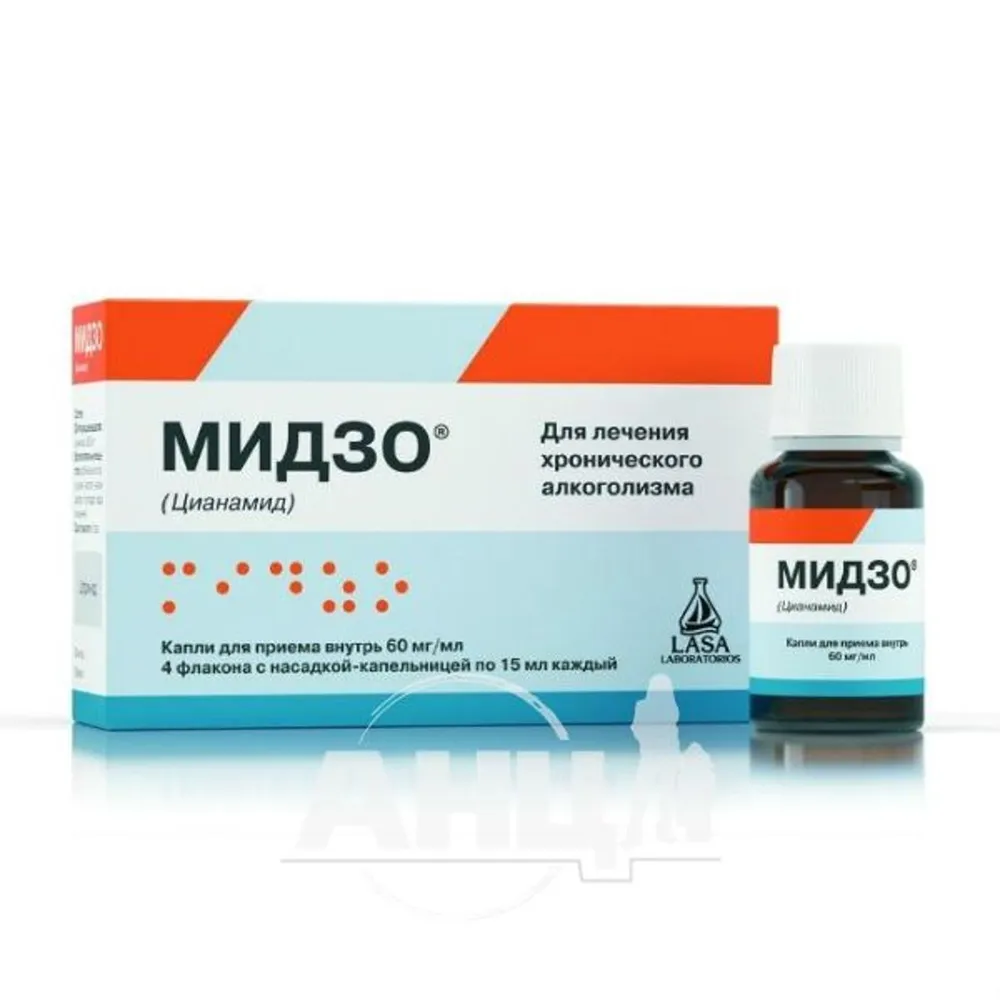
MIDZO®
UkraineThe drug is used for the treatment of chronic alcoholism and for the prevention of its relapses.
Frequently asked questions
How should Midzo® be taken correctly?
The drug is taken orally at a dose of 12–25 drops (equivalent to 36–75 mg) twice a day at 12-hour intervals. Treatment must only begin 12 hours after the last consumption of alcohol and must be conducted strictly under medical supervision.
What side effects can Midzo® cause?
The most common side effects are nausea, stomach discomfort, increased fatigue, dizziness, and decreased appetite. Rare cases of drowsiness, depression, impotence, tinnitus, or skin rashes may also occur.
When should this drug not be taken?
Contraindications include severe heart disease, respiratory disorders, heart, liver, or kidney failure, hepatic encephalopathy, as well as hypersensitivity to the components of the product. The drug is prohibited for use in children, pregnant women, and breastfeeding women.
What will happen if the drug is taken together with alcohol?
An unpleasant reaction may occur: facial flushing, nausea, palpitations, shortness of breath, weakness, blurred vision, chest pain, or profuse sweating. In severe cases, vomiting, low blood pressure, respiratory depression, or loss of consciousness may occur.
Can this product be combined with other medicines?
It is necessary to avoid taking it together with metronidazole, isoniazid, phenytoin, and other drugs that affect aldehyde metabolism. The product is also incompatible with drugs of the aldehyde group (e.g., paraldehyde). If you have recently taken disulfiram, the break before starting Midzo® must be at least 10 days.
How does the drug affect the ability to drive a vehicle?
The drug may cause drowsiness and fatigue; therefore, caution should be exercised when driving a car or operating machinery.
Instructions for use
INSTRUCTIONS FOR MEDICAL USE OF THE MEDICINAL PRODUCT MIZO® (MEEDZO®)
Composition:
Active substance: 1 drop contains 3 mg of the active ingredient cyanamide;
1 ml of drops contains 60 mg of the active ingredient cyanamide;
Excipients: sorbic acid, glacial acetic acid, sodium acetate trihydrate, purified water.
Pharmaceutical form. Oral drops.
Main physicochemical properties: colorless, clear liquid with a slight odor of acetic acid.
Pharmacotherapeutic group. Agent used in alcohol dependence.
ATC code N07BB.
Pharmacological properties.
Pharmacodynamics.
The action of cyanamide is based on inhibition of the enzymatic biotransformation of ethanol (acetaldehyde dehydrogenase). This leads to increased concentrations of the metabolite of ethanol—acetaldehyde—which causes unpleasant sensations (facial flushing, nausea, tachycardia, dyspnea), making alcohol consumption highly undesirable after taking the drug. This creates a conditioned aversion to the taste and smell of alcohol. The sensitizing effect of cyanamide on alcohol manifests earlier (approximately within 45–60 minutes) and lasts for a shorter duration (about 12 hours) compared to disulfiram. Unlike disulfiram, cyanamide does not exhibit a hypotensive effect.
Clinical characteristics.
Indications.
Treatment of chronic alcoholism and prevention of relapses.
Contraindications.
Severe heart diseases, respiratory tract diseases with impaired function, respiratory, cardiac, hepatic, and renal insufficiency, increased individual sensitivity to the drug. Hepatic encephalopathy.
Interaction with other medicinal products and other types of interactions.
Administration of MIZO® together with metronidazole, isoniazid, phenytoin, and other aldehyde dehydrogenase inhibitors, which may enhance the reaction to alcohol interaction, should be avoided. After disulfiram use, a break of at least 10 days must elapse before starting treatment with MIZO®.
MIZO® is incompatible with aldehyde group agents (with paraldehyde and chloral derivatives).
Special precautions for use.
MIDZO® should only be initiated under medical supervision and with the patient's informed consent. An alcohol reaction may occur due to alcohol present in certain medicinal products and food items.
MIDZO® treatment must not begin earlier than 12 hours after the last alcohol consumption. The drug should be used with caution in cases where the reaction to concomitant alcohol intake may pose a health risk to the patient: in hyperthyroidism, diabetes mellitus, epilepsy, cardiovascular diseases, bronchial asthma, acute and chronic nephritis. Long-term treatment should be avoided. However, if prolonged use is necessary, thyroid function should be monitored, as cases of hypothyroidism have been reported. Patient evaluation is recommended every 6 months.
Alcohol reaction. When taken concomitantly with alcohol, the following symptoms may occur: skin hyperemia, pulsating sensation in the head and neck, nausea, tachycardia, dyspnea, weakness, blurred vision, profuse sweating, and chest pain. In more severe cases – vomiting, decreased arterial blood pressure, respiratory depression, and collapse. The nature and severity of symptoms depend on the amount of alcohol consumed and the dose of the drug taken. In severe cases, symptomatic therapy should be administered to support respiratory and cardiovascular functions, including intravenous administration of antihistamine agents.
Use during pregnancy or breastfeeding.
The use of this drug is contraindicated during pregnancy or breastfeeding.
Ability to influence reaction rate while driving or operating machinery.
Caution is advised when driving or operating machinery, as the drug may cause drowsiness and fatigue.
Dosage and Administration.
Use strictly as prescribed by a physician. Treatment is initiated after patient examination and warnings about possible consequences and complications. The drug is administered orally according to an individual regimen, 36–75 mg (12–25 drops twice daily with a 0.5 interval) every 12 hours.
Children.
The drug must not be used in children.
Overdose.
Symptoms have not been described. An overdose may enhance adverse effects. In case of ingestion of large doses, gastric lavage is necessary. Treatment consists of detoxification and symptomatic therapy aimed at supporting liver function, respiration, cardiovascular system, monitoring hematocrit levels, and, if necessary, blood transfusion.
Adverse reactions.
The drug is usually well tolerated if the patient does not consume alcohol. Adverse reactions are usually mild and resolve without discontinuation of treatment.
Nature and frequency of adverse reactions:
Endocrine system
Rare: hypothyroidism.
Nervous system
Very rare: depression, somnolence.
Reproductive system and mammary gland
Rare: impotence.
Sensory organs
Rare: tinnitus.
Gastrointestinal tract
Frequent: nausea, epigastric discomfort.
Renal and urinary system
Uncommon: increased urinary output.
Skin and subcutaneous tissue
Rare: skin rashes, allergic dermatitis (due to accidental contact with the drug).
General disorders
Frequent: increased fatigue, dizziness, decreased appetite.
Laboratory test abnormalities
Very rare: transient leukocytosis, granulocytopenia, aplastic anemia, which resolve after discontinuation of treatment.
Cases of inclusion bodies in hepatocytes similar to those observed in Lafora disease have been reported. Such changes are usually associated with prolonged administration of high doses of cyanamide (more than 3 months) and resolve after treatment is discontinued.
Shelf life. 2 years. Do not use the drug after the expiry date stated on the package.
Storage conditions. Store in a light-protected place, in the original packaging at a temperature not exceeding 25 °C.
Keep out of reach of children.
Packaging. 15 ml in a brown glass bottle with dropper; 4 bottles per cardboard box.
Prescription status. Prescription only.
Manufacturer.
SPECIAL PRODUCTS LINE S.P.A., ITALY.
Manufacturer's address and location of operations.
Via Fratta Rotonda Vado Largo, 1
03012 Anagni (Province of Frosinone), Italy.
Marketing Authorization Holder. LLC "ZDRAVO".
Address of the Marketing Authorization Holder.
54/19/19A Avtozavodska Street, Kyiv, 04114, Ukraine.
Date of last review.
The original data is available in the language of the country of manufacture.
Data source: State Register of Medicinal Products of Ukraine
Data last verified: August 13, 2026