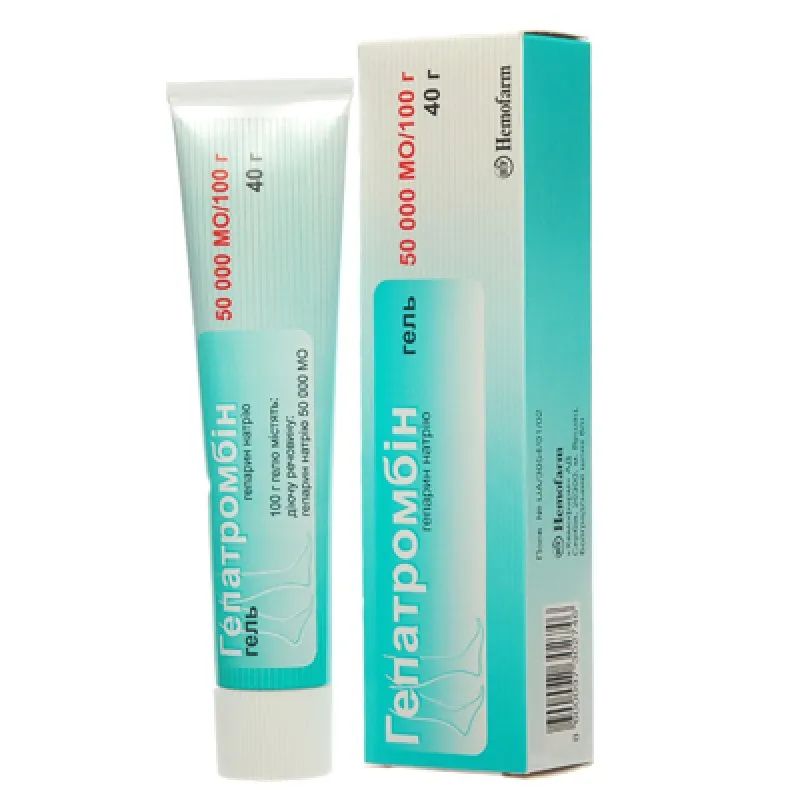
HEPATROMBIN
UkraineThe drug is used for the treatment of superficial vein diseases (varicose veins, thrombophlebitis, phlebothrombosis), as well as for injuries, bruises, swelling, and subcutaneous hematomas.
Frequently asked questions
How should Hepatrombin be used correctly?
Adults should apply the gel to the affected and adjacent areas of the skin 2-3 times a day. During normal use, the gel is rubbed in with gentle massaging motions from bottom to top. However, if treating phlebitis, the gel should be applied in a thin layer without rubbing and covered with an elastic bandage.
Who should not use this drug?
Hepatrombin should not be used in case of hypersensitivity to the components, the presence of open, infected, or bleeding wounds and ulcers, or blood clotting disorders (hemophilia, thrombocytopenia, etc.). The drug is also contraindicated for pregnant and breastfeeding women.
What are the possible side effects?
The drug is most often well-tolerated, but mild skin redness may occasionally occur. In some cases, an allergic reaction is possible: itching, swelling, burning, rash, or edema. Systemic reactions may occur if applied to very large areas of the skin.
Can the gel be combined with other medicines?
The gel should not be applied simultaneously with other topical agents containing tetracycline, hydrocortisone, salicylic acid, or anticoagulants. Caution should also be exercised if you are already taking oral anticoagulants, as heparin may prolong blood clotting time.
Can the product be used by children?
Due to limited experience, the drug is not recommended for use in children.
What should be done if the gel accidentally enters the body?
If the gel is accidentally swallowed, it may cause nausea or vomiting. In such a case, gastric lavage is necessary.
Instructions for use
INSTRUCTIONS FOR MEDICAL USE OF THE MEDICINAL PRODUCT Hepathrombin (Hepathrombin)
Composition:
Active substance: sodium heparin;
100 g of gel contain sodium heparin 30,000 IU or 50,000 IU;
Excipients: allantoin, dexpanthenol, disodium edetate, lemon oil, isopropyl alcohol, carbomers, oil of common pine, oil of mountain pine, levomenthol, polysorbates, macrogol glyceryl caprylocaprate, sorbitol solution non-crystallizing (E 420), triethanolamine, purified water.
Pharmaceutical form. Gel.
Main physico-chemical properties:
transparent colorless gel with a characteristic pine and isopropanol odor.
Pharmacotherapeutic group. Agents used in varicose veins. Heparin or heparinoids for topical use. ATC code C05B A03.
Pharmacological properties.
Pharmacodynamics.
Hepatrombin gel is a high-dose topical preparation of the direct-acting anticoagulant heparin. It exerts local antithrombotic, anti-edematous, and anti-inflammatory effects, stimulates tissue metabolic processes, as well as tissue granulation and epithelialization, and improves local blood circulation.
Pharmacokinetics.
When applied topically, heparin does not produce systemic effects, rapidly penetrates through the skin, and accumulates in the stratum corneum of the epidermis, thus exerting exclusively local action.
Clinical characteristics.
Indications.
Treatment of diseases of superficial veins, such as varicose veins and associated complications, phlebothrombosis, thrombophlebitis, superficial periphlebitis. Postoperative varicose phlebitis, complications following surgical removal of subcutaneous veins of the lower limbs. Injuries and contusions, infiltrates and localized edema, subcutaneous hematomas. Injuries and sprains of muscular-tendinous and capsuloligamentous structures.
Contraindications.
Hypersensitivity to heparin or to any of the other components of the drug; bleeding leg ulcers; open and/or infected wounds; hemorrhagic diathesis; purpura; thrombocytopenia; hemophilia. Tendency to bleeding.
Interaction with other medicinal products and other forms of interaction.
Hepatrombin must not be used concomitantly with topical medicinal products, e.g., preparations containing tetracycline, hydrocortisone, salicylic acid, anticoagulants.
The use of heparin may contribute to prolongation of prothrombin time in patients receiving oral anticoagulants.
Special precautions for use.
Apply only to intact skin. The product should not be used in cases of bleeding, or applied to infected skin areas with purulent processes, or to mucous membranes. In patients presenting hemorrhagic symptoms, the possibility of using the product should be carefully considered.
When treating phlebitis, this medicinal product should not be rubbed into the skin, but only applied thinly to the affected area and the area then wrapped with an elastic bandage.
The gel must not be applied to weeping skin areas, wounds, ulcers or blisters, mucous membranes, eyes, or areas around the eyes. In case of accidental ingestion by a child, nausea or vomiting may occur. In such a case, gastric lavage should be performed.
Treatment is symptomatic.
The gel is not recommended for application to large skin areas in patients with coagulation disorders.
Use during pregnancy or breastfeeding. Do not use the medicinal product during pregnancy or breastfeeding.
Ability to affect reaction rate when driving or operating machinery. Hepatrombin gel does not affect the ability to react quickly when driving or operating machinery.
Administration and Dosage
Apply topically.
Begin treatment with the dose of 50000 IU/100 g; the dose of 30000 IU/100 g should be used for continuation of treatment and for prophylactic purposes.
Adults should apply a 5 cm strip of gel to affected areas and also to adjacent skin regions 2–3 times daily, rubbing it in gently with light massaging movements from bottom upwards.
In cases of phlebitis, this medicinal product should not be rubbed into the skin, but only applied as a thin layer to the affected area and the area then bandaged with a compression or elastic bandage.
The duration of treatment is determined by the physician according to the patient's condition.
Children. Due to limited experience of use, the drug should not be administered to children.
Overdose.
Because of the minimal systemic absorption of the drug, the risk of overdose with topical application is absent.
In case of accidental oral ingestion, nausea and vomiting may occur. Gastric lavage should be performed; subsequent treatment is symptomatic.
Heparin activity can be neutralized with protamine sulfate.
Side effects.
The drug is usually well tolerated; only in isolated cases may mild skin irritation (redness) occur, which spontaneously resolves after some time.
During the course of treatment, a hypersensitivity reaction to some of the drug's ingredients may develop. Signs of such hypersensitivity include itching, redness, swelling of the skin, burning sensation, skin rashes, urticaria, angioneurotic edema, hemorrhages, and occasionally the appearance of small pustules, vesicles, or bullae. When applied to large areas of skin, systemic adverse reactions are possible.
Shelf life. 3 years.
Storage conditions. Store at a temperature not exceeding 25 °C. Keep out of reach of children.
Packaging. 40 g in a tube; 1 tube per cardboard box.
Availability. Over-the-counter.
Manufacturer.
«HEMOFARM» AD.
Manufacturer's address.
Beogradski put bb, 26300, Vrsac, Republic of Serbia.
Similar drugs
The original data is available in the language of the country of manufacture.
Data source: State Register of Medicinal Products of Ukraine
Data last verified: August 13, 2026