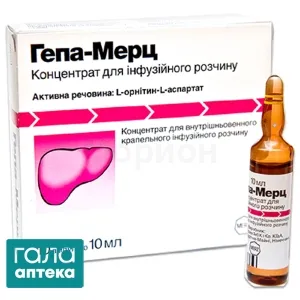
HEPA-MERZ
UkraineThe drug is used for the symptomatic treatment of hepatic encephalopathy (in both latent and overt forms).
Frequently asked questions
How should Hepa-merz be taken correctly?
The drug is administered intravenously. Typically, the dose is up to 4 ampoules (40 ml) per day. In severe conditions (precoma or coma), a physician may prescribe up to 8 ampoules (80 ml) within 24 hours. It is important not to inject the drug into an artery. Before use, the contents of the ampoules are mixed with 500 ml of infusion solution, but no more than 6 ampoules per such volume.
Who should not use this drug?
Contraindications include hypersensitivity to the components of the product and severe renal impairment (renal failure, particularly with a creatinine level above 3 mg/100 ml).
What are the possible side effects of Hepa-merz?
Nausea (uncommon) and vomiting (rare) are possible. These symptoms are usually short-lived and subside if the dose or infusion rate is reduced. Anaphylactic reactions are also unknown.
Can the drug be taken during pregnancy or breastfeeding?
Use should be avoided during pregnancy, although in life-threatening cases, a physician may weigh the risks and benefits. Taking the drug while breastfeeding is not recommended.
Does the drug affect the ability to drive a vehicle?
During treatment, the ability to drive a vehicle or operate machinery may be impaired; therefore, such activities should be avoided.
Can this drug be mixed with other medicines?
Since no studies have been conducted, the drug should not be mixed with other medicinal products. It may only be mixed with standard infusion solutions.
Instructions for use
INSTRUCTIONS for medical use of the medicinal product HEPAMERC
Composition:
Active substance: L-ornithine-L-aspartate;
5 g of L-ornithine-L-aspartate in 10 ml of concentrate;
Excipient: water for injections.
Pharmaceutical form. Concentrate for solution for infusion.
Main physicochemical properties: clear solution, colorless to pale yellow.
Pharmacotherapeutic group.
Agents used in liver diseases, lipotropic substances. Hepatotropic agents. ATC code A05BA.
Pharmacological Properties
Pharmacodynamics
The in vivo action of L-ornithine-L-aspartate is due to the amino acids ornithine and aspartate, which promote ammonia detoxification through the synthesis of urea and glutamine.
Urea synthesis occurs in periportal hepatocytes, where ornithine acts as an activator of two enzymes: ornithine carbamoyltransferase and carbamoylphosphate synthetase, as well as a substrate for urea synthesis.
Glutamine synthesis occurs in perivenous hepatocytes. In particular, under pathological conditions, aspartate and dicarboxylates, including metabolites of ornithine, are absorbed by cells and utilized there for ammonia binding in the form of glutamine.
Glutamate is an amino acid that binds ammonia under both physiological and pathophysiological conditions. The resulting amino acid, glutamine, is not only a non-toxic form for ammonia elimination but also activates the important urea cycle (intracellular glutamine metabolism).
Under physiological conditions, ornithine and aspartate do not limit urea synthesis.
Animal experimental studies have shown that the ability of L-ornithine-L-aspartate to reduce ammonia levels is due to accelerated glutamine synthesis. In some clinical studies, this improvement has been demonstrated with respect to the ratio of branched-chain amino acids to aromatic amino acids.
Pharmacokinetics
The elimination half-life of ornithine and aspartate is short – 0.3–0.4 hours. A small portion of aspartate is excreted unchanged in urine.
Clinical characteristics.
Indications.
Symptomatic treatment of latent and manifest hepatic encephalopathy.
Contraindications.
Hypersensitivity to L-ornithine-L-aspartate or to other components of the medicinal product.
Severe impairment of renal function (renal failure). Creatinine level above 3 mg/100 ml (considered as a guideline value).
Interaction with other medicinal products and other forms of interaction.
Studies on interactions have not been conducted. No interactions are known to date.
Special precautions for use.
Hepa-Merz, concentrate for solution for infusion, must not be administered intra-arterially.
When high doses of Hepa-Merz are administered, plasma and urinary urea levels should be monitored.
In patients with impaired liver function, the infusion rate should be adjusted according to the individual patient's condition in order to prevent nausea and vomiting.
Use during pregnancy or breastfeeding.
Data on the use of Hepa-Merz during pregnancy are lacking. Studies in animals using L-ornithine-L-aspartate to evaluate its toxic effects on reproductive function have not been conducted. Therefore, the use of Hepa-Merz during pregnancy should be avoided.
However, if treatment with Hepa-Merz during pregnancy is considered necessary due to life-threatening indications, the physician should carefully weigh the potential risk to the fetus/child against the expected benefit to the mother.
It is not known whether L-ornithine-L-aspartate is excreted in breast milk. Therefore, the use of Hepa-Merz should be avoided during breastfeeding.
Ability to affect reaction speed when driving or operating machinery.
The ability to drive or operate machinery may be impaired during treatment with L-ornithine-L-aspartate; therefore, such activities should be avoided during therapy.
Dosage and Administration.
Administer intravenously.
The usual dose is up to 4 ampoules (40 ml) per day.
In cases of precoma or coma, up to 8 ampoules (80 ml) may be administered within 24 hours, depending on the severity of the condition.
The Hepa-Merz infusion concentrate may be mixed with standard infusion solutions. The contents of ampoules should be mixed with infusion solution only immediately before use. Prior to administration, add the contents of the ampoules to 500 ml of infusion solution; however, no more than 6 ampoules should be dissolved in 500 ml of infusion solution.
The maximum infusion rate of L-ornithine-L-aspartate is 5 g/hour (equivalent to the contents of 1 ampoule).
The duration of treatment should be determined by the physician according to the patient's clinical condition.
Children.
Experience with use in children is limited; therefore, the drug should not be used in pediatric practice.
Overdose.
To date, no signs of intoxication due to overdose of L-ornithine-L-aspartate have been observed. Overdose may enhance adverse effects. In case of overdose, symptomatic treatment is recommended.
Adverse reactions.
The adverse reactions listed below have been observed during clinical trials and post-marketing use. Frequency categories are defined as follows:
very common (≥ 1/10),
common (≥ 1/100, < 1/10),
uncommon (≥ 1/1000, < 1/100),
rare (≥ 1/10000, < 1/1000),
very rare (< 1/10000),
not known: cannot be estimated from the available data.
Immune system disorders:
Not known: hypersensitivity, anaphylactic reactions.
Gastrointestinal disorders:
Uncommon: nausea.
Rare: vomiting.
Overall, gastrointestinal symptoms are transient and do not require discontinuation of treatment. They resolve with dose reduction or slower administration rate.
Shelf life. 3 years.
Storage conditions.
Store at temperatures not exceeding 25 °C in a place inaccessible to children.
Incompatibilities.
Since compatibility studies have not been conducted, this medicinal product must not be mixed with other medicinal products.
Hepa-Merz can be mixed with standard infusion solutions. However, no more than 6 ampoules should be dissolved in 500 ml of infusion solution.
Packaging.
10 ml in an ampoule; 10 ampoules in a cardboard box.
Prescription status.
Prescription only.
Manufacturer.
Merz Pharma GmbH & Co. KGaA.
Manufacturer's address and location of operations.
Ludwigstrasse 22, 64354 Reinheim, Germany / Ludwigstrasse 22, 64354 Reinheim, Germany.
Similar drugs
| Brand name | Dosage form | Active substance / Dosage | Manufacturer |
|---|---|---|---|
| HEPATOX | concentrate for infusion solution |
|
Holopack Verpackungstechnik GmbH (secondary packaging, control; manufacturing of unpackaged products, primary and secondary packaging, control) |
| HEPTRAL-PHARMEX | concentrate for infusion solution |
|
Farmex Group LLC |
| LARNAMIN® | concentrate for infusion solution |
|
Farmak JSC |
The original data is available in the language of the country of manufacture.
Data source: State Register of Medicinal Products of Ukraine
Data last verified: August 13, 2026