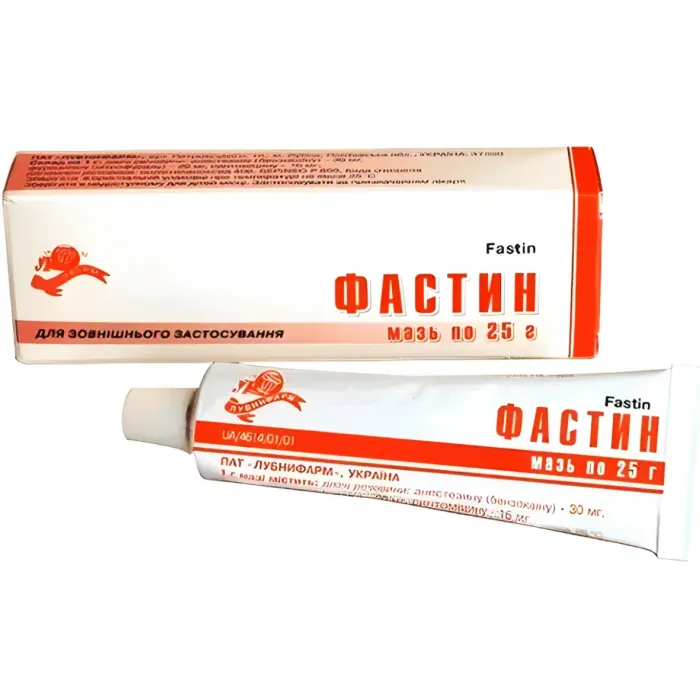
FASTIN
UkraineThe drug is used for the local treatment of first-degree burns, fresh second-to-third-degree burns, purulent wounds, and pyoderma.
Frequently asked questions
How should Fastin be used correctly?
Apply a thin layer of ointment to a sterile gauze pad and apply it to the affected area of the skin. The dressing is usually changed once every 7–10 days. If pain occurs or fluid is discharged, the dressing should be changed more frequently.
Who should not use this drug?
Use is contraindicated in cases of individual hypersensitivity to the components, a history of allergic or toxic reactions to chloramphenicol or nitrofurans derivatives, as well as in psoriasis, eczema, fungal skin diseases, and allergic dermatoses.
What are the possible side effects of Fastin?
Possible allergic reactions (swelling, rash, itching, fever), dermatitis, or local irritation.
Can the ointment be used by children?
Products containing syntomycin are not prescribed to infants under 4 weeks of age. In children under 6 years of age, the ointment should be used with caution and only as prescribed by a physician.
Can the drug be used by pregnant or breastfeeding women?
This can only be done if the physician considers that the benefit to the mother outweighs the potential risk to the child.
Does the ointment interact with other medicines?
At this time, interactions with other medicinal products have not been established.
Instructions for use
INSTRUCTIONS for medical use of the medicinal product FASTIN
Composition:
Active substances: 1 g of ointment contains anestezin (benzocaine) 30 mg, furacilin (nitrofurale) 20 mg, synthomycin 16 mg;
Excipients: polyethylene glycol-400, sepineo P600, purified water.
Pharmaceutical form. Ointment.
Main physicochemical properties: thick mass, from light yellow to brownish-yellow color, odorless.
Pharmacotherapeutic group.
Antibiotics and chemotherapeutic agents for dermatological use. Antibiotics and chemotherapeutic agents, combinations. ATC code D06C.
Pharmacological properties.
Pharmacodynamics.
Fastin ointment has bacteriostatic properties and a superficial anesthetic effect.
Pharmacokinetics.
The ointment Fastin contains anestezin (benzocaine) 30 mg. Benzocaine is poorly soluble in water, which results in its slow absorption. Like all ester derivatives of para-aminobenzoic acid, it is hydrolyzed by esterases in blood plasma and liver. As a result, para-aminobenzoic acid and ethanol are formed, the latter being metabolized to acetyl coenzyme A. Para-aminobenzoic acid undergoes conjugation with glycine or is excreted unchanged by the kidneys. The extent of systemic effect of the drug after topical application to the skin has not been studied.
Clinical characteristics.
Indications.
Local treatment of first-degree burns, fresh second- to third-degree burns, pyoderma, and purulent wounds.
Contraindications.
Individual hypersensitivity to the components of the drug. Allergic and toxic reactions (dyspeptic symptoms, dysbacteriosis, psychiatric disorders) to chloramphenicol in medical history, hypersensitivity to nitrofuran derivatives. Psoriasis, eczema, fungal skin diseases, allergic dermatoses.
Interaction with other medicinal products and other forms of interaction.
Not established.
Special precautions for use.
The drug is contraindicated in patients with a history of allergic reactions to chloramphenicol or anestezin.
Use during pregnancy or breastfeeding.
During pregnancy or breastfeeding, the drug should be used only if, in the opinion of the physician, the expected benefit to the mother outweighs the potential risk to the fetus or infant.
Ability to influence reaction rate when driving or operating machinery.
Has no effect.
Method of administration and dosage.
Fastin ointment is applied to adults and children as topical applications to the skin. The ointment is applied in a thin layer onto a sterile gauze pad, which is then placed on the affected skin area. The dressing is changed once every 7–10 days. More frequent dressing changes are performed in case of pain, exudate accumulation, or in other circumstances that may reduce the drug's effectiveness and lead to complications of the pathological process.
Children.
Preparations containing chloramphenicol for topical use are not prescribed to children during the first 4 weeks of life.
The drug should be used with caution in children under 6 years of age and only as directed by a physician.
Overdose.
May result in increased intensity of adverse reactions. Treatment is symptomatic.
Adverse reactions.
Immune system side effects: allergic reactions due to hypersensitivity to components of the drug may occur, including angioneurotic edema, fever, rash, itching sensation.
Skin and skin appendages side effects: dermatitis.
Local irritant effect is possible.
Shelf life. 2 years.
Storage conditions.
Store in the original packaging at a temperature not exceeding 25 °C.
Keep out of reach of children.
Packaging.
25 g in a tube; 1 tube in a carton.
Prescription status. Over-the-counter.
Manufacturer.
JSC "Lubnypharm".
Manufacturer's location and address of business activity.
16, Barvinkova Street, Lubny, Poltava region, 37500, Ukraine.
INSTRUCTION
for medical use of the medicinal product
FASTIN
Composition:
Active substances: 1 g of ointment contains anestezin (benzocaine) 30 mg, furacilin (nitrofurantoin) 20 mg, sintomycin 16 mg;
Excipients: polyethylene glycol-400, sepineo P600, purified water.
Pharmaceutical form. Ointment.
Main physicochemical properties: viscous mass, from light yellow to brownish-yellow color, odorless.
Pharmacotherapeutic group.
Antibiotics and chemotherapeutic agents for dermatological use. Antibiotics and chemotherapeutic agents, combinations. ATC code D06C.
Pharmacological properties.
Pharmacodynamics.
Fastin ointment has bacteriostatic properties and a superficial anesthetic effect.
Pharmacokinetics.
The ointment Fastin contains benzocaine 30 mg per 1 g. Benzocaine is poorly soluble in water, which determines its slow absorption. Like all ester derivatives of para-aminobenzoic acid, it is hydrolyzed by plasma and liver esterases. As a result, para-aminobenzoic acid and ethanol are formed, the latter being metabolized to acetyl coenzyme A. Para-aminobenzoic acid undergoes conjugation with glycine or is excreted unchanged by the kidneys. Systemic effects of the drug after topical application to the skin have not been studied.
Clinical characteristics.
Indications.
Local treatment of first-degree burns, fresh second- to third-degree burns, pyoderma, and purulent wounds.
Contraindications.
Individual hypersensitivity to the components of the drug. Allergic and toxic reactions (dyspeptic symptoms, dysbacteriosis, psychiatric disorders) to chloramphenicol in medical history, hypersensitivity to nitrofuran derivatives. Psoriasis, eczema, fungal skin diseases, allergic dermatoses.
Interaction with other medicinal products and other types of interactions.
Not established.
Special precautions.
The drug should not be used in patients prone to allergic reactions to sintomycin or anestezin.
Use during pregnancy or breastfeeding.
During pregnancy or breastfeeding, the drug may be used only when, in the physician’s opinion, the expected benefit to the mother outweighs the potential risk to the fetus or infant.
Ability to influence reaction rate when driving or operating machinery.
Does not affect.
Method of administration and dosage.
Fastin ointment is applied to the skin in adults and children. The ointment is applied in a thin layer onto a sterile gauze pad, which is then placed on the affected skin area. The dressing is changed once every 7–10 days. More frequent dressing changes are performed in case of pain, exudate accumulation, or other conditions that may reduce the drug’s efficacy or lead to complications of the pathological process.
Children.
Topical medicinal products containing sintomycin should not be prescribed to children during the first 4 weeks of life.
The drug should be used with caution in children under 6 years of age and only under medical supervision.
Overdose.
May result in an intensification of adverse reactions. Treatment is symptomatic.
Adverse reactions.
Immune system side effects: allergic reactions due to hypersensitivity to components of the drug may occur, including angioedema, fever, rash, itching sensation.
Skin and skin appendages side effects: dermatitis.
Local irritant effect is possible.
Shelf life. 2 years.
Storage conditions.
Store in the original packaging at a temperature not exceeding 25 °C.
Keep out of reach of children.
Packaging.
25 g in a tube; 1 tube in a carton.
Prescription status. Over-the-counter.
Manufacturer.
JSC "Lubnypharm".
Manufacturer's location and address of business activity.
16, Barvinkova Street, Lubny, Poltava region, 37500, Ukraine.
Similar drugs
| Brand name | Dosage form | Active substance / Dosage | Manufacturer |
|---|---|---|---|
| INFLARAX | ointment | LLC "Corporation "Zdorovya" (all stages of manufacturing, quality control, batch release; all stages of manufacturing, except quality control and batch release) | |
| LEVOSIN | ointment | PJSC "HIMFARMZAVOD "CHERVONA ZIRKA" | |
| METROAVIN | ointment | PJSC "HIMFARMZAVOD "CHERVONA ZIRKA" |
The original data is available in the language of the country of manufacture.
Data source: State Register of Medicinal Products of Ukraine
Data last verified: August 13, 2026