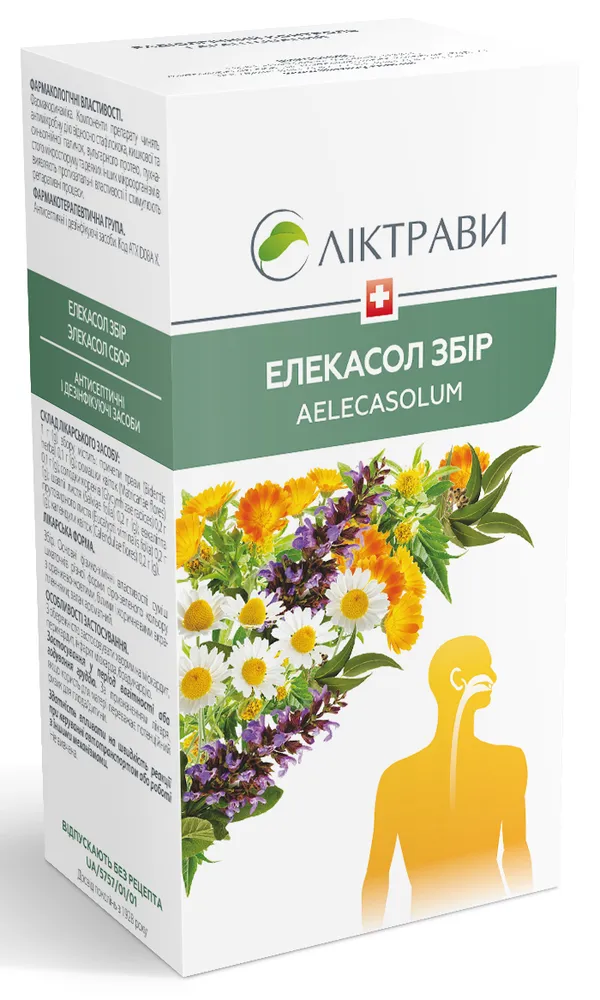
ELECASOL
UkraineThe drug is used in combination therapy for acute and chronic diseases of the ear, throat, and nose, as well as for inflammatory diseases of the oral cavity and the digestive tract.
Frequently asked questions
How should Elecasol be taken correctly?
The infusion may be taken orally while warm 3 times a day, 30 minutes before meals. Dosage depends on age: children 3-7 years old — 1 tablespoon (for loose tea) or 1/4 cup (for filter bags); 7-12 years old — 2 tablespoons or 1/2 cup; 12-14 years old — 1/4 cup or 2/3 cup; adults and children from 14 years old — 1/3 cup or 1 cup. The drug can also be used locally for gargling, inhalation, compresses, sprays, and micro-enemas.
Who should not use Elecasol?
Contraindications include hypersensitivity to the components, arterial hypertension, impaired liver or kidney function, low blood potassium levels (hypokalemia), and severe obesity.
What are the possible side effects?
Possible allergic reactions (rash, itching, skin redness, edema), increased blood pressure, and decreased blood potassium levels. If these occur, administration should be discontinued and a doctor should be consulted.
Can the drug be combined with other medicines?
Concomitant use with cardiac glycosides, antiarrhythmic drugs (e.g., quinidine), diuretics (thiazide and loop), adrenocorticosteroids, or laxatives may enhance the reduction of potassium levels in the body.
Is it safe to take the drug for a long time?
Long-term use (over 2 months) may lead to an imbalance of water and electrolytes.
Can the drug be taken by pregnant or breastfeeding women?
It should only be used under medical supervision if the benefit to the mother outweighs the potential risk to the child.
Instructions for use
I N S T R U C T I O N for medical use of the medicinal product ELECASOLUM (AELECASOLUM)
Composition:
Active substances: 1 g of the herbal mixture contains: Bidens herb (Bidentis herba) 0.1 g; chamomile flowers (Matricariae flos) 0.1 g; licorice roots (Glycyrrhizae radices) 0.2 g; sage leaves (Salviae folium) 0.2 g; eucalyptus narrow-leaved leaves (Eucalypti viminalis folium) 0.2 g; marigold flowers (Calendulae flos) 0.2 g.
Pharmaceutical form. Herbal mixture.
Main physico-chemical properties: a mixture of irregularly shaped fragments of grayish-green color with orange-yellow, white and brown specks; aromatic odor.
Pharmacotherapeutic group. Antiseptics and disinfectants. ATC code D08AX.
Pharmacological properties.
Pharmacodynamics.
The components of the drug exert antimicrobial action against staphylococcus, Escherichia coli, Pseudomonas aeruginosa, Proteus vulgaris, Microsporum canis, and some other microorganisms; they also exhibit anti-inflammatory properties and stimulate reparative processes.
Clinical characteristics.
Indications.
In complex therapy of acute and chronic diseases of the ear, throat, and nose; inflammatory diseases of the oral cavity and gastrointestinal tract.
Contraindications.
Hypersensitivity to the components of the drug. Arterial hypertension; hepatic or renal function impairment; hypokalemia, severe degree of obesity.
Interaction with other medicinal products and other forms of interaction. Concurrent use with cardiac glycosides, antiarrhythmic agents (quinidine), thiazide and loop diuretics, adrenocorticosteroids, and laxatives may enhance hypokalemia.
Special precautions for use.
Use with caution in patients with myocarditis, pericarditis, myocardial infarction, bradycardia.
Use during pregnancy or breastfeeding. On a doctor's prescription, if the benefit to the mother outweighs the potential risk to the fetus/child.
Ability to affect reaction speed when driving or operating machinery. No effect.
Method of Administration and Dosage
Place 2 tablespoons of the herbal mixture into an enameled container, pour 200 ml of hot boiled water, cover with a lid, and steep in a boiling water bath for 15 minutes. Cool at room temperature for 45 minutes, then strain, squeezing the residue. Add boiled water to the strained infusion to bring the total volume to 200 ml. For local use, apply in diluted form (diluted with boiled water 3–4 times) as rinses, compresses, microenemas, irrigations, and inhalations. For oral administration, take the undiluted warm infusion 3 times daily, 30 minutes before meals:
- Adults and children aged 14 years and older – ⅓ cup;
- Children aged 3–7 years – 1 tablespoon;
- Children aged 7–12 years – 2 tablespoons;
- Children aged 12–14 years – ¼ cup.
Shake the infusion well before use.
Place 2 filter bags into a glass or enameled container, pour 200 ml of boiling water, cover, and let steep for 15 minutes. Take the warm infusion 3 times daily, 30 minutes before meals:
- Adults and children aged 14 years and older – 1 cup;
- Children aged 3–7 years – ¼ cup;
- Children aged 7–12 years – ½ cup;
- Children aged 12–14 years – ⅔ cup.
For local use, the infusion can be applied as rinses, compresses, microenemas, irrigations, and inhalations.
Store the prepared infusion at 8–15°C for no more than 48 hours.
The duration of treatment is determined individually by the physician.
Children. The product is indicated for children aged 3 years and older.
Overdose. Prolonged use (more than 2 months) may cause disturbances in water-electrolyte balance.
Side effects.
Allergic reactions are possible (including rash, itching, skin hyperemia, development of edema), increased blood pressure, hypokalemia. If adverse reactions occur, discontinue use of the product and consult a physician.
Shelf life. 3 years. Do not use after the expiry date stated on the packaging.
Storage conditions. Store in the original packaging at a temperature not exceeding 25 °C, in a place inaccessible to children.
Packaging. 60 g or 75 g in cartons with inner packet; 1.5 g in tea bags, 20 tea bags per carton or in a carton with inner packet; 1.5 g in individually wrapped tea bags, 20 tea bags per carton.
Dispensing category. Over-the-counter.
Manufacturer/Marketing authorization holder. JSC "Liktrevy", Ukraine.
Manufacturer's address/Marketing authorization holder's address.
Ukraine, 10001, Zhytomyr Oblast, city of Zhytomyr, Kyivske Shose, building 21.
The original data is available in the language of the country of manufacture.
Data source: State Register of Medicinal Products of Ukraine
Data last verified: August 13, 2026