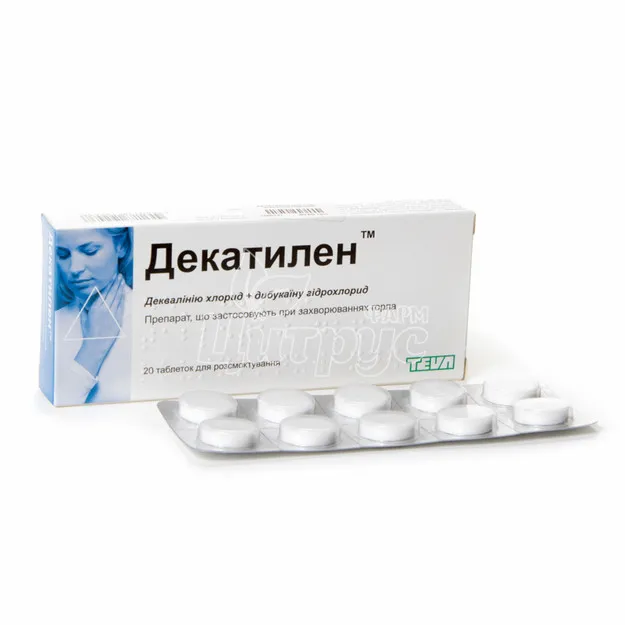
DECATILEN™
UkraineThe drug is used for the local treatment of acute inflammations of the oral cavity and throat, such as gingivitis, stomatitis, tonsillitis, laryngitis, and pharyngitis. It is also recommended for halitosis (bad breath), candidiasis, and during the postoperative period following tooth or tonsil removal.
Frequently asked questions
How should Decatilen™ be taken correctly?
Tablets should be dissolved slowly in the mouth without chewing. For adults and children aged 12 years and older, it is recommended to take 1 tablet every 2 hours, and after symptoms subside, every 4 hours. For children aged 4 years and older, 1 tablet every 3 hours, and after symptoms subside, every 4 hours. The duration of the course is determined by a physician.
What are the possible side effects of Decatilen™?
Allergic reactions may occur, such as rash, itching, burning, or irritation of the oral and throat mucosa. In cases of misuse, ulcers and necrosis may occur in rare instances.
Who should not use this drug?
The drug is contraindicated in individuals with hypersensitivity to its components or an allergy to quaternary ammonium compounds. It should not be used in children under 4 years of age, nor in patients with fructose intolerance syndrome.
Can the drug be taken with diabetes mellitus?
Yes, since the drug does not contain sugar, it can be used by people with diabetes mellitus.
How does the drug interact with other agents?
The antibacterial effect is reduced when used simultaneously with anionic surfactants (e.g., toothpaste). It should also not be combined with cholinesterase inhibitors.
Can the drug be taken during pregnancy or breastfeeding?
Pregnant women may use the drug only after consulting a physician, if the benefit outweighs the risk. Use of the drug during breastfeeding is not recommended.
Instructions for use
INSTRUCTIONS for medical use of the medicinal product Decatylen™
Composition:
Active substances: chlorhexidine dihydrochloride, dibucaine hydrochloride;
1 dispersible tablet contains chlorhexidine dihydrochloride 0.25 mg, dibucaine hydrochloride 0.03 mg;
Excipients: sorbitol (E 420), talc, magnesium stearate, colloidal anhydrous silicon dioxide, peppermint flavor, peppermint oil.
Pharmaceutical form. Dispersible tablets.
Main physicochemical properties: white, round dispersible tablets, bevelled on both sides, with a score line on one side and an imprint "D" on the other.
Pharmacotherapeutic group. Preparations used in throat diseases. ATC code R02A.
Pharmacological Properties
Pharmacodynamics
As a bactericidal and fungistatic agent, dequalinium chloride acts against microorganisms causing mixed infections of the oral cavity and throat. The spectrum of activity of this topical chemotherapeutic agent is broad and includes most Gram-positive and Gram-negative bacteria, as well as fungi, spirochetes, and pathogenic microorganisms responsible for mixed infections of the oral cavity and throat. Accumulation of dibucaine hydrochloride in the body helps to relieve the pain symptoms associated with infections of the oral cavity and throat.
Microorganisms resistant to dequalinium chloride are unknown.
Does not cause caries formation.
Pharmacokinetics
The main active component is absorbed in negligible amounts.
Clinical characteristics.
Indications.
Local treatment of acute inflammatory diseases of the oral cavity and throat: gingivitis, ulcerative and aphthous stomatitis, tonsillitis, laryngitis, and pharyngitis. Decatilen™ is also recommended for use in cases of bad breath.
Decatilen™ can be used in cases of mixed infections of the oral cavity and throat (as recommended by a physician); as an adjunctive agent in the treatment of catarrhal tonsillitis, lacunar tonsillitis, and Plaut-Vincent angina; in cases of oral and pharyngeal candidiasis.
It is recommended in the postoperative period following tonsillectomy and tooth extraction.
Contraindications.
Hypersensitivity to any of the components of the drug. Allergy to quaternary ammonium compounds (e.g., benzalkonium chloride).
Interaction with other medicinal products and other forms of interaction.
The antibacterial activity of dequalinium is reduced when used concomitantly with anionic surfactants, for example, toothpaste. The use of the drug should not be combined with the intake of cholinesterase inhibitors.
Special precautions for use
Since the drug does not contain sugar, it is suitable for use in patients with diabetes mellitus.
The drug contains sorbitol and therefore should not be used in patients with rare hereditary disorders such as fructose intolerance. Use with caution in patients with low plasma cholinesterase levels.
Use during pregnancy or breastfeeding.
Pregnancy
Controlled studies have not been conducted. Under these circumstances, the drug may be used during pregnancy only after consultation with a physician, if the therapeutic benefit outweighs the potential risk to the fetus.
Breastfeeding period
Clinical studies on the passage of active substances into breast milk have not been conducted; therefore, the drug is not recommended for use during breastfeeding.
Ability to influence reaction speed when driving or operating machinery.
Studies on the effect of the drug on the ability to drive vehicles or operate machinery have not been conducted. However, the possibility that the drug may have any negative effect in this regard is highly unlikely.
Method of Administration and Dosage
For adults and children aged 12 years and older
Administer 1 tablet every 2 hours; after reduction of inflammatory symptoms – 1 tablet every 4 hours.
For children aged 4 years and older
Administer 1 tablet every 3 hours; after reduction of inflammatory symptoms – 1 tablet every 4 hours.
The maximum daily dose is 10–12 tablets during the acute phase and 6 tablets after inflammatory symptoms have subsided.
The tablets should be sucked slowly, without chewing. The duration of treatment is determined individually by the physician. The patient should consult a doctor if symptoms persist or worsen after 5 days of treatment with the drug.
Children
The drug in this pharmaceutical form is contraindicated for children under 4 years of age.
Overdose
The drug is generally well tolerated. In case of overdose, nausea and vomiting may occur; in rare cases – ulcers and necrosis of the esophagus.
Treatment of overdose is symptomatic; if necessary, protective (coating) agents may be used.
Inducing vomiting and gastric lavage are not recommended.
Side effects.
Hypersensitivity reactions may occasionally occur after using the medication, such as rash, itching, burning sensation, and irritation of the oral and pharyngeal mucosa. In rare cases, particularly with abuse, ulceration and necrosis may occur. If any unusual reactions occur, discontinue use of the medication and consult a physician immediately for further management.
Shelf life. 3 years.
Storage conditions. Store at a temperature not exceeding 25 °C in a place inaccessible to children.
Packaging. 10 effervescent tablets per blister; 2, 3, or 4 blisters per cardboard box.
Availability. Over-the-counter.
Manufacturers.
Acino Pharma AG.
Balkanpharma-Razgrad AD.
Manufacturers' addresses.
Birsstrasse 2, 4253 Liesberg, Switzerland.
68 Aprilsko Vastanie Blvd, Razgrad 7200, Bulgaria.
Similar drugs
| Brand name | Dosage form | Active substance / Dosage | Manufacturer |
|---|---|---|---|
| AMILAR® IS | tablets, chewable |
|
Interkhim Limited Liability Partnership |
| AMILAR® IS | tablets, chewable |
|
Interkhim Limited Liability Partnership |
| AMILAR® IS | tablets, chewable |
|
Interkhim Limited Liability Partnership |
| CELESTA® DUO | tablets, chewable |
|
PJSC «Pharmaceutical Company «Darnitsa» |
| DECVADOL | tablets, chewable |
|
JSC "Kyiv Vitamin Plant" |
| DECVADOL | tablets, chewable |
|
JSC "Kyiv Vitamin Plant" |
| DECVADOL | tablets, chewable |
|
JSC "Kyiv Vitamin Plant" |
| DECVADOL | tablets, chewable |
|
JSC "Kyiv Vitamin Plant" |
| LARITILEN | tablets, chewable |
|
PJSC "Kyivmedpreparat" |
| LARITILEN | tablets, chewable |
|
PJSC "Kyivmedpreparat" |
| LARITILEN | tablets, chewable |
|
PJSC "Kyivmedpreparat" |
The original data is available in the language of the country of manufacture.
Data source: State Register of Medicinal Products of Ukraine
Data last verified: August 13, 2026