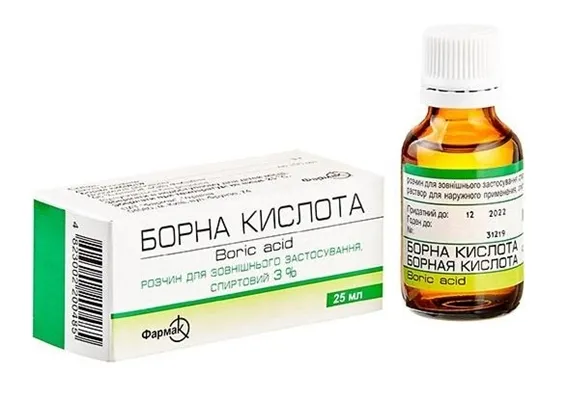
BORIC ACID
UkraineThe drug is used as an antiseptic for pyoderma, weeping eczema, diaper rash, as well as for acute and chronic otitis media.
Frequently asked questions
How should Boric acid be used correctly?
For skin lesions (eczema, diaper rash, pyoderma), the affected areas should be treated 2–3 times a day with a swab soaked in the solution. For otitis, instill 3–5 drops into the ear canal or insert solution-soaked cotton swabs 2–3 times a day.
What are the possible side effects of Boric acid?
Allergic reactions are possible: redness, itching, urticaria, swelling, or rash. In rare cases, anaphylactic shock or epithelial peeling may occur. With prolonged use or in patients with kidney problems, nausea, vomiting, diarrhea, headache, convulsions, or confusion may occur.
Who should not use this drug?
Use is contraindicated in cases of hypersensitivity to boric acid, impaired renal function, traumatic damage to the eardrum, as well as during pregnancy and breastfeeding. The drug is not intended for children.
Can the drug be applied to large areas of the skin?
No, the drug should not be applied to large areas of the skin or used for cavity irrigation. Also, do not allow the solution to come into contact with the eyes.
Does this product interact with other medicines?
Currently, there is no information regarding interactions with other medicinal products; however, you should inform your doctor if you are already taking any other medications.
Instructions for use
INSTRUCTIONS FOR MEDICAL USE OF THE MEDICINAL PRODUCT BORIC ACID (BORIC ACID)
Composition:
Active substance: boric acid;
100 ml of solution contain boric acid – 3 g;
Excipients: ethanol 96%, purified water.
Pharmaceutical form. Alcohol solution for external use.
Main physicochemical properties: clear colorless liquid.
Pharmacotherapeutic group.
Antiseptics and disinfectants. ATC Code D08AD.
Pharmacological properties.
Pharmacodynamics. The medicinal product exerts an antiseptic effect. It coagulates proteins (including enzymes) of microbial cells, disrupts the permeability of the cell membrane, thereby inhibiting the growth and development of bacteria.
Pharmacokinetics. When applied externally, the preparation is absorbed through damaged skin and wound surfaces; if accidentally ingested, it is absorbed through the mucous membrane of the gastrointestinal tract. Boric acid can accumulate in body tissues. It is slowly eliminated from the body.
Clinical characteristics.
Indications.
Pyoderma, weeping eczema, intertrigo, acute and chronic otitis media.
Contraindications.
Hypersensitivity to boric acid, impaired renal function, chronic mesotympanitis with normal or minimally altered mucosa, traumatic perforations of the tympanic membrane; pregnancy and breastfeeding periods, including treatment of mammary glands; children (including newborns).
Special precautions.
Do not apply the drug to large skin areas; do not use for cavity irrigation. Avoid contact with eyes.
Do not violate the rules for using the medicinal product — this may harm health.
Interaction with other medicinal products and other types of interactions.
Interaction is currently unknown.
When using any other medicinal products simultaneously, inform your physician.
Special precautions.
Use during pregnancy or breastfeeding.
The medicinal product is contraindicated in women during pregnancy and breastfeeding.
Ability to affect reaction rate when driving or operating machinery.
No effect.
Method of Administration and Dosage
Apply externally. For pyoderma, intertrigo, and eczema, affected skin areas should be treated with a wipe moistened with the preparation 2–3 times daily.
For otitis, tampons moistened with the solution should be inserted into the external auditory canal, or 3–5 drops should be instilled 2–3 times daily.
Children
The drug is not administered to children.
Overdose
In case of accidental ingestion, perform gastric lavage via a tube, administer saline laxatives and enterosorbents (activated charcoal) orally, as well as symptomatic therapy.
Symptoms of acute poisoning: nausea, vomiting, diarrhea, circulatory disturbances, and central nervous system depression, decreased body temperature, shock, coma, erythematous rash. In cases of severe poisoning, measures should be taken to support vital functions; hemodialysis or peritoneal dialysis, and blood transfusion may be required. With prolonged use of the drug over large skin areas, symptoms of chronic intoxication may develop: tissue edema, exhaustion, stomatitis, eczema, menstrual cycle disturbances in women, anemia, seizures, alopecia. In such cases, the drug should be discontinued and symptomatic treatment initiated.
Side effects
The use of the drug may cause allergic reactions (skin redness, itching, urticaria, rashes, swelling). In isolated cases – development of anaphylactic reactions, including shock; epithelial desquamation.
With prolonged use and in patients with impaired kidney function, nausea, vomiting, diarrhea, headache, confusion, oliguria, and seizures may occur.
If any adverse events occur, consult a physician immediately!
Shelf life: 3 years.
The drug must not be used after the expiry date stated on the packaging.
Storage conditions:
Store at a temperature not exceeding 25 °C. Keep out of reach of children.
Packaging:
20 ml in bottles.
Supply classification:
Over-the-counter (without prescription).
Manufacturer/Applicant:
LLC "DKP "Pharmaceutical Factory".
Manufacturer's address and place of business:
4, Korolyova St., Stanishivka, Zhytomyr District, Zhytomyr Oblast, 12430, Ukraine.
Similar drugs
| Brand name | Dosage form | Active substance / Dosage | Manufacturer |
|---|---|---|---|
| BORIC ACID | solution, alcoholic, for external use |
|
Farmak JSC |
| BORIC ACID ALCOHOLIC SOLUTION 2 % | solution, alcoholic, for external use |
|
Ternofarm LLC |
| BORIC ACID ALCOHOLIC SOLUTION 3 % | solution, alcoholic, for external use |
|
PJSC Pharmaceutical Factory "Viola" |
| BORIC ACID SOLUTION ALCOHOLIC | solution, alcoholic, for external use |
|
PJSC "Fitofarm" |
| BORIC ACID SPIRIT SOLUTION 3 % | solution, alcoholic, for external use |
|
Farmak Cherkasy LLC |
The original data is available in the language of the country of manufacture.
Data source: State Register of Medicinal Products of Ukraine
Data last verified: August 13, 2026