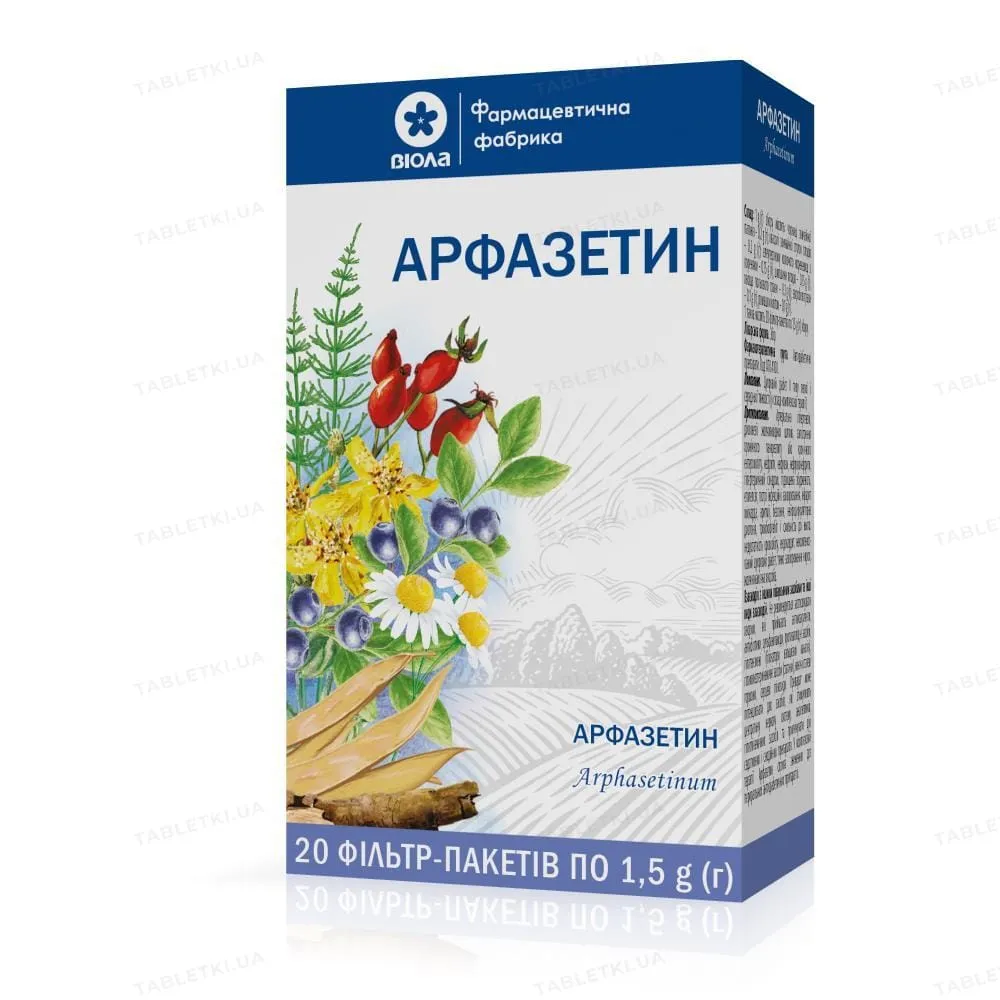
ARFAZETIN
UkraineThe drug is prescribed for the treatment of mild to moderate type 2 diabetes mellitus as part of complex therapy.
Frequently asked questions
How to correctly prepare and take Arfazetin?
To prepare 5 g of the herbal blend, pour 200 ml of hot boiled water over it, infuse in a water bath for 15 minutes, cool for 45 minutes, strain, and top up with water to 200 ml. Take in warm form, 1/3–1/2 cup, 2–3 times a day, 30 minutes before meals, for 20–30 days. Filter bags can also be used: pour 200 ml of boiling water over 2 bags, infuse for 15 minutes, and take 1 cup 2 times a day, 30 minutes before meals. The course lasts 20–30 days and can be repeated after 10–15 days. It is recommended to complete 3–4 courses per year.
Who should not take this drug?
Contraindications include arterial hypertension, gallstone disease, severe kidney disease, biliary tract problems, pancreatitis, enterocolitis, epilepsy, insomnia, myocardial infarction, arrhythmia, thrombophlebitis, as well as pregnancy and breastfeeding.
What are the possible side effects of Arfazetin?
Possible side effects include excitement, sleep disturbances, irritability, increased blood pressure and rapid heartbeat, allergic reactions (rash, itching, edema), and lower back pain or pain during urination. With prolonged use (over 2 months), muscle spasms and digestive problems may occur.
Can the drug be combined with other medicines?
It is not recommended to take it together with anticoagulants, antibiotics, sulfonamides, contraceptives, blood pressure medications (calcium channel blockers), statins, female hormones, and cardiac glycosides. The drug may enhance the effect of agents that stimulate the nervous system and inhibit the effect of sleeping pills.
Can you drive a car during treatment?
Caution should be exercised when driving a car or operating machinery.
Can the drug be given to children?
In children aged 12 years and older, the drug may only be used under strict medical supervision.
Instructions for use
INSTRUCTIONS FOR MEDICAL USE OF THE MEDICINAL PRODUCT ARFAZETIN
Composition:
Active ingredients: blueberry shoots, common bean fruit pods, Eleutherococcus senticosus rhizomes with roots, rosehip fruits, field horsetail herb, St. John's wort herb, chamomile flowers;
1 g of the mixture contains: blueberry shoots – 0.2 g; common bean fruit pods – 0.2 g; Eleutherococcus senticosus rhizomes with roots – 0.15 g; rosehip fruits – 0.15 g; field horsetail herb – 0.1 g; St. John's wort herb – 0.1 g; chamomile flowers – 0.1 g.
Pharmaceutical form. Herbal mixture.
Main physicochemical properties: a heterogeneous mixture of grayish-green fragments with light-yellow, grayish-brown, cream, yellowish-gray, orange-red, brownish-red, brown and white specks; odor weak, pleasant.
Pharmacotherapeutic group. Antidiabetic agents. ATC code A10X.
Pharmacological properties.
Pharmacodynamics.
The components of the herbal mixture contain essential oil, flavonoids, coumarins, polysaccharides, mineral salts, organic acids, tannins, alkaloids, resinous substances, and bitter compounds. This complex of biologically active substances exhibits a hypoglycemic effect in type II diabetes mellitus, making it possible in some cases to reduce daily doses of oral antidiabetic agents and improving carbohydrate tolerance. In type I diabetes mellitus, a significant hypoglycemic effect has not been observed.
Clinical characteristics.
Indications.
Type 2 diabetes mellitus of mild to moderate severity (as part of combination therapy).
Contraindications.
Arterial hypertension, biliary tract dyskinesia, acute exacerbation of chronic pancreatitis or chronic enterocolitis, nephritis, nephroses, nephronephritis, hyperthermic syndrome, increased excitability, epilepsy, acute infectious diseases, myocardial infarction, arrhythmias, insomnia, neurocirculatory dystonia, thrombophlebitis and predisposition to it, circulatory insufficiency, endocarditis, decompensated diabetes mellitus, severe kidney diseases, cholelithiasis.
Interaction with other medicinal products and other forms of interaction.
Use is not recommended in patients taking anticoagulants, antibiotics, sulfonamides, contraceptives, antihypertensive agents (calcium channel blockers), hypocholesterolemic agents (statins), female sex hormones, or cardiac glycosides.
The drug may potentiate the effects of agents stimulating the central nervous system, analeptics, and hypoglycemic agents, and may suppress the effects of sedatives and hypnotics.
In combination therapy, Arfazetin contributes to reducing the doses of oral antidiabetic drugs.
Special precautions for use.
Before use, it is recommended to shake the tincture.
When using Arfazetin in combination with antidiabetic agents, the rules for administration, precautions, and contraindications established for oral antidiabetic drugs should be followed.
Avoid UV radiation exposure during treatment.
Use during pregnancy or breastfeeding. Contraindicated.
Ability to affect reaction rate when driving or operating machinery.
Although there are no data on the effect of Arfazetin on reaction speed, the medicinal product should be used with caution when driving or operating machinery.
Administration and Dosage.
Place 5 g (1 dessert spoon) of the herbal mixture into an enameled container, pour 200 ml (1 cup) of hot boiled water, cover with a lid, and steep in a boiling water bath for 15 minutes. Cool at room temperature for 45 minutes, then strain and squeeze the residue into the strained infusion. Adjust the volume of the infusion to 200 ml with boiled water. Take warm, in doses of ⅓–½ cup, 2–3 times daily, 30 minutes before meals, for 20–30 days.
Before use, the infusion should be shaken.
Place 2 filter packets into a glass or enameled container, pour 200 ml (1 cup) of boiling water, cover and steep for 15 minutes. Take warm, one cup twice daily, 30 minutes before meals, for 20–30 days. After a 10–15 day interval, the treatment course should be repeated. Conduct 3–4 courses per year.
Children. Can be administered to children aged 12 years and older under strict medical supervision.
Overdose. Increased intensity of adverse reactions.
Adverse reactions.
Central nervous system: excitation, sleep disturbances, irritability, anxiety, decreased work capacity.
Skin reactions: allergic reactions including hyperemia, rash, itching, skin swelling, photosensitization.
Cardiovascular system: increased blood pressure, tachycardia.
Urinary system: kidney tissue irritation manifested by lower back pain and pain at the end of urination.
With prolonged use (more than 2 months), the medicinal product may cause muscle spasms and gastrointestinal disturbances.
Shelf life. 2 years.
Storage conditions. Store in original packaging at a temperature not exceeding 25°C.
Keep out of reach of children.
Packaging. 50 g or 75 g in packs with inner pouch; 1.5 g in tea bags, 10 or 20 tea bags per pack.
Availability. Over-the-counter.
Manufacturer: JSC "Pharmaceutical Factory "Viola".
Manufacturer's address: 4 Skladska Street, Zaporizhzhia, Ukraine, 69050.
Marketing authorization holder: JSC "Pharmaceutical Factory "Viola".
Address of the marketing authorization holder: 75 Amosova Akademika Street, Zaporizhzhia, Ukraine, 69063.
Similar drugs
| Brand name | Dosage form | Active substance / Dosage | Manufacturer |
|---|---|---|---|
| ARFAZETIN | herbal mixture |
|
PJSC "Lektravy" |
| SADIFIT | herbal mixture |
|
PJSC "Lektravy" |
The original data is available in the language of the country of manufacture.
Data source: State Register of Medicinal Products of Ukraine
Data last verified: August 13, 2026