APPETISTIM
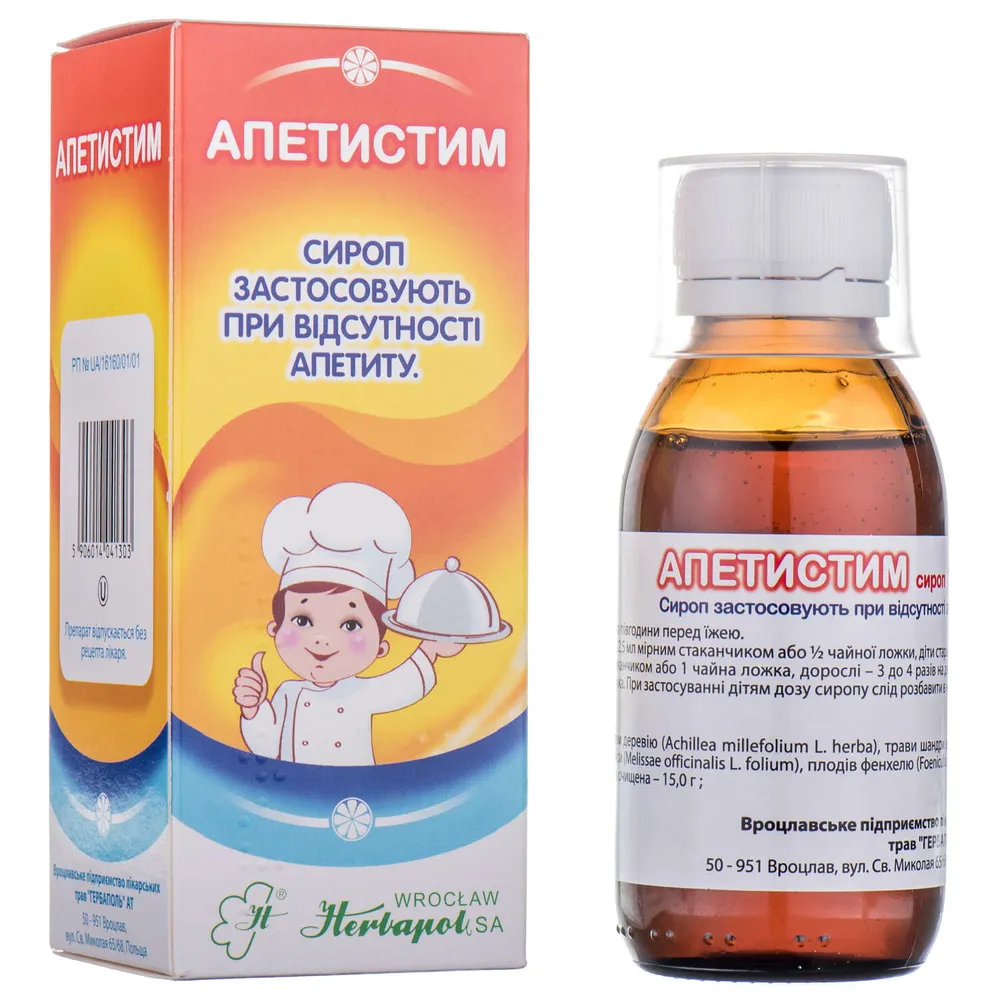
UkraineThe drug is traditionally used for the lack of appetite.
Frequently asked questions
How to take Appetistim correctly?
The syrup should be taken orally approximately half an hour before meals. For adults, it is recommended to take 15 ml 3–4 times a day; for adolescents and children aged 6 years and older, 5 ml 2–3 times a day; and for children aged 3 to 6 years, 2.5 ml 2 times a day. For children, the syrup dose should be diluted in a small amount of water or weak tea.
Who should not take this drug?
It should not be used in case of hypersensitivity to the active substances, excipients, or plants of the Asteraceae family (e.g., chamomile or calendula). The drug is also contraindicated in individuals with rare hereditary disorders involving fructose intolerance, glucose/galactose malabsorption, or sucrase-isomaltase deficiency.
What are the possible side effects of Appetistim?
Possible allergic reactions of the skin and subcutaneous tissue, as well as allergic reactions of the respiratory system.
Can the drug be taken during pregnancy or breastfeeding?
Due to the lack of safety data, this syrup should not be used during pregnancy and breastfeeding.
Does the drug affect the ability to drive a vehicle?
No, the drug does not affect the ability to drive a vehicle or operate other mechanisms.
What to do if symptoms do not disappear?
If symptoms worsen or do not subside within 10 days, you should consult a doctor to consider changing the treatment.
What is the age limit for administration?
The drug should not be used in children under 3 years of age.
Instructions for use
INSTRUCTION FOR MEDICAL USE OF THE MEDICINAL PRODUCT APESTIM
Composition:
Active substances: 100 g of syrup contains a complex liquid extract (1:2) from: yarrow herb (Achillea millefolium L. herba), white horehound herb (Marrubium vulgare L. herba), lemon balm leaves (Melissae officinalis L. folium), fennel fruits (Foeniculum vulgare Mill., fructus) (3/2/3/2), extraction agent — purified water — 15.0 g;
Excipients: orange concentrate, sodium benzoate, sucrose, purified water.
Pharmaceutical form. Syrup.
Main physicochemical properties: liquid, yellowish in color, with sweet-bitter taste and characteristic odor.
Pharmacotherapeutic group. Agents affecting the digestive system and metabolism. Appetite stimulants. ATC code A15.
Pharmacological properties.
The syrup contains an extract of medicinal herbs containing bitter compounds (centaury herb, lemon balm leaves, yarrow herb) and fennel fruits, which enhance gastric juice secretion via reflex pathways. This type of preparation is traditionally used for loss of appetite.
Clinical characteristics.
Indications.
The medicinal product Appetistim is traditionally used in the absence of appetite.
Contraindications.
Hypersensitivity to the active substances, to any excipient, or to plants of the Asteraceae family, for example chamomile, calendula.
Interaction with other medicinal products and other forms of interaction.
Interaction studies have not been performed.
Special precautions for use
Patients with rare hereditary disorders such as fructose intolerance, glucose-galactose malabsorption syndrome, or sucrase-isomaltase deficiency must not take this medicinal product.
Use during pregnancy or breastfeeding
Pregnancy and breastfeeding
Due to the lack of clinical safety data, the syrup should not be used during pregnancy or breastfeeding.
Fertility
No data available.
Ability to influence reaction speed when driving or operating machinery
The medicinal product Apetistim does not affect the ability to drive vehicles or operate machinery.
Method of Administration and Dosage.
Take the syrup orally, approximately half an hour before meals.
A measuring cup is provided in the package to facilitate dosing.
When administering to children, the dose of syrup should be diluted in a small amount of weak tea or water.
Dosage
Children aged 3 to 6 years — 2.5 ml twice daily (using the measuring cup).
Children aged 6 years and adolescents (up to 18 years) — 5 ml 2–3 times daily (using the measuring cup).
Adults — 15 ml 3–4 times daily (using the measuring cup).
Duration of Use
If symptoms worsen or do not resolve within 10 days, consider changing the treatment.
Children.
Do not use in children under 3 years of age.
Overdose.
Cases of overdose have not been reported.
Side effects
The side effects are listed by system organ classes according to the MedDRA classification and by frequency of occurrence: very common (≥ 1/10); common (≥ 1/100 to < 1/10); uncommon (≥ 1/1000 to < 1/100); rare (≥ 1/10,000 to < 1/1000); very rare (< 1/10,000); frequency not known (cannot be estimated based on available data).
The following may occur during the use of Apetistym:
- Skin and subcutaneous tissue disorders (allergic skin reactions) – frequency not known;
- Respiratory, thoracic and mediastinal disorders (allergic reactions of the respiratory system) – frequency not known.
Reporting of suspected adverse reactions
Reporting suspected adverse reactions after authorization of the medicinal product is important, as it allows continued monitoring of the benefit-risk balance of the medicinal product. Healthcare professionals should report any suspected adverse reactions via the national pharmacovigilance system.
Shelf life. 3 years.
Storage conditions.
Store at temperatures not exceeding 25°C. Keep out of the reach of children.
Packaging.
A colored glass bottle containing 125 g of syrup, with an HDPE cap, a measuring cup, and patient leaflet, all packed in a cardboard box.
Authorization category.
Over-the-counter (without prescription).
Manufacturer.
Herbapol Wrocław Pharmaceutical Plant Sp. z o.o.
Manufacturer's address and location of operations.
50-951 Wrocław, ul. Świętego Mikołaja 65/68, Poland.
The original data is available in the language of the country of manufacture.
Data source: State Register of Medicinal Products of Ukraine
Data last verified: August 13, 2026