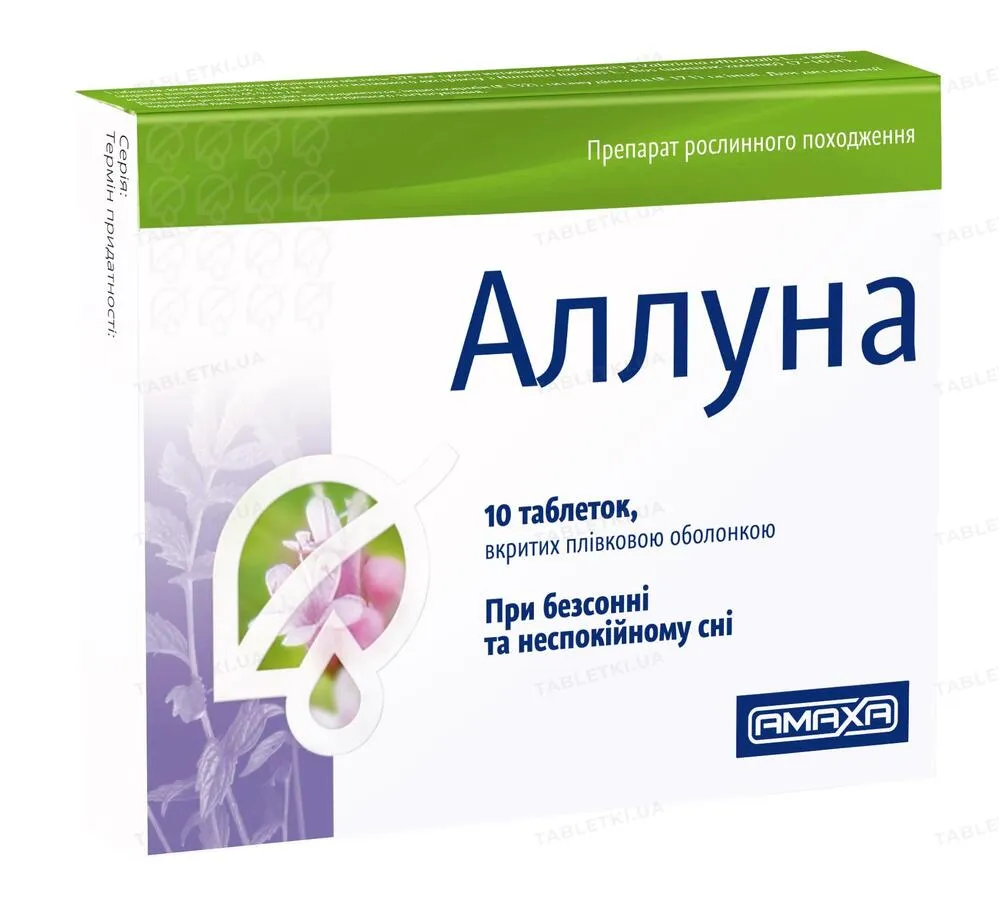
ALLUNA
UkraineThe drug is used to treat sleep disorders, such as difficulty falling asleep, insomnia, and restless sleep.
Frequently asked questions
How should Alluna be taken correctly?
Adults are recommended to take 1 tablet one hour before bedtime, swallowing with water. If necessary, the dose can be increased to 1.5 tablets. To restore normal sleep, the drug should be taken for at least 2 weeks, and for the best results, up to 4 weeks.
Who should not take this drug?
Contraindications include hypersensitivity to the active substances or excipients, as well as depression and other conditions accompanied by depression of the central nervous system. Use in children is not recommended.
What are the possible side effects of Alluna?
Possible gastrointestinal disorders (nausea, vomiting, diarrhea, abdominal cramps), dizziness, drowsiness, general weakness, decreased mental and physical performance, emotional blunting, or depression. Allergic reactions (rash, itching, skin swelling) are also possible.
Can I drive while taking the medication?
It is not recommended to take the drug before driving or operating machinery that could be dangerous.
How does the drug interact with other substances?
The drug may enhance the effects of alcohol, as well as sedatives, hypnotics, analgesics, antispasmodics, and anti-anxiety medications. Combination with synthetic sedatives requires medical supervision.
Can the drug be taken by pregnant or breastfeeding women?
The safety of use during these periods has not been evaluated; therefore, it is not recommended to take the drug without prior consultation with a physician.
Instructions for use
INSTRUCTIONS FOR MEDICAL USE OF THE MEDICINAL PRODUCT Alluna (Alluna®)
Composition:
Active substances: 1 film-coated tablet contains:
375 mg of dry native extract from Valeriana officinalis L., radix (valerian root) (5-8:1),
84 mg of dry native extract from Humulus lupulus L., flos (hops flowers) (7-10:1),
extraction solvent: methanol 45% m/m;
Excipients: colloidal anhydrous silicon dioxide, sodium croscarmellose, hypromellose, indigocarmine (E 132), polyethylene glycol 20000, magnesium stearate, maltodextrin, microcrystalline cellulose, stearic acid, titanium dioxide (E 171).
Pharmaceutical form. Film-coated tablets.
Main physico-chemical properties: pale blue tablets with characteristic valerian odour, elongated shape, convex on both sides, approximately 7 x 20 mm, with a break line on both sides. The tablet may be divided into equivalent doses.
Pharmacotherapeutic group. Hypnotics and sedatives. Other hypnotics and sedatives.
ATC code N05CM.
Pharmacological Properties
Pharmacodynamics
The sedative effects of preparations containing valerian root and hop cones have long been empirically recognized and confirmed in preclinical trials and controlled clinical studies for preparations containing valerian root. To date, no clinical studies have been conducted on hop cone extracts as an active medicinal substance for insomnia. However, at least four randomized, placebo- or comparator-controlled prospective clinical studies have been carried out with fixed combinations of dry extracts obtained from valerian root and hop cones using 45% methanol (m/m).
Oral administration of these fixed combinations of extracts at recommended doses has demonstrated improvement in sleep latency and sleep quality. It is not possible to attribute these effects with high certainty to any specific known components. Several mechanisms of action have been identified for various constituents of valerian root (sesquiterpenoids, lignans, flavonoids), which may contribute to the clinical effect, including interaction with the GABA system, agonism at the A-1 adenosine receptor, and binding to the 5-HT1A receptor. Additionally, several mechanisms of action have been identified for various components of hop cones (bitter acids, flavonoids), including interaction with the GABA system, agonism at melatonin receptors (ML1 and ML2), and binding to serotonin receptor subtypes (5-HT4e, 5-HT6, and 5-HT7).
At present, it is unknown whether hop cone extract acts alone as a mild sedative or functions as a synergist for valerian root extract.
Pharmacokinetics
Data not available.
Clinical characteristics.
Indications.
A herbal medicinal product for the treatment of sleep disorders, such as difficulty falling asleep, insomnia, and restless sleep.
Contraindications.
Hypersensitivity to the active substances or to any of the excipients of this medicinal product.
Depression and other conditions associated with depression of central nervous system activity.
Interaction with other medicinal products and other forms of interaction.
Limited data are available on the pharmacological interaction with other medicinal products.
Clinically significant interaction with drugs metabolized via CYP2D6, CYP3A4/5, CYP1A2, or CYP2E1 pathways has not been observed. Combination with synthetic sedatives requires medical assessment and supervision.
Valerian preparations may enhance the effect of alcohol, sedatives, hypnotics, analgesics, spasmolytics, and anxiolytic drugs.
Special precautions for use.
Patients who have had severe liver function impairment or a history of severe liver disease should use the medicinal product with caution. Alcohol consumption should be avoided during treatment with this product.
Specific sensitivity to the smell of valerian may occur.
This medicinal product contains less than 1 mmol (23 mg)/dose of sodium, i.e. it is practically sodium-free.
Use during pregnancy or breastfeeding.
The safety of using this medicinal product during pregnancy or breastfeeding has not been evaluated. It is not recommended to use any medicinal products during pregnancy or breastfeeding without consulting a doctor.
Ability to affect reaction speed when driving or operating machinery.
Do not take this medicinal product before driving or operating potentially hazardous machinery.
Dosage and Administration
Dosage
Adults
Adults should take 1 film-coated tablet, taken with water, 1 hour before bedtime. If necessary, the dose may be increased to 1 ½ film-coated tablets.
Duration of Use
Due to the gradual onset of therapeutic effect, the fixed combination of valerian root and hop cones is not intended for acute interventional treatment of mild nervous tension or sleep disorders. This herbal medicinal product should be taken for at least 2 weeks to restore normal sleep. For optimal therapeutic effect, continued use for 4 weeks is recommended.
If symptoms persist or worsen after 4 weeks of continuous use, a physician should be consulted.
Administration
For oral use.
Children
Not recommended for use in children.
Overdose
A dose of approximately 20 g of valerian root may cause mild symptoms (increased fatigue, abdominal cramps, sensation of chest tightness, dizziness, hand tremor, and mydriasis), which resolve within 24 hours. Limited information is available on overdose with the fixed combination of valerian root and hop cones. Single cases of ingestion up to 30 tablets per day have been reported without details on adverse reactions. In isolated cases, ingestion of up to 25 tablets per day resulted in symptoms such as atypical abdominal sounds, somnolence, tachycardia, restlessness, and dizziness.
If symptoms occur, treatment should be supportive.
Treatment: symptomatic.
Side effects.
The frequency of side effects is defined according to the following categories:
Very common (≥ 1/10)
Common (≥ 1/100 to < 1/10)
Uncommon (≥ 1/1000 to < 1/100)
Rare (≥ 1/10000 to < 1/1000)
Very rare (< 1/10000)
Not known – cannot be estimated from available data.
Gastrointestinal disorders: gastrointestinal disturbances such as nausea, vomiting, diarrhea, and abdominal cramps. Frequency of occurrence is not known.
Skin and subcutaneous tissue disorders: skin reactions. Occur very rarely.
Central and peripheral nervous system disorders: dizziness, drowsiness, suppression of emotional responses, depression, general weakness, decreased mental and physical performance.
Immune system disorders: hypersensitivity reactions including rash, itching, hyperemia, skin swelling.
If side effects occur that are not described in this instruction for medical use, a physician should be informed.
Shelf life.
3 years.
Storage conditions.
Store at temperatures not exceeding 25 °C in a dry, dark place, out of reach of children.
Packaging.
10 tablets per blister pack, 1 or 3 blister packs per cardboard box.
Prescription status. Over-the-counter.
Manufacturer.
Max Zeller Sohne AG, Switzerland.
Manufacturer's address and place of business.
Seeblickstrasse 4, 8590 Romanshorn, Switzerland.
Marketing authorization holder.
Amaxa Ltd, United Kingdom.
Address of the marketing authorization holder.
31 John Islip Street, London SW1P 4FE, United Kingdom.
Similar drugs
| Brand name | Dosage form | Active substance / Dosage | Manufacturer |
|---|---|---|---|
| ALORA | tablets, film-coated |
|
NOBEL ILAC SANAYI VE TICARET A.S. |
| CORVALTAB EXTRA | tablets, film-coated | Farmas Start LLC | |
| DONORMIL | tablets, film-coated |
|
UPSA SAS |
| DORMIPLANT | tablets, film-coated |
|
Dr. Willmar Schwabe GmbH & Co. KG |
| HYPNOS® | tablets, film-coated |
|
PJSC «Pharmaceutical Company «Darnitsa» |
| NOVO-PASIT | tablets, film-coated | Teva Czech Industries s.r.o. | |
| PERSEN | tablets, film-coated | SOFARMA AD | |
| QUAIT® SOOTHING | tablets, film-coated |
|
Farmak JSC |
| SLEEPEZON | tablets, film-coated |
|
KRKA, d.d., Novo Mesto (manufacturing "in bulk", primary and secondary packaging, quality control and batch release) / KRKA, d.d., Novo Mesto (batch control (only physical and chemical control methods)) |
| SLIPDOX | tablets, film-coated |
|
ASTRAFARM LLC |
| SON-NIGHT | tablets, film-coated |
|
LLC "FARMEKS GROUP" (all manufacturing stages, quality control, batch release) |
| SONMIL | tablets, film-coated |
|
JSC "Kyiv Vitamin Plant" |
The original data is available in the language of the country of manufacture.
Data source: State Register of Medicinal Products of Ukraine
Data last verified: August 13, 2026