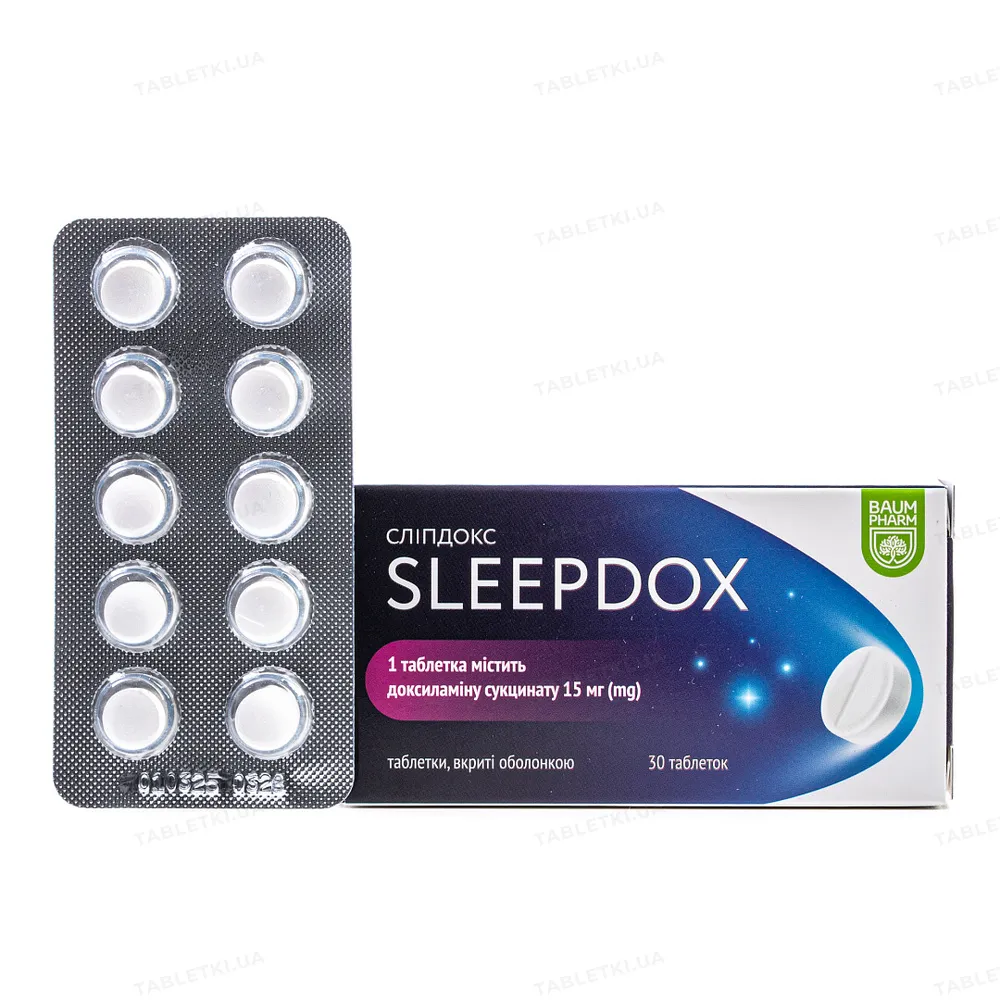
SLIPDOX
UkraineThe drug is used to treat occasional insomnia in adults.
Frequently asked questions
How should Slipdox be taken correctly?
Tablets should be taken orally 15–30 minutes before bedtime. The recommended dose is from half to one tablet (7.5–15 mg) per day. In some cases, the dose may be increased to 2 tablets (30 mg), however, the duration of the course should not exceed 5 days.
Who should not take this drug?
The drug is contraindicated in cases of hypersensitivity to doxylamine or other antihistamines, acute glaucoma, urinary disorders (urethroprostatic disorders), as well as congenital galactosemia or lactase deficiency. It is not recommended for children under 18 years of age.
What are the possible side effects of Slipdox?
Possible side effects include daytime drowsiness, dizziness, slowed reaction time, dry mouth, constipation, palpitations, visual disturbances, confusion, or allergic reactions (rash, itching).
Can the drug be combined with alcohol?
No, alcohol consumption should be avoided while using the drug, as it enhances the sedative effect.
Does the drug affect the ability to drive a car?
Yes, the drug may cause daytime drowsiness and impaired reaction speed, which poses a danger when driving a car or operating machinery. To minimize this risk, a sleep duration of at least 7 hours must be ensured after taking the medication.
Can the drug be taken by elderly people?
Elderly people should use the drug with caution and under medical advice, as there is a possibility of increased concentration of the substance in the body, and a risk of dizziness, cognitive disorders, and falls.
Instructions for use
INSTRUCTIONS FOR MEDICAL USE OF THE MEDICINAL PRODUCT SLEEPDOX (SLEEPDOX)
Composition:
Active substance: doxylamine;
1 tablet contains doxylamine succinate 15 mg;
Excipients: lactose monohydrate; sodium croscarmellose; microcrystalline cellulose; magnesium stearate; coating "Se Coat™" (hypromellose, polyethylene glycol (macrogol) 6000, titanium dioxide (E 171)).
Pharmaceutical form. Film-coated tablets.
Main physicochemical properties: white, round, biconvex film-coated tablets; a cross-section reveals two layers.
Pharmacotherapeutic group.
Antihistamines for systemic use. ATC code R06AA09.
Hypnotics and sedatives. ATC code N05CM.
[END OF TEXT]
Pharmacological Properties
Pharmacodynamics
SLEEPDOX is a sedative agent belonging to the class of ethanolamines and acting as a histamine H1-receptor blocker, exerting sedative and antimuscarinic (M-cholinoblocking) effects. It reduces sleep onset latency, increases sleep duration and improves sleep quality without altering sleep stages.
Pharmacokinetics
Doxylamine succinate is well absorbed from the gastrointestinal tract. Maximum plasma concentration is reached within 2 hours after tablet administration. The mean elimination half-life from plasma is approximately 10 hours.
Doxylamine succinate undergoes hepatic biotransformation. It is partially metabolized in the liver via demethylation and N-acetylation. The elimination half-life may be significantly prolonged in elderly patients or in patients with renal or hepatic impairment. Various metabolites formed during degradation are not quantitatively significant, as 60% of the administered dose is excreted in urine as unchanged doxylamine.
Data regarding the ability of doxylamine succinate to pass into breast milk are lacking; however, such possibility cannot be excluded.
Clinical characteristics.
Indications.
Intermittent insomnia in adults.
Contraindications.
Hypersensitivity to doxylamine succinate or to excipients, or to other antihistamines.
History or family history of acute angle-closure glaucoma.
Urethroprostatic disorders with risk of urinary retention.
Interaction with other medicinal products and other forms of interaction.
Combinations to be avoided.
Alcohol enhances the sedative effect of most H1-antihistamines. Consumption of alcoholic beverages and use of medicinal products containing ethanol should be avoided.
With sodium oxybate, due to enhanced central nervous system (CNS) depression. Impaired reaction speed may pose a danger when driving or operating machinery.
Combinations to be taken into account:
- with atropine and atropine-like medicinal products (imipramine-type antidepressants, most atropine-like H1-antihistamines, anticholinergic antiparkinsonian agents, atropine-like spasmolytic drugs, disopyramide, phenothiazine neuroleptics, as well as clozapine), due to occurrence of adverse effects such as urinary retention, constipation, dry mouth;
- with other sedative medicinal products, morphine derivatives (analgesics; drugs used for cough treatment and substitution therapy), neuroleptics; barbiturates, benzodiazepines; anxiolytics other than benzodiazepines (meprobamate); other hypnotics, sedative antidepressants (amitriptyline, doxepin, mianserin, mirtazapine, trimipramine); sedative H1-antihistamines; centrally acting antihypertensive agents; others: baclofen, thalidomide), due to enhanced central nervous system (CNS) depression. Impaired reaction speed may pose a danger when driving or operating machinery;
- with other hypnotics, due to central nervous system (CNS) depression.
Special precautions for use
Insomnia may have various causes that do not necessarily require the use of medicinal products; therefore, consultation with a physician is recommended before starting treatment with SLIPDOX.
Like all hypnotic or sedative agents, doxylamine succinate may exacerbate sleep apnea syndrome (increasing the number and duration of breathing pauses).
The risk of abuse and development of drug dependence is low. However, cases of abuse and subsequent development of drug dependence have been reported. Signs of abuse or dependence should be carefully monitored. Treatment duration should not exceed 5 days. The use of this medicinal product is not recommended in patients with a history of disorders related to psychoactive substance use.
Doxylamine succinate remains in the body for approximately 5 elimination half-lives (see section "Pharmacokinetics").
The half-life may be significantly prolonged in elderly individuals or in patients with renal or hepatic impairment. With repeated administration, the drug or its metabolites reach a steady state much later and at higher levels. The efficacy and safety of the drug can only be assessed after reaching a steady state.
Dose adjustment may be required (see section "Dosage and administration").
H1-antihistamines should be used with caution in elderly patients due to the risk of cognitive disorders, sedative effects, slowed reaction time, and/or vertigo/dizziness, which may increase the risk of falls (e.g., when getting up at night), potentially leading to serious consequences in this patient population.
In elderly patients and in those with renal or hepatic impairment, increased plasma concentrations and reduced plasma clearance have been observed. A reduced dose of the medicinal product is recommended.
To prevent daytime drowsiness, it is important to remember that the duration of sleep after taking the drug should be at least 7 hours.
Alcohol consumption should be avoided during treatment.
Excipients
The medicinal product contains lactose and is therefore contraindicated in cases of congenital galactosemia, glucose-galactose malabsorption syndrome, or lactase deficiency.
This medicinal product contains sodium croscarmellose. Caution is advised when administering to patients on a sodium-controlled diet.
Use during pregnancy or breastfeeding
Based on available data, doxylamine may be used during pregnancy after consultation with a physician. If this medicinal product is used in late pregnancy, the anticholinergic and sedative properties of this molecule should be taken into account when monitoring the newborn.
It is unknown whether doxylamine passes into breast milk; therefore, the use of this medicinal product is not recommended during breastfeeding.
Effect on ability to drive or operate machinery
Caution should be exercised regarding the risk of daytime drowsiness, which may occur after taking this medicinal product, particularly in individuals who drive vehicles or operate machinery. The risk of impaired reaction speed increases if sleep duration is insufficient.
See section "Interaction with other medicinal products and other forms of interaction".
Dosage and Administration.
For oral use. Take 15–30 minutes before bedtime.
The recommended dose is 7.5–15 mg per day (½–1 tablet per day). If necessary, the dose may be increased to 30 mg per day (2 tablets per day).
In elderly patients and patients with renal or hepatic impairment, a reduced dose is recommended.
The duration of treatment is 2–5 days.
If insomnia persists for more than 5 days, consult a physician regarding the need for continued use of the drug.
Children.
This medicinal product is not recommended for children under 18 years of age.
Overdose.
Symptoms: the initial signs of acute poisoning include drowsiness and anticholinergic effects: excitation, dilated pupils, accommodation paralysis, dry mouth, facial and neck flushing, hyperthermia, and sinus tachycardia. Delirium, hallucinations, and athetoid movements are more commonly observed in children; these may sometimes precede seizures—a rare complication of severe poisoning—or even coma. Even in the absence of seizures, acute doxylamine poisoning may occasionally cause rhabdomyolysis, which can lead to acute renal failure. This muscle disorder is relatively common and requires systematic screening through measurement of creatine phosphokinase activity.
Treatment: administration of activated charcoal (50 g for adults and 1 g/kg for children). Symptomatic treatment should be provided as needed. Anticonvulsants and artificial ventilation of the lungs may be administered when indicated.
Adverse reactions.
In the morning, after evening administration of the drug, delayed reactions and dizziness may occur; therefore, to prevent falling, sudden movements should be avoided. Anticholinergic effects may rarely develop: constipation, dry mouth, tachycardia, urinary retention, visual disturbances (accommodation disorders, blurred vision, hallucinations, visual defects), confusion.
Daytime drowsiness: if this effect occurs, the dose should be reduced.
Allergic reactions are possible, including skin rashes and itching.
Cases of drug abuse and development of drug dependence have been reported.
In addition, it is known that H1-antihistamine medicinal products cause sedative effects, cognitive disorders, and psychomotor activity impairment.
Shelf life. 3 years.
Storage conditions.
Store in the original packaging at a temperature not exceeding 25 °C.
Keep out of reach of children.
Packaging.
10 tablets in a blister; 1 or 3 blisters per carton.
Dispensing category.
№ 10 – over-the-counter.
№ 30 – prescription only.
Marketing Authorization Holder:
TOV "Predstavnytstvo BAUM PHARM GmbH".
Address of the Marketing Authorization Holder.
66, Shyrokа Street, Lviv, 79052, Ukraine.
Manufacturer.
TOV "ASTRAFARM", Ukraine.
Manufacturer's address and place of business.
6, Kyivska Street, Vyshneve, Buchanskyi district, Kyiv region, 08132, Ukraine.
Similar drugs
| Brand name | Dosage form | Active substance / Dosage | Manufacturer |
|---|---|---|---|
| BIOSON | tablets, film-coated |
|
Farmas Start LLC |
| DONORMIL | tablets, film-coated |
|
UPSA SAS |
| HYPNOS® | tablets, film-coated |
|
PJSC «Pharmaceutical Company «Darnitsa» |
| SLEEPEZON | tablets, film-coated |
|
KRKA, d.d., Novo Mesto (manufacturing "in bulk", primary and secondary packaging, quality control and batch release) / KRKA, d.d., Novo Mesto (batch control (only physical and chemical control methods)) |
| SON-NIGHT | tablets, film-coated |
|
LLC "FARMEKS GROUP" (all manufacturing stages, quality control, batch release) |
| SONMIL | tablets, film-coated |
|
JSC "Kyiv Vitamin Plant" |
| SONNIKS® | tablets, film-coated |
|
ASTRAFARM LLC |
The original data is available in the language of the country of manufacture.
Data source: State Register of Medicinal Products of Ukraine
Data last verified: August 13, 2026