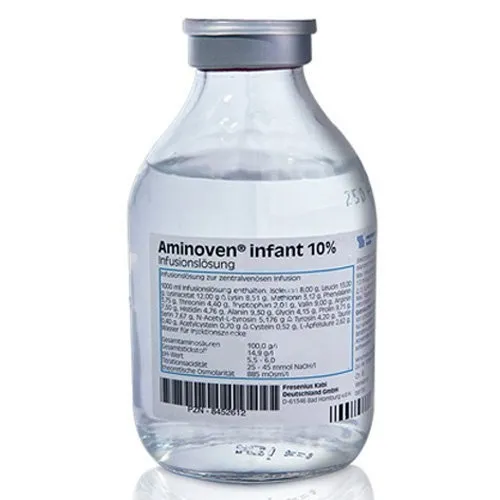
AMINOVEN INFANT 10% SOLUTION FOR INFUSION
SpainIt is an amino acid solution used for partial parenteral nutrition in children. It may also be used for total parenteral nutrition when combined with appropriate amounts of carbohydrates, lipids, vitamins, electrolytes, and trace elements.
Frequently asked questions
How should this medication be administered?
It is administered through an infusion set directly into the bloodstream via continuous intravenous infusion. The exact dose will be determined by the physician according to the patient's weight and clinical condition.
When should Aminoven Infant 10% not be used?
It should not be administered if there is an allergy to its components, congenital abnormalities in amino acid metabolism, severe circulatory problems (shock), lack of oxygen (hypoxia), accumulation of acidic substances in the blood (metabolic acidosis), or very low potassium levels. It should also not be used in cases of decompensated heart failure, fluid accumulation in the lungs, or excess body water.
What side effects can Aminoven Infant 10% cause?
It may cause headache, chills, fever, nausea, or vomiting. Vein inflammation (thrombophlebitis) may also occur if administered through peripheral veins. If an excessive dose is given, vomiting, nausea, chills, and increased excretion of amino acids in the urine may appear.
What should I do if a higher than recommended dose is administered?
If symptoms of overdose occur, the infusion should be slowed or stopped. In case of accidental ingestion or overdose, immediate consultation with a physician or the Toxicology Information Service is required.
Are there interactions with other medications?
To avoid risks of contamination or incompatibility, amino acid solutions should not be mixed with other medications. If it is necessary to add other nutrients (such as vitamins or electrolytes), this should be done cautiously and under hygienic conditions.
How should I store the product?
Keep out of reach of children, at a temperature not exceeding 25°C, without freezing, and protected from light. Do not use if the container is damaged, if the solution is not clear, or if the expiration date has passed.
Instructions for use
Package leaflet: Information for the user
Introduction
PACKAGE LEAFLET: INFORMATION FOR THE USER
Aminoven Infant 10% Infusion solution
Read the entire leaflet carefully before you start using the medicine:
the same symptoms, as it may harm them.
|
In this leaflet:
- What AMINOVEN INFANT 10% is and what it is used for
- Before using AMINOVEN INFANT 10%
- How to use AMINOVEN INFANT 10%
- Possible side effects
- Storage of AMINOVEN INFANT 10%
- Further information
Each liter of solution contains:
L-isoleucine 8.000 g
L-leucine 13.000 g
L-lysine monoacetate 12.000 g = L-lysine 8.51 g
L-methionine 3.120 g
L-phenylalanine 3.750 g
L-threonine 4.400 g
L-tryptophan 2.010 g
L-valine 9.000 g
L-arginine 7.500 g
L-histidine 4.760 g
Glycine 4.150 g
L-alanine 9.300 g
L-proline 9.710 g
L-serine 7.670 g
Taurine 0.400 g
N-acetyl-L-tyrosine 5.176 g = L-tyrosine 4.20 g
N-acetyl-L-cysteine 0.700 g = L-cysteine 0.52 g
L-malic acid 2.620 g
1. What AMINOVEN INFANT 10% is and what it is used for
10% amino acid solution for partial parenteral nutrition in pediatric patients.
This solution may be used for total parenteral nutrition in combination with appropriate amounts of carbohydrates and lipids as an energy source, as well as vitamins, electrolytes, and trace elements.
2. BEFORE USING AMINOVEN INFANT 10%
Do not administer AMINOVEN INFANT 10% if you have:
- an allergy to any of the components present in the solution
- a congenital disorder in amino acid metabolism
- severe circulatory impairment with life-threatening risk (shock)
- inadequate oxygen supply (hypoxia)
- accumulation of acidic substances in the blood (metabolic acidosis)
- excessively low levels of potassium (hypokalemia)
You should not receive infusions if you have:
- decompensated heart failure
- fluid accumulation in the lungs (pulmonary edema)
- excess water in the body (hyperhydration)
If you have any of the conditions listed above, AMINOVEN INFANT 10% must not be administered. Inform the healthcare professional so that this treatment is not given to you.
Take special care with AMINOVEN INFANT 10%
If you experience an allergic reaction during administration of Aminoven Infant 10%, the infusion must be stopped immediately. Inform your doctor or nurse if you develop any of the following symptoms during the infusion:
- Fever (elevated temperature)
- Chills
- Skin rash
- Breathing difficulties
Caution is required in cases of low sodium levels (hyponatremia).
Patients with renal or hepatic insufficiency require individualized dosing.
Daily monitoring at the infusion site for possible signs of inflammation or infection is necessary.
When used in newborns and children under 2 years of age, the solution (in bags and administration sets) must be protected from light exposure until administration is complete. Exposure of Aminoven Infant 10% to ambient light, especially after mixing with trace elements or vitamins, may lead to the formation of peroxides and other degradation products. These can be minimized by protecting the product from light.
Use of other medicines
Inform your doctor or pharmacist if you are using or have recently used any other medicines, including those obtained without a prescription. This includes herbal (medicinal plant) products.
3. HOW TO USE AMINOVEN INFANT 10%
Aminoven Infant 10% will be administered into your blood via an intravenous infusion.
Your doctor will determine your dose based on your body weight and clinical condition.
For physicians and healthcare professionals, please refer to the "Dosage and method of administration" section at the end of this leaflet, which provides detailed information regarding dosage and administration.
When used in newborns and children under 2 years of age, the solution (in bags and administration sets) must be protected from exposure to light until administration is complete (see section 2).
If you receive more AMINOVEN INFANT 10% than you should
As with other amino acid solutions, administration of an overdose of Aminoven Infant 10% or exceeding the recommended infusion rate may result in chills, vomiting, nausea, and increased renal loss of amino acids.
If symptoms of overdose occur, the infusion should be slowed or stopped.
In case of overdose or accidental ingestion, contact your doctor or the Poison Information Service immediately. Telephone (91) 562 04 20.
4. Possible adverse effects
Like all medicines, Aminoven Infant 10% can have adverse effects, although not everyone will experience them.
As with all hypertonic infusion solutions, thrombophlebitis may occur if peripheral veins are used.
Between 1 and 10 out of every 1,000 patients treated may experience headache, chills, fever, nausea, or vomiting. Although these effects are not necessarily related to this solution, they may generally occur with parenteral nutrition, especially at the beginning.
If you consider any of the adverse effects you experience to be severe, or if you notice any adverse effects not listed in this leaflet, inform your doctor or pharmacist.
5. Storage of AMINOVEN INFANT 10%
- Keep out of the reach and sight of children.
- Do not store above 25°C.
- Do not freeze.
- Store protected from light.
- Do not use AMINOVEN INFANT 10% after the expiry date stated on the label after the letters CAD. The expiry date refers to the last day of the month indicated.
- Use AMINOVEN INFANT 10% only if the solution is clear, free from particles, and the container is intact.
Dispose of any unused solution remaining.
- Medicines must not be disposed of via wastewater or household waste. Ask your pharmacist how to dispose of medicines and containers you no longer need. This helps protect the environment.
When used in newborns and children under 2 years of age, the solution (in bags and administration sets) must be protected from light exposure until administration is complete (see section 2).
6. ADDITIONAL INFORMATION
Composition of AMINOVEN INFANT 10% per 1000 ml:
L-isoleucine L-leucine L-lysine monacetate = L-lysine 8.51 g | 13.000 12.000 | 8.000 g g | g | |||
L-methionine L-phenylalanine | 3.750 | g | 3.120 | g | ||
L-threonine | 4.400 | g | ||||
L-tryptophan | 2.010 | g | ||||
L-valine | 9.000 | g | ||||
L-arginine | 7.500 | g | ||||
L-histidine Glycine | 4.760 | g 4.150 | g | |||
L-alanine | 9.300 | g | ||||
L-proline | 9.710 | g | ||||
L-serine Taurine | 7.670 | g 0.400 | g | |||
N-acetyl-L-tyrosine | 5.176 | g | ||||
=L-tyrosine 4.20 g | ||||||
N-acetyl-L-cysteine | 0.700 | g | ||||
=L-cysteine 0.52 g | ||||||
L-malic acid | 2.620 | g |
The other components are: Water for injection and nitrogen
Appearance of the product and contents of the container
Aminoven Infant 10% is a clear solution.
Container sizes:
Glass bottles of 100 ml, 250 ml and 1000 ml. Not all container sizes may be marketed.
Marketing Authorization Holder and Manufacturer
Fresenius Kabi España S.A.U.
C/ Marina 16-18, 08005-Barcelona (Spain)
For any information about this product, please contact the local representative and Marketing Authorization Holder:
Fresenius Kabi España S.A.U.
C/ Marina 16-18,
08005-Barcelona (Spain)
This leaflet has been reviewed in
September 2019
<-------------------------------------------------------------------------------------------------------------------
The following information is intended exclusively for healthcare professionals:
Dosage and method of administration
Aminoven Infant 10% must be administered by continuous intravenous infusion via a central vein.
Maximum infusion rate:
Up to 0.1 g amino acids/kg body weight/hour = 1.0 ml/kg body weight/hour
Maximum daily dose:
- Under 1 year of age: 1.5–2.5 g amino acids/kg body weight = 15–25 ml/kg body weight
- 2–5 years of age: 1.5 g amino acids/kg body weight = 15 ml/kg body weight
- 6–14 years of age: 1.0 g amino acids/kg body weight = 10 ml/kg body weight
The solution should be administered for as long as parenteral nutrition is required.
Method of administration:
When used in newborns and children under 2 years of age, the solution (in bags and administration sets) must be protected from exposure to light until administration is complete.
Warnings and precautions for use
In pediatric parenteral nutrition, frequent laboratory monitoring and assessment are recommended for the following parameters: blood urea nitrogen, ammonia, electrolytes, glucose and triglycerides (in case a lipid emulsion is administered), acid-base balance and fluid balance, liver enzymes, and serum osmolality.
Infusion through peripheral veins may cause irritation of the venous intima and thrombophlebitis. To minimize the risk of venous irritation, daily monitoring of the infusion site is recommended.
Aminoven Infant 10% may be used as part of a total parenteral nutrition regimen, in combination with adequate amounts of energy (carbohydrate solutions, lipid emulsions), electrolytes, vitamins, and trace elements.
Exposure to light of intravenous parenteral nutrition solutions, especially after mixing with trace elements or vitamins, may have adverse effects on clinical outcomes in newborns due to the formation of peroxides and other degradation products. When used in newborns and children under 2 years of age, Aminoven Infant 10% must be protected from ambient light until administration is complete.
Overdose
As with other amino acid solutions, administration of an overdose of Aminoven Infant 10% or exceeding the recommended infusion rate may result in chills, vomiting, nausea, and increased renal loss of amino acids.
In such cases, the infusion must be stopped immediately. Administration may be resumed at a reduced dose. In cases of hyperkalemia, infusion of 200 to 500 ml of 10% glucose solution with the addition of 1–3 U of modified insulin per 3–5 g of glucose is advisable.
If symptoms of overdose occur, the infusion should be slowed or stopped.
Incompatibilities
Due to the increased risk of microbiological contamination and incompatibilities, amino acid solutions should not be mixed with other medicinal products. Therefore, when it is necessary to add other nutrients such as carbohydrates, lipid emulsions, electrolytes, vitamins, or trace elements to Aminoven Infant 10% for complete parenteral nutrition, precautions must be taken, including hygienic mixing, thorough mixing, and knowledge of compatibility.
Aminoven Infant 10% must not be stored after addition of other components.
Instructions for use/handling
For intravenous use only.
Use immediately after opening the vial.
Do not use Aminoven Infant 10% after the expiry date.
Use only clear solutions in intact containers.
Keep out of the reach and sight of children.
For long-term parenteral nutrition with Aminoven Infant 10%, essential fatty acids, vitamins, and trace elements must be supplemented.
When used in newborns and children under 2 years of age, the solution must be protected from exposure to light until administration is complete. Exposure of Aminoven Infant 10% to ambient light, especially after mixing with trace elements or vitamins, generates peroxides and other degradation products, which can be minimized by protecting the product from light.
Shelf life
- Shelf life of the packaged medicinal product for sale
Aminoven Infant 10% has a shelf life of 2 years.
- Shelf life after opening the container
From a microbiological standpoint, unless the method of opening prevents the risk of microbiological contamination, the product should be used immediately.
- Shelf life after mixing with other components
The addition of other components to Aminoven Infant 10% solution prior to administration should be performed under hygienic conditions to ensure proper dispensing. Unless otherwise demonstrated, mixed solutions should be used within 24 hours of preparation.
Similar drugs
The original data is available in the language of the country of manufacture.
Data source: Online Medicines Information Centre (CIMA) — AEMPS
Data last verified: September 21, 2026