AMINOVEN 15% SOLUTION FOR INFUSION
SpainIt is used to provide nutrition through the bloodstream when it is not possible to eat normally. It provides amino acids that the body uses to manufacture proteins and repair muscles, organs, and other structures.
Frequently asked questions
How should this medication be taken?
It is administered via infusion (intravenous drip). The dose, amount, and drip rate will be determined by a doctor according to the needs of each patient.
Who should not use Aminoven 15%?
It should not be used if you are allergic to its components, have protein or amino acid metabolism disorders, metabolic acidosis, renal failure without dialysis, advanced hepatic failure, fluid retention, shock, hypoxia, or decompensated heart failure. It should also not be used in individuals under 18 years of age.
What side effects can Aminoven 15% cause?
If the infusion is too rapid, it may cause loss of potassium or sodium in the blood and folate deficiency. At the injection site, it may cause vein irritation or the formation of a clot (thrombophlebitis). In case of overdose, nausea, vomiting, and chills may occur.
What should I tell my doctor before starting treatment?
You must inform them if you have low potassium or sodium levels, folate deficiency, heart problems, if you are pregnant, breastfeeding, or if you are taking any other medication.
What should I do if an excessive dose is administered?
If you believe too much has been administered, you must inform your doctor or nurse immediately. You can also consult the Toxicological Information Service by calling 91 562 04 20.
Instructions for use
Package leaflet: Information for the user
Introduction
PACKAGE LEAFLET: INFORMATION FOR THE USER
AMINOVEN 15% Solution for infusion
Amino acids
Read all of this leaflet carefully before you start using this medicine, because it contains important information for you:
|
Package leaflet contents:
- What Aminoven 15% is and what it is used for
- What you need to know before using Aminoven 15%
- How to use Aminoven 15%
- Possible side effects
- Storage of Aminoven 15%
- Contents of the pack and other information
1. What Aminoven 15% is and what it is used for
Aminoven 15% is an intravenous infusion solution. It is available in glass bottles of 250 ml, 500 ml, and 1000 ml, and in polypropylene bags with an overpouch of 500 ml and 1000 ml.
Aminoven 15% provides nutritional support through your bloodstream when you are unable to eat normally. It supplies amino acids that your body will use to produce proteins (to build and repair muscles, organs, and other body structures).
Normally, Aminoven 15% is mixed with lipids, carbohydrates, electrolytes, and vitamins, which together meet your total nutritional requirements.
2. What you need to know before using Aminoven 15%
Do not use Aminoven 15%
-
if you are allergic (hypersensitive) to any of the components of Aminoven 15%.
-
if you have disorders of protein or amino acid metabolism
-
if you have metabolic acidosis (acid levels in your body fluids and tissues are too high)
-
if you have renal insufficiency without dialysis or other form of blood filtration
-
if you have advanced hepatic insufficiency
-
if you have fluid retention
-
if you are in shock
-
if you have hypoxia (low oxygen levels)
-
if you have decompensated cardiac insufficiency
Aminoven 15% must not be administered to children or adolescents under 18 years of age.
For children under 2 years of age, pediatric amino acid preparations should be used, formulated to meet differing metabolic requirements.
Warnings and precautions
Inform your doctor if
- you have low levels of potassium in the blood (hypokalemia)
- you have low levels of sodium in the blood (hyponatremia)
- you have a folate deficiency
- you have heart problems (cardiac insufficiency)
Your doctor or healthcare professional will check before administration that the solution is free from particles.
Use of Aminoven 15% with other medicines
Inform your doctor or pharmacist if you are taking or have recently taken any other medicines, including those obtained without a prescription.
Pregnancy and breastfeeding
You must inform your doctor if you are pregnant, think you may be pregnant, or are breastfeeding; your doctor will decide whether Aminoven 15% should be administered.
Driving and using machines
Aminoven 15% does not affect your ability to drive or operate machinery.
3. How to use Aminoven 15%
Follow exactly the administration instructions for Aminoven 15% given by your doctor.
Consult your doctor or pharmacist if you have any doubts.
This medicine will be administered to you by infusion (intravenous drip).
The amount and rate at which the infusion is given will depend on your needs.
Your doctor will decide the correct dose to be administered to you.
You may be monitored during your treatment.
If you use more Aminoven 15% than you should:
It is highly unlikely that you will be given more infusion than required, as your doctor or healthcare professional will monitor you during treatment.
Effects of an overdose may include nausea, vomiting, and chills. If you experience these symptoms or think you have been given too much Aminoven 15%, inform your doctor or nurse immediately.
If you have used more Aminoven 15% than you should, contact your doctor, pharmacist, or call the Toxicology Information Service at telephone number 91 562 04 20, indicating the medicine and the amount used.
If you have any further questions about the use of this medicine, ask your doctor or pharmacist.
4. Possible adverse effects
Like all medicines, this medicine can cause adverse effects, although not everyone will experience them.
The following adverse effects have been observed when the infusion has been administered too quickly:
- Loss of potassium or sodium from the blood
- Folate deficiency
The following adverse effects may occur at the injection site:
- Irritation of the vein
- Thrombophlebitis (formation of a clot) at the site of administration in the vein
Reporting of adverse effects
If you experience any type of adverse effect, consult your doctor, pharmacist, or nurse, even if it is an effect not listed in this leaflet. You may also report them directly through the Spanish Pharmacovigilance System for Human Medicinal Products: www.notificaRAM.es. By reporting adverse effects, you can help provide more information on the safety of this medicine.
5. Storage of Aminoven 15%
Keep this medicine out of the sight and reach of children.
Your hospital doctor and pharmacist are responsible for the proper storage, use, and administration of Aminoven 15%.
Do not freeze and store in the original packaging to protect from light.
Do not use this medicine after the expiry date stated on the container.
Dispose of any unused solution.
Medicines should not be disposed of via wastewater or household waste. Ask your pharmacist how to dispose of medicines and containers you no longer need. This will help protect the environment.
6. Package Contents and Additional Information
Composition of Aminoven 15%
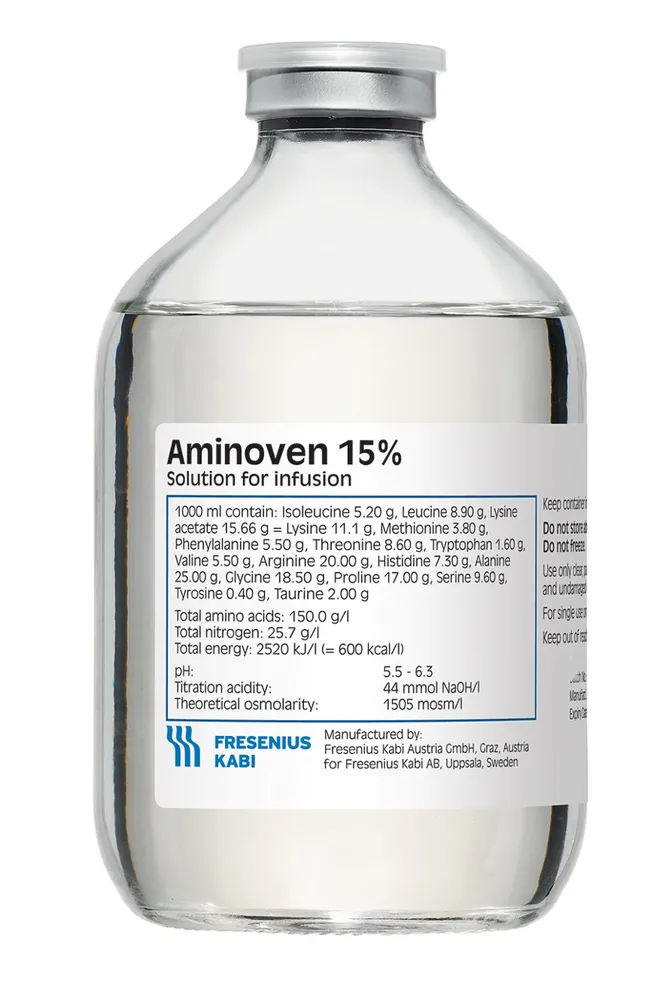
Each 1000 ml of Aminoven 15% contains the following active substances:
Active Substances Quantity (g)
Isoleucine 5.20
Leucine 8.90
Lysine acetate 15.66 (equivalent to 11.1 g of Lysine)
Methionine 3.80
Phenylalanine 5.50
Threonine 8.60
Tryptophan 1.60
Valine 5.50
Arginine 20.00
Histidine 7.0
Alanine 25.00
Glycine 18.50
Proline 17.00
Serine 9.60
Tyrosine 0.40
Taurine 2.00
Aminoven 15% also contains glacial acetic acid, water for injections, and malic acid.
Appearance of the Product and Contents of the Container
Aminoven 15% is available in colorless glass bottles with rubber stopper/aluminum cap containing 250 ml, 500 ml, or 1000 ml of solution.
Not all container sizes may be marketed.
Marketing Authorization Holder and Manufacturer
Marketing Authorization Holder:
Fresenius Kabi Deutschland GmbH
61346 Bad Homburg v.d.H.
Germany
Manufacturers:
Aminoven in glass bottles is manufactured at:
Fresenius Kabi Austria GmbH
Hafnerstraße 36
8055 Graz
Austria
Local Representative:
Fresenius Kabi España SAU
Marina 16-18
08005 Barcelona
Spain
Date of the most recent review of this summary: November 2017.
Detailed and updated information on this medicinal product is available on the website of the Spanish Agency of Medicines and Medical Devices (AEMPS) http://www.aemps.gob.es/
This information is intended exclusively for healthcare professionals:
Dosage and Administration
Daily requirements for amino acids depend on body weight and the patient's metabolic condition.
The maximum daily dose varies according to the patient's clinical condition and may even change from day to day.
The recommended infusion period is to provide continuous infusion for at least 14 to 24 hours, depending on the clinical situation. Bolus administration is not recommended.
The solution should be administered as long as parenteral nutrition is required.
Aminoven 15%
For administration via central venous route as a continuous infusion.
The usual daily dose of Aminoven 15% is 6.7–13.3 ml per kg of body weight (equivalent to 1.0–2.0 g of amino acids per kg of body weight), e.g., corresponding to 470–930 ml of Aminoven 15% for a body weight of 70 kg. The maximum infusion rate is 0.67 ml of Aminoven 15% per kg of body weight per hour (equivalent to 0.1 g of amino acids per kg of body weight per hour).
Maximum daily dose in adults
13.3 ml of Aminoven 15% per kg of body weight/day (equivalent to 2.0 g of amino acids per kg of body weight), e.g., corresponding to 140 g of amino acids for a body weight of 70 kg.
Aminoven 15% is contraindicated in children.
Overdose (symptoms, emergency procedures, antidotes)
As with other amino acid solutions, chills, vomiting, nausea, and increased renal excretion of amino acids may occur if an overdose of Aminoven is administered or if the infusion rate is exceeded. In such cases, infusion must be stopped immediately. Afterwards, treatment may be resumed at a reduced dose.
Too rapid infusion may also cause fluid overload and electrolyte disturbances.
Emergency procedures should consist of general supportive measures, with special attention to respiratory and cardiovascular systems.
Close biochemical monitoring and appropriate management of specific abnormalities are essential.
There is no specific antidote in case of overdose.
Storage
Keep out of the reach and sight of children.
Store the container in its outer carton. Do not store above 25°C. Do not freeze.
Use only if the solution is clear, free from particles, and the container is intact.
Do not use this medicinal product after the expiry date stated on the packaging under the term EXP. The expiry date refers to the last day of the month indicated.
Once the container is opened, the solution should be used immediately with a sterile infusion set. Any unused portion of the solution must be discarded after infusion.
Aminoven may be aseptically mixed with other nutrients such as lipid emulsions, carbohydrates, and electrolytes. Upon request, the manufacturer can provide data on the chemical and physical stability of mixtures stored at 4°C for up to 9 days.
From a microbiological standpoint, total parenteral nutrition (TPN) mixtures prepared under uncontrolled or non-validated conditions should be used immediately. If not used immediately, storage times and conditions prior to use are the responsibility of the user and should normally not exceed 24 hours at a temperature of 2°C to 8°C, unless the mixture was prepared under controlled and validated aseptic conditions.
Similar drugs
The original data is available in the language of the country of manufacture.
Data source: Online Medicines Information Centre (CIMA) — AEMPS
Data last verified: September 21, 2026