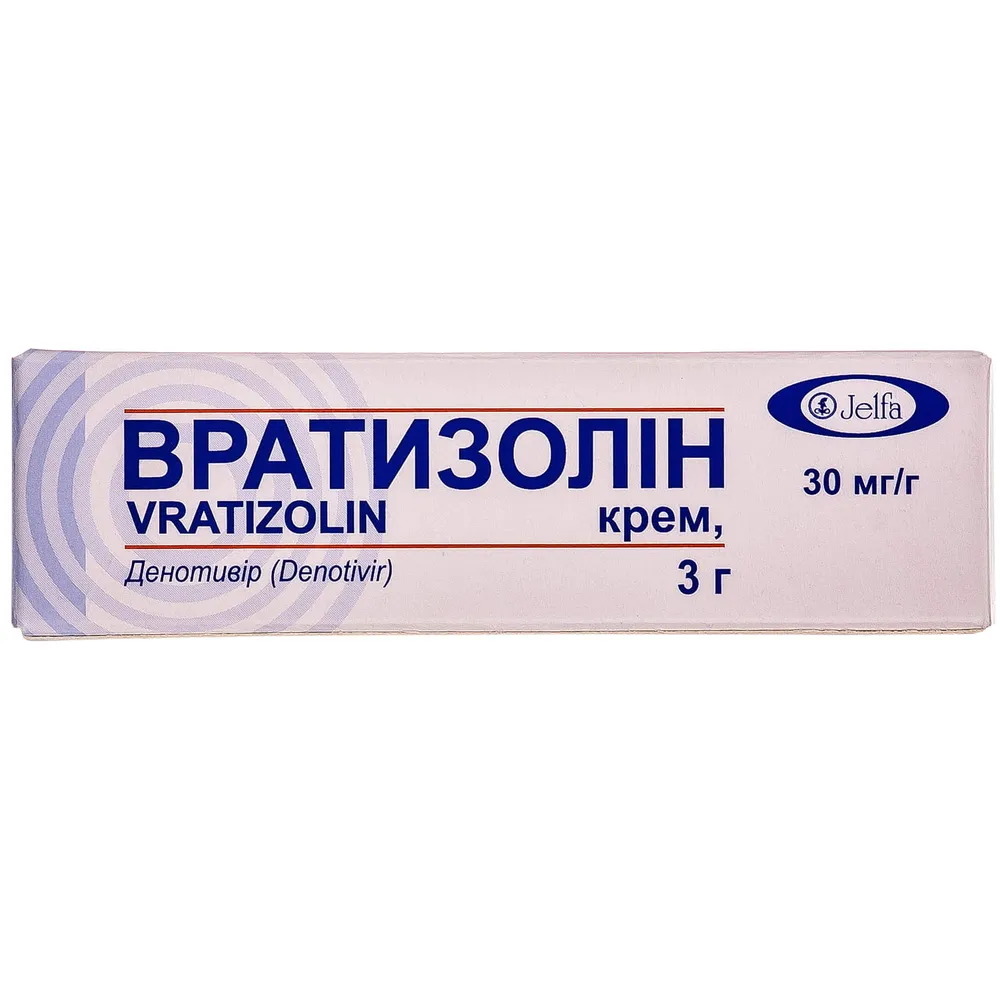
VRATIZOLIN
UkraineThe drug is used to treat herpes on the lips and face caused by the Herpes simplex virus.
Frequently asked questions
How should Vratizolin cream be used correctly?
The cream should be applied in small amounts several times a day directly onto the herpes ulcers. Treatment usually lasts 5 days. It is important to start application as soon as possible after the appearance of the first symptoms, such as itching or burning. Hands must be washed before and after application to avoid spreading the infection.
What are the possible side effects of Vratizolin?
Possible local skin reactions, such as skin irritation at the application site or contact dermatitis. Allergic reactions (hypersensitivity) are also possible.
Who should not use this drug?
The product should not be used by people with increased sensitivity to the active substance or to any other components of the composition.
Where exactly should the cream not be applied?
The cream must not be applied to mucous membranes (for example, in the oral cavity or eyes) and must not be used to treat genital herpes.
Can the drug be used during pregnancy or breastfeeding?
Due to the lack of sufficient data, the use of the drug during pregnancy and breastfeeding is not recommended.
Does the drug affect the ability to drive a vehicle?
No, the drug does not affect reaction speed when driving a vehicle or other mechanisms.
Instructions for use
INSTRUCTION for medical use of the medicinal product | Vratizolin (VRATIZOLIN)
Composition:
Active substance: denotivir;
1 g of cream contains denotivir 30 mg;
Excipients: cetostearyl alcohol, stearyl alcohol, cetyl palmitate 15, white soft paraffin, propylene glycol, methylparaben (E 218), propylparaben (E 216), sodium lauryl sulfate, purified water.
Pharmaceutical form. Cream.
Main physicochemical properties: homogeneous, cream-like mass of white color with a specific odor.
Pharmacotherapeutic group. Chemotherapeutic agents for topical use. Antiviral agents. ATC code D06B B.
Pharmacological properties.
Pharmacodynamics.
Denotivir is the active substance of an antiviral drug for topical use. It inhibits viral replication, including that of Herpes simplex. It reduces the duration of the disease, and when applied during the prodromal period, it may prevent the development of this illness (however, it does not prevent recurrence of Herpes simplex).
Pharmacokinetics.
In cream form, denotivir penetrates into the affected layers of the skin but does not reach deeper layers; therefore, its blood concentration cannot be determined.
Clinical characteristics.
Indications.
Herpes labialis and facial herpes caused by the Herpes simplex virus.
Contraindications.
Hypersensitivity to the active substance or to any of the other components of the medicinal product.
Interaction with other medicinal products and other forms of interactions.
No interactions have been observed under conditions of topical application.
Special precautions for use.
Vratizolin is indicated only for the treatment of herpes that may appear on any area of the lips and face. It must not be applied to mucous membranes, such as the oral cavity or eyes. This medicinal product must not be used for the treatment of genital herpes. Patients with particularly severe forms of herpes labialis require medical consultation. Patients infected with the Herpes simplex virus should be informed about the possibility of virus transmission, especially during periods of active skin lesions. To prevent the spread of infection, avoid friction of skin lesions, for example with a towel. Avoid contact with the eyes when applying the cream to herpes lesions on the lips and face.
Due to the presence of cetyl alcohol and stearyl alcohol, the medicinal product may cause local skin reactions (e.g., contact dermatitis).
The medicinal product contains propylene glycol and may cause skin irritation.
Due to the presence of methylparaben and propylparaben, the medicinal product may cause allergic reactions (possibly delayed).
Use during pregnancy or breastfeeding.
Due to insufficient data on the effects of the medicinal product on pregnancy, use during pregnancy is not recommended.
There are no data available on the passage of denotivir into breast milk; therefore, use of the product is not recommended during breastfeeding.
Ability to influence the speed of reactions when driving vehicles or operating machinery.
The medicinal product does not affect the speed of reactions when driving vehicles or operating machinery.
Method of Administration and Dosage.
Vratizolin is intended for topical application to the skin only. Hands must be washed before and after applying the cream to prevent spreading the infection to other areas of the skin. Treatment of herpes should be initiated as early as possible upon the first symptoms, such as itching and burning. A small amount of cream should be applied several times daily to the herpes lesions. Treatment usually lasts 5 days. Recurrence of the disease is possible in infected patients. In such a case, Vratizolin cream should be applied immediately to prevent the formation of vesicles.
Children.
Data on use in children are lacking.
Overdose.
No cases of overdose have been reported with topical application.
Adverse reactions.
Skin and subcutaneous tissue disorders: Frequency unknown – local reactions such as skin irritation at the application site, contact dermatitis.
Immune system disorders: Frequency unknown – hypersensitivity reactions.
Shelf life. 2 years.
Storage conditions. Store at temperatures not exceeding 25 °C. Keep out of the reach of children.
Packaging. 3 g in a tube; 1 tube in a cardboard box.
Availability. Over-the-counter.
Manufacturer. Elfa Pharmaceutical Plant A.T.
Manufacturer's address.
58-500 Jelenia Góra, ul. Władysława Pola 21, Poland.
The original data is available in the language of the country of manufacture.
Data source: State Register of Medicinal Products of Ukraine
Data last verified: August 13, 2026