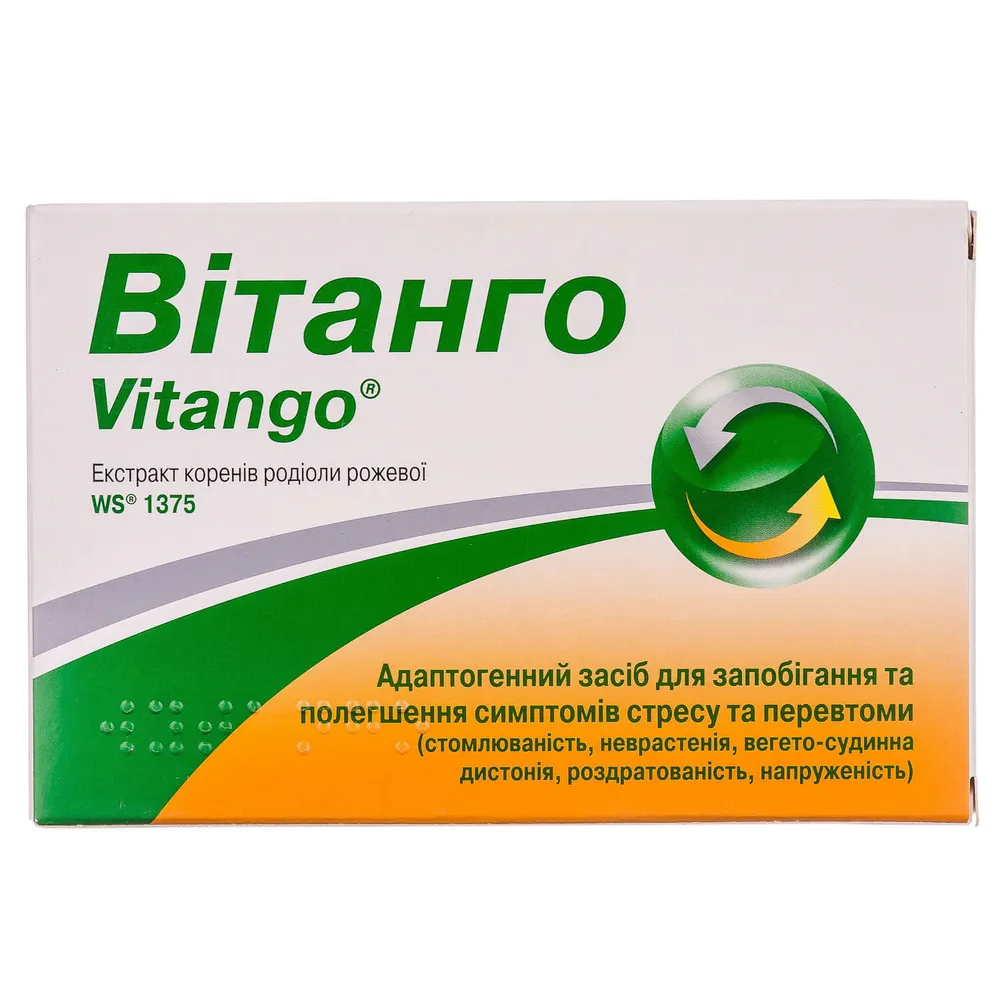
VITANGO
UkraineThe drug is used for the temporary relief of physical and mental symptoms of stress and fatigue, such as irritability, tension, and tiredness.
Frequently asked questions
How should Vitango be taken correctly?
Adults should take 1 tablet twice daily (in the morning and at lunchtime) 30 minutes before meals, swallowing with a glass of water. The duration of the course should be determined by a physician.
What are the possible side effects of Vitango?
Possible side effects include mild headache, dizziness, insomnia, or restlessness. Mild digestive issues (abdominal pain, nausea, diarrhea, vomiting) or allergic reactions (rash, itching) may also occur.
Who should not take this drug?
Contraindications include hypersensitivity to the components of the drug, pregnancy, and breastfeeding. The drug is also not recommended for children under 18 years of age and patients with impaired liver or kidney function.
Can the drug be taken with other medicines?
Data regarding interactions with other medicinal products are unavailable.
What should be done if symptoms do not disappear?
If symptoms persist for more than 2 weeks or worsen during treatment, it is necessary to consult a physician.
Instructions for use
INSTRUCTION FOR MEDICAL USE OF THE MEDICINAL PRODUCT VITANGO (VITANGO®)
Composition:
Active substance: dry extract of rhizome and roots of Rhodiola rosea (Rhodiola rosea);
One film-coated tablet contains 200 mg of dry extract of rhizome and roots of Rhodiola rosea (Rhodiola rosea) (1.5–5:1) (extraction solvent: ethanol 60% m/m);
Excipients: microcrystalline cellulose, sodium croscarmellose, colloidal silicon dioxide, magnesium stearate, hypromellose, stearic acid, iron oxide red (E 172), titanium dioxide (E 171), anti-adherent emulsion: simethicone, methylcellulose, sorbic acid.
Pharmaceutical form. Film-coated tablets.
Main physicochemical properties: round, red film-coated tablets.
Pharmacotherapeutic group.
Tonics. ATC code: A13A.
Pharmacological properties.
Pharmacodynamics.
Rhodiola rosea extract WS® 1375 is an adaptogen that enables the body to adapt to stressful conditions. It exerts its adaptogenic effects by modulating the hypothalamic-pituitary-adrenal axis, which plays a primary role in organizing the body's response to stress. In addition, Vitango normalizes the level and activity of neurotransmitters in the central nervous system. Thus, it eliminates stress-induced disturbances in appetite, locomotor activity, and sexual function in animals, and also enhances cellular energy production by increasing adenosine triphosphate levels.
Clinical studies of Vitango show clinically significant improvement of stress-related symptoms such as physical and mental fatigue, exhaustion, irritability, impaired mood, and concentration after 4–8 weeks of treatment. A 12-week clinical study demonstrated the drug's ability to increase individual stress resistance, thereby reducing the risk of burnout syndrome development. Vitango's capacity to prevent stress was confirmed in another study after 12 weeks of treatment, which showed a positive effect on attention and mental resource allocation in individuals at risk for stress-related symptoms.
Pharmacokinetics.
Data are lacking.
Clinical characteristics.
Indications.
For temporary relief of mental and physical symptoms of stress and fatigue (tiredness, irritability, tension).
Contraindications.
Hypersensitivity to the active substance or to any component of the medicinal product. Pregnancy and lactation.
Interaction with other medicinal products and other forms of interaction.
Data on interactions are lacking.
Special precautions
The medicinal product is not recommended for patients with impaired liver or kidney function due to lack of relevant data.
The product contains less than 1 mmol of sodium (23 mg) per film-coated tablet, i.e. it is practically sodium-free.
Use during pregnancy or breastfeeding.
Contraindicated.
Pregnancy
Data on the use of Vitango in pregnant women are lacking or limited. Animal studies do not indicate harmful effects on human reproductive function.
Lactation
It is unknown whether Vitango or its metabolites are excreted in breast milk. Risk to the breastfed infant cannot be excluded.
Fertility
Animal studies have not revealed any harmful effects on fertility or on embryonic or fetal development.
Dosage and Administration
Adults should take 1 tablet twice daily (in the morning and at noon), 30 minutes before meals, with a glass of water. The duration of treatment is determined individually by a physician.
If symptoms persist for 2 weeks or worsen during treatment, consult a doctor.
Children
The product is not recommended for use in children (under 18 years of age).
Overdose
No cases of overdose have been reported.
Adverse Effects
From the nervous system
Mild headache, restlessness, insomnia, dizziness. Frequency unknown.
From the gastrointestinal tract
Mild gastrointestinal complaints (abdominal pain, diarrhea, nausea, and vomiting). Frequency unknown.
From the skin and subcutaneous tissues / from the immune system
Mild hypersensitivity reactions (allergic reactions such as skin rash and itching). Frequency unknown.
If other adverse reactions occur, consult a doctor.
Reporting suspected adverse reactions after drug registration is of great importance. It enables ongoing monitoring of the benefit-risk balance of the drug. Medical and pharmaceutical professionals, as well as patients or their legal representatives, should report all suspected adverse reactions and lack of drug efficacy via the Automated Pharmacovigilance Information System at: https://aisf.dec.gov.ua.
Shelf life. 5 years.
Do not use after the expiry date stated on the packaging.
Storage conditions. No special storage conditions required. Keep out of reach of children.
Packaging. 15 tablets in a blister pack; 1 or 2 blisters per cardboard box.
Release category.
Over-the-counter (without prescription).
Manufacturer.
Dr. Willmar Schwabe GmbH & Co. KG.
Manufacturer's address and place of business.
Willmar-Schwabe-Strasse 4, 76227 Karlsruhe, Germany.
The original data is available in the language of the country of manufacture.
Data source: State Register of Medicinal Products of Ukraine
Data last verified: August 13, 2026