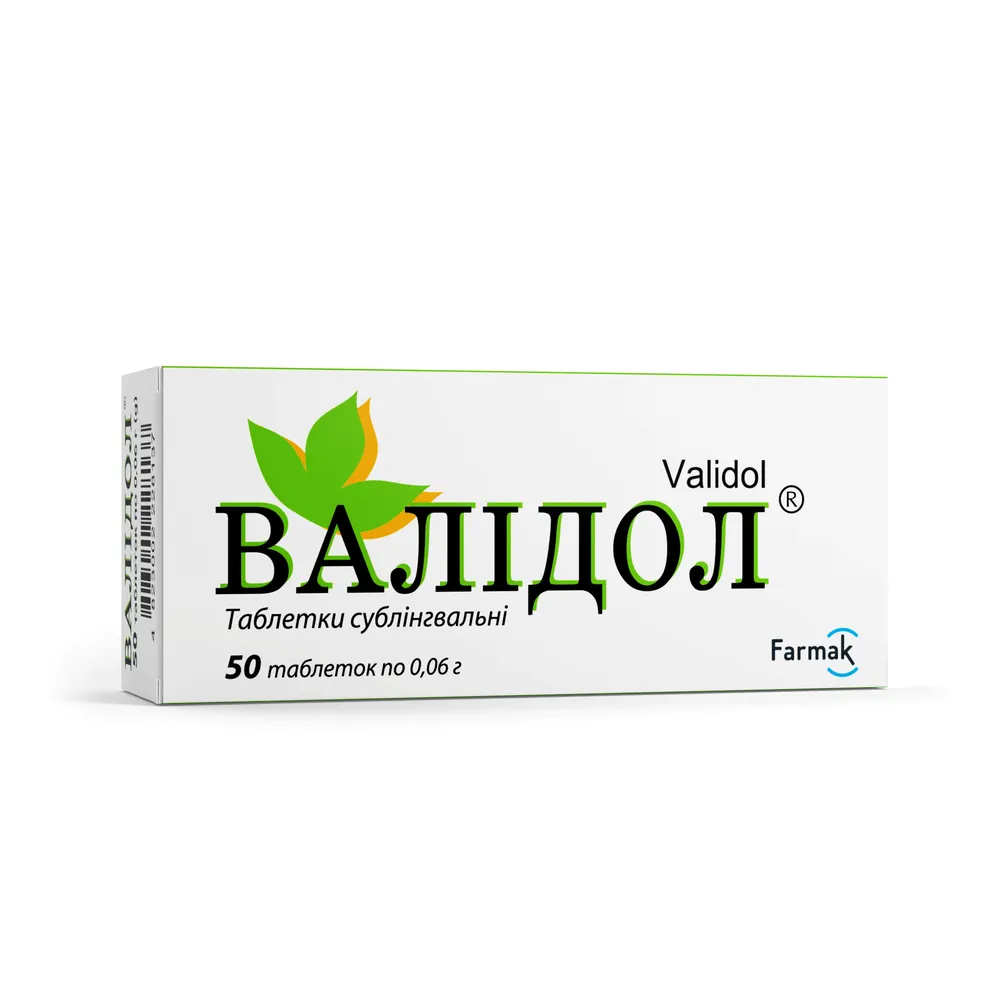
VALIDOL®
UkraineThe drug is used for mild angina attacks, motion sickness (sea and air sickness), hysteria, neurosis, as well as for headaches caused by the intake of nitrates.
Frequently asked questions
How to take Validol® correctly?
Tablets should be held in the mouth under the tongue until they are completely dissolved. Adults are recommended to take 1–2 tablets at a time, with a daily dose of 2–4 tablets (this may be increased if necessary, but not more than 600 mg per day). The course of treatment usually lasts up to 7 days.
When should the drug not be taken?
Contraindications include hypersensitivity to the components of the composition, severe low blood pressure (hypotension), and acute myocardial infarction.
What side effects can Validol® cause?
With prolonged use, nausea, abdominal discomfort, tearing, dizziness, drowsiness, or a short-term drop in blood pressure may sometimes occur. Allergic reactions are also possible: rash, itching, urticaria, or Quincke's edema.
Can the drug be taken with other medicines?
An enhancement of the sedative and blood pressure-lowering effects is possible if the drug is taken simultaneously with other psychotropic or antihypertensive agents, alcohol, opioid analgesics, or anesthetics.
Does the drug affect the ability to drive a vehicle?
Caution should be exercised during the first hours after administration, as dizziness, drowsiness, and slowed reaction times may occur.
Can the drug be taken by people with diabetes mellitus?
Since the drug contains sugar, patients with diabetes mellitus should take this into account when using it.
Instructions for use
INSTRUCTION FOR MEDICAL USE OF THE MEDICINAL PRODUCT VALLIDOL® (Validol®)
Composition:
Active ingredient: 1 tablet contains a solution of menthol in menthyl ester of isovaleric acid (natural menthol – mint extract – 4.9%) – 0.06 g (60 mg);
Excipients: powdered sugar (sugar powder), calcium stearate.
Pharmaceutical form. Sublingual tablets.
Main physicochemical properties: flat cylindrical tablets with beveled edges and a groove, white or yellowish-white in color, with a characteristic odor of menthol. Gray specks and a powdery deposit of sugar powder on the tablet surface are permissible.
Pharmacotherapeutic group.
Cardiological preparations. ATC code C01EX.
Pharmacological properties.
Pharmacodynamics.
The medicinal product exerts a calming effect on the central nervous system and also produces a moderate reflex vasodilating (coronary-relaxing) action by reflex stimulation of sensitive nerve ("cold") receptors in the oral mucosa. Stimulation of these receptors induces the release of endorphins, enkephalins, dynorphins, and other peptides, as well as histamine and kinins, which play an important role in reducing pain sensitivity, normalizing vascular permeability, and regulating other vital mechanisms of the cardiovascular and nervous systems.
Pharmacokinetics.
When administered sublingually, Valiodol® is absorbed through the oral mucosa. The therapeutic effect begins approximately 5 minutes after administration.
Following absorption, it undergoes biotransformation in the liver and is excreted in the urine as glucuronides.
Clinical characteristics.
Indications.
- Angina attacks of mild severity;
- seasickness and airsickness;
- hysteria;
- neurosis;
- headache associated with nitrate intake.
Contraindications.
Hypersensitivity to the components of the drug. Severe arterial hypotension, acute myocardial infarction.
Interaction with other medicinal products and other forms of interaction.
Reduces the intensity of headache caused by nitrates. Potentiation of sedative and antihypertensive effects may occur when used concomitantly with other psychotropic and antihypertensive agents, opioid analgesics, anesthetics, and alcohol.
Special precautions for use.
If chest pain does not subside after taking the medication, it is essential to consult a physician to rule out acute coronary syndrome.
The medicinal product contains sugar, which should be taken into account by patients with diabetes mellitus.
Use during pregnancy or breastfeeding.
The use of the drug during pregnancy or breastfeeding is possible if, in the opinion of the physician, the expected beneficial effect for the mother outweighs the potential risk to the fetus/child.
Ability to influence reaction rate when driving or operating machinery.
Caution is required during the first hours after taking the drug when driving vehicles or performing tasks requiring heightened attention, as dizziness, drowsiness, and reduced psychomotor reaction speed may occur.
Method of Administration and Dosage.
Hold the tablets in the mouth (under the tongue) until completely dissolved.
The single dose for adults is 1–2 tablets; the daily dose is 2–4 tablets.
If necessary, the daily dose may be increased. Maximum daily dose – 600 mg.
Duration of treatment – up to 7 days.
Children.
There is no experience with the use of the drug for the treatment of children.
Overdose.
Symptoms: headache, nausea, excitement, cardiac disturbances, decreased arterial pressure, central nervous system depression.
Treatment: discontinuation of the drug and symptomatic therapy.
Side effects.
Rarely, with prolonged use, mild nausea, abdominal discomfort, lacrimation, dizziness, transient arterial hypotension, and drowsiness may occur; these symptoms quickly resolve spontaneously.
Allergic reactions are possible, including Quincke's edema, urticaria, rashes, and itching.
Shelf life.
2 years.
Do not use the medicinal product after the expiry date stated on the packaging.
Storage conditions.
Store in the original packaging at a temperature not exceeding 15 °C.
Keep out of reach of children.
Packaging.
10 tablets in a blister. 1 or 5 blisters per pack.
10 tablets in a blister, without carton packaging.
Availability. Over-the-counter.
Manufacturer. JSC "Farmak".
Manufacturer's address and place of business.
74, Kyrylivska Street, Kyiv, 04080, Ukraine.
Similar drugs
| Brand name | Dosage form | Active substance / Dosage | Manufacturer |
|---|---|---|---|
| PECHEVSKY VALIKARDOL-NATUR | tablets, sublingual |
|
PJSC "Tekhnolog" |
The original data is available in the language of the country of manufacture.
Data source: State Register of Medicinal Products of Ukraine
Data last verified: August 13, 2026