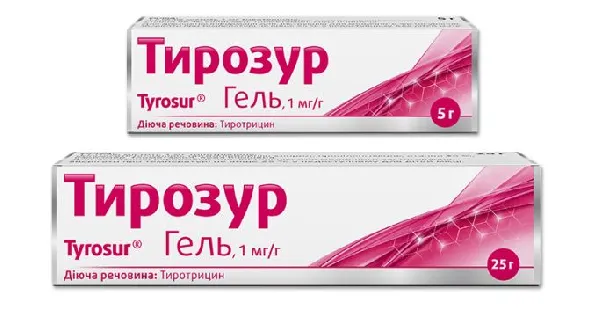
TYROZUR
UkraineThe gel is used for the local treatment of superficial wounds, such as scratches, abrasions, or lacerations, that have minor exudation and signs of infection.
Frequently asked questions
How should Tyrozur be used correctly?
The gel should be applied in a thin layer to the affected areas of the skin 2–3 times daily. Small wounds usually do not require a bandage, but for large or weeping lesions, the use of a protective dressing is recommended, which should be changed every 1–2 days. If there is no improvement after one week, the treatment should be reviewed.
What are the possible side effects of Tyrozur?
Possible skin irritation, a burning sensation, or allergic reactions such as redness (erythema), urticaria, and contact dermatitis.
Who should not use this product?
The product should not be used in case of hypersensitivity to its components. It is also prohibited to administer the gel into the nose, as this may lead to impairment of the sense of smell.
Can the gel be used during pregnancy or breastfeeding?
Due to the lack of sufficient safety data, the use of the product during pregnancy and breastfeeding is not recommended.
Can the product be used in children?
Yes, if necessary, the gel can be used in children of any age.
Does the product affect the ability to drive a vehicle?
No, the product does not affect reaction speed.
Instructions for use
INSTRUCTION FOR MEDICAL USE OF THE MEDICINAL PRODUCT TYROSUR (TYROSUR®)
Composition:
Active substance: tyrothricin,
1 g of gel contains 1 mg of tyrothricin;
Excipients: cetylpyridinium chloride, propylene glycol, 96% ethanol, carbomer, tromethamine, purified water.
Pharmaceutical form. Gel.
Main physicochemical properties: colorless opalescent viscous gel.
Pharmacotherapeutic group. Antibiotics for topical use.
ATC code D06AX08.
Pharmacological Properties
Pharmacodynamics
Tyrothricin is a compound of various cyclic and linear polypeptides exhibiting antibacterial activity, produced as an endotoxin by the anaerobic spore-forming bacterium Bacillus brevis. This compound contains up to 70–80% tyrocidines (mainly cyclic decapeptides) and up to 20–30% gramicidines (neutral linear pentadecapeptides).
It is primarily active against Gram-positive bacteria such as Staph. aureus MSSA, Staph. aureus MRSA, Staph. haemolyticus, Strep. pyogenes, Strep. viridans, Enterococcus faecalis, Diplococcus pneumoniae, Corynebact. spp., Neisseria meningitidis, certain strains of Neisseria gonorrhoeae, fungi, and trichomonads, as well as some Gram-negative bacteria and certain fungal species including Candida.
Tyrothricin exerts dose-dependent bacteriostatic or bactericidal effects against microorganisms such as Clostridia.
The release of substances such as nitrogen and phosphates from bacterial cells ensures the effectiveness of tyrocidine. Similar to cationic detergents, tyrocidine disrupts the osmotic barrier of bacterial cell membranes. Due to its direct action on the bacterial cell wall, the drug's effect is not limited to inhibition of cell growth or division; it also induces the bactericidal effect of tyrocidine.
In addition, gramicidines form cation-selective channels in the bacterial cell membrane, leading to potassium loss and, consequently, changes in intracellular cation concentrations and cytolysis. Furthermore, gramicidines disrupt phosphorylation processes in the cellular respiration chain.
Due to the unique mechanism of action of tyrothricin, which differs from that of systemic antibiotics, cross-resistance does not occur.
Tyrozur gel accelerates wound healing by cleansing the wound bed and stimulating granulation and epithelialization processes.
Pharmacokinetics
The extent to which tyrothricin may be systemically absorbed is unknown. High concentrations have been detected in the stratum corneum of the skin (after application to intact skin) and directly within the wound.
Clinical characteristics.
Indications.
Local treatment of superficial wounds with minimal exudate and presence of superinfection caused by pathogens sensitive to tyrothricin, such as lacerated wounds, scratches, abrasions.
Contraindications.
Hypersensitivity to the components of the drug.
Contraindicated for intranasal use; there have been reports that this route of administration may lead to olfactory disturbances.
Interaction with other medicinal products and other forms of interactions.
Unknown.
Special precautions for use.
Caution is necessary when applying to areas around the eyes, as this may cause a burning sensation.
Tirozur gel contains propylene glycol, which may cause skin irritation.
Use during pregnancy or breastfeeding.
There are no data on the effects of Tirozur gel during pregnancy. Adequate studies on the effects of tyrothricin and cetypyridinium chloride on reproductive function in animals have not been conducted. The potential risk to humans is unknown; therefore, Tirozur gel should not be used during pregnancy.
It is unknown whether tyrothricin or cetypyridinium chloride passes into breast milk; therefore, the product should not be used during breastfeeding.
Ability to affect reaction speed when driving or operating machinery.
No effect.
Method of administration and dosage.
Apply the gel 2–3 times daily in a thin layer to the affected areas of the skin. For minor wounds and skin inflammations on exposed areas of the body, covering them is usually not necessary. In cases of extensive injuries or weeping wounds, a protective dressing is recommended, which should be changed every 1–2 days.
The duration of treatment is determined individually, depending on the course of the disease. If no improvement is observed after one week of using the medication, the treatment should be reassessed.
Children.
If necessary, Tyrozur gel can be used in children of any age.
Overdose.
No cases of overdose have been reported.
Side effects.
Skin irritation, burning sensation, allergic reactions including erythema, urticaria, contact dermatitis.
Shelf life.
3 years.
Do not use after the expiry date stated on the packaging.
Shelf life after first opening of the tube – 3 months.
Storage conditions.
Store at a temperature not exceeding 25 °C, in a place inaccessible to children.
Packaging.
5 g or 25 g of gel in a tube; 1 tube in a cardboard box.
Supply category.
Over-the-counter.
Manufacturer.
Engelhard Arzneimittel GmbH & Co. KG.
Manufacturer's address and place of business.
Herzbergstrasse 3, 61138 Niederdorfelden, Germany.
The original data is available in the language of the country of manufacture.
Data source: State Register of Medicinal Products of Ukraine
Data last verified: August 13, 2026