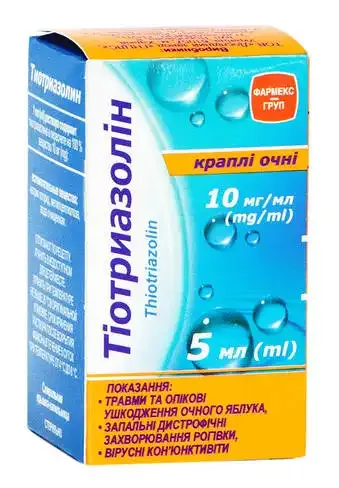
THIOTRIAZOLIN
UkraineThe drug is used for injuries and burns of the eyeball, inflammatory dystrophic diseases of the cornea, and viral conjunctivitis. It is also used to prevent eye inflammation and reduce eye strain in people who work at a computer.
Frequently asked questions
How should Thiotriazolin be used correctly?
Instill 2 drops into the conjunctival sac of the affected eye 3–4 times a day. The course of treatment usually lasts 14–15 days, but may be extended to 30 days if necessary. The vial must be warmed to room temperature before use.
What are the possible side effects?
The drug is usually well-tolerated, but reactions may occur at the site of application. In case of individual sensitivity, allergic reactions such as itching or redness (hyperemia) may occur, and cases of rhinitis have also been reported.
Who should not use this drug?
The drug should not be used in case of hypersensitivity to its components. It is also not recommended for children, as there is no experience regarding its use in this age group.
How should I use the drops if I work at a computer?
Instill 2 drops immediately before starting work, and then repeat the procedure every 2 hours. The exact duration of use should be determined by a physician.
Can the drug be used during pregnancy or breastfeeding?
There are no contraindications for use during this period.
Instructions for use
INSTRUCTIONS FOR MEDICAL USE OF THE MEDICINAL PRODUCT THIOTRIZOLIN (THIOTRIZOLIN)
Composition:
Active substance: thiotriazolin;
1 ml of solution contains 10 mg of morpholine salt of thiazotic acid (thiotriazolin),
calculated as 100% substance; 1 ml of solution contains 20 drops;
Excipients: sodium chloride, methylcellulose, water for injections.
Pharmaceutical form. Eye drops.
Main physicochemical properties: slightly opalescent, colorless or slightly yellowish liquid.
Pharmacotherapeutic group. Ophthalmological agents. ATC code S01X A.
Pharmacological properties.
Pharmacodynamics.
The pharmacological effect of tiotriazolin is due to activation of the antioxidant enzyme system and inhibition of lipid peroxidation processes in ischemic areas of ocular tissues, reduction of severity of neurotrophic disorders, increased intensity and rate of reparative processes, decreased tissue inflammatory response, and improvement of blood flow in the ocular microcirculatory system. The drug promotes early recovery of corneal sensitivity, formation of more delicate opacity, significant reduction in the number of various complications, reduces symptoms of visual asthenopia, improves functional parameters of the ciliary muscle and central retinal areas, thereby enhancing ocular functional capacity.
Pharmacokinetics.
Not studied.
Clinical characteristics.
Indications.
Injuries and burns of the eyeball, inflammatory dystrophic diseases of the cornea, viral conjunctivitis. For prevention of eye inflammations and reduction of visual asthenopia symptoms in individuals working with personal computers.
Contraindications.
Hypersensitivity to the drug.
Interaction with other medicinal products and other forms of interaction.
Unknown.
Special precautions.
None.
Use during pregnancy or breastfeeding.
No contraindications.
Ability to affect reaction speed when driving or operating machinery.
No effect.
Method of Administration and Dosage
The drug is administered starting from the first days of the disease as instillations of 2 drops 3–4 times daily into the conjunctival sac of the affected eye.
Thiotriazoline instillations should be carried out for 14–15 days. If necessary, the treatment course may be extended up to 30 days.
For individuals working with personal computers, the drug is administered as instillations of 2 drops immediately before starting work, followed by every 2 hours. The duration of use should be determined individually by a physician.
Since the drug must be stored at 2–8 °C after opening the bottle, it should be warmed to room temperature prior to administration.
Children.
There is no experience with use in children; therefore, the drug is not recommended for this age group.
Overdose.
Overdose is impossible when recommended doses are followed.
Side effects.
The drug is usually well tolerated; injection site reactions may occur. In cases of increased individual sensitivity, allergic reactions are possible, including itching and hyperemia.
Cases of rhinitis have been reported.
Shelf life. 2 years.
After opening the vial, store at a temperature between 2 °C and 8 °C for 5 days.
Storage conditions.
Store in the original packaging at a temperature not exceeding 25 °C.
Keep out of reach of children.
Packaging. 1 vial with dropper cap per carton.
Prescription status. Prescription only.
Manufacturer. JSC "Kyivmedpreparat".
Manufacturer's address and location of activity.
139 Saksahanskoho Street, Kyiv, 01032, Ukraine.
Similar drugs
| Brand name | Dosage form | Active substance / Dosage | Manufacturer |
|---|---|---|---|
| OFTAN® CATACHROM | drops, ophthalmic | Santen AG (manufacturer responsible for batch release) | |
| OKOFERON® | drops, ophthalmic |
|
FZ "STADA" LLC |
| TAUFON | drops, ophthalmic |
|
LLC "Research Plant "GNCLS" (all manufacturing stages, quality control, batch release) |
| TAUFON | drops, ophthalmic |
|
Farmak JSC |
| THIOTRIAZOLIN | drops, ophthalmic |
|
LLC "Research Plant "GNCLS" (all manufacturing stages, quality control, batch release) |
The original data is available in the language of the country of manufacture.
Data source: State Register of Medicinal Products of Ukraine
Data last verified: August 13, 2026