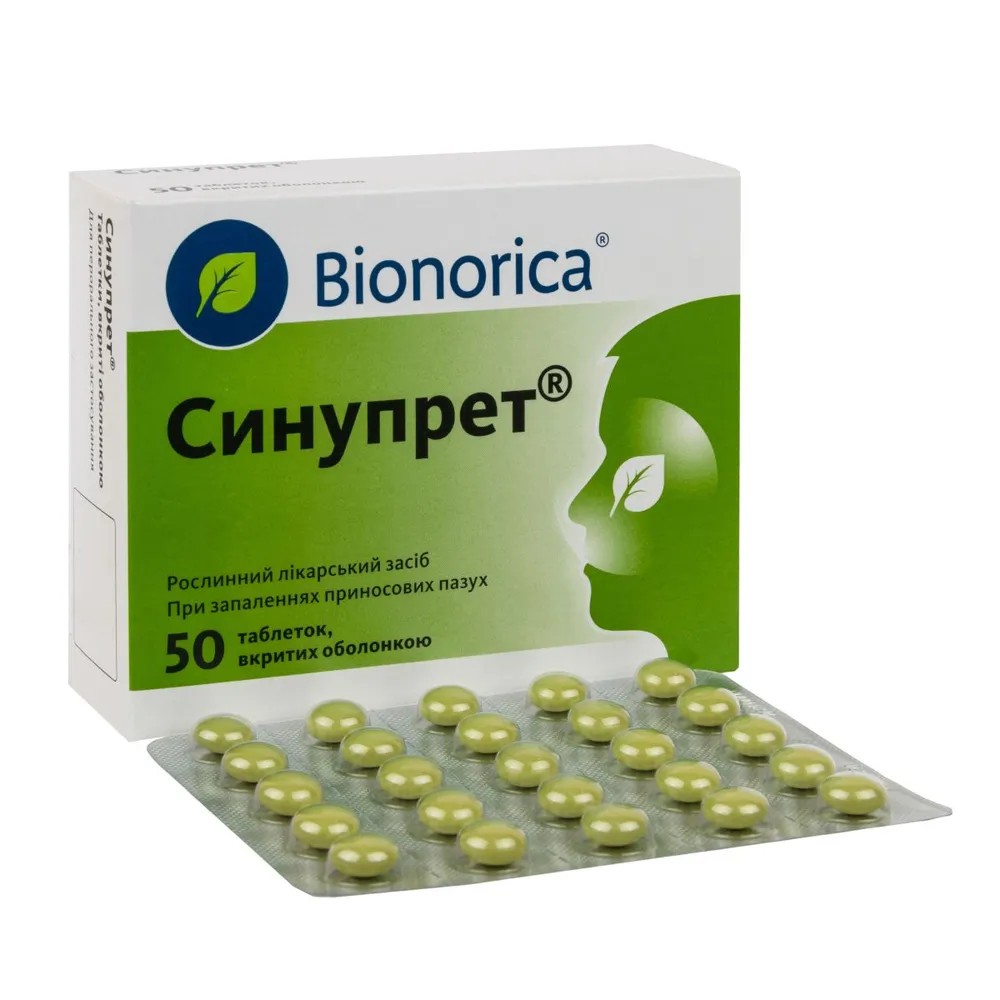
SINUPRET
UkraineThe drug is used for the treatment of acute and chronic inflammation of the paranasal sinuses.
Frequently asked questions
How should Sinupret be taken correctly?
Adults and children aged 12 years and older should take 2 tablets 3 times a day, and children aged 6 to 11 years should take 1 tablet 3 times a day. Tablets should be swallowed whole, without chewing, and taken with a sufficient amount of water. Typically, the course of treatment lasts from 7 to 14 days.
Who should not take this drug?
The drug must not be taken in case of hypersensitivity to its components or to other types of primrose, as well as in case of peptic ulcer. It is also contraindicated for people with glucose-galactose malabsorption, sucrase-isomaltase deficiency, or hereditary fructose, galactose, or lactose intolerance.
What side effects can Sinupret cause?
Gastrointestinal disorders may occasionally occur (stomach pain, nausea, diarrhea, vomiting, abdominal discomfort). Allergic reactions are also possible: rash, itching, skin redness, Quincke's edema, shortness of breath, or facial swelling.
Can the drug be taken together with other medicines?
No interactions with other agents have been observed; however, combination with antibiotics is possible and advisable.
Can the drug be taken by people with stomach problems or diabetes?
People with gastritis or a 'sensitive stomach' should take the drug after meals, drinking a sufficient amount of fluid. For patients with diabetes mellitus, it is important to know that 1 tablet contains an average of 0.01 carbohydrate units.
Can the drug be used in children under 6 years of age?
The use of tablets is not recommended for children under 6 years of age due to insufficient experience. For preschool children, it is better to use Sinupret in the form of drops or syrup.
Instructions for use
INSTRUCTIONS FOR MEDICAL USE OF THE MEDICINAL PRODUCT SİNUPRET® (SINUPRET®)
Composition:
Active substances: 1 tablet contains dried medicinal plants in the form of powder:
Gentian root (Radix Gentianae) 6 mg,
Primrose flowers with calyx (Flores Primulae cum Calycibus) 18 mg,
Sorrel herb (Herba Rumicis) 18 mg,
Elder flowers (Flores Sambuci) 18 mg,
Verbena herb (Herba Verbenae) 18 mg;
Excipients: calcium carbonate (E 170), ricinus oil, colloidal anhydrous silicon dioxide, acrylic copolymer, gelatin, glucose, lactose monohydrate, light magnesium oxide, aluminium hydroxide, copper chlorophyllin (E 141), riboflavin (E 101), corn starch, dextrin, glycol montan wax, potato starch, purified water, shellac, sorbitol (E 420), stearic acid, sucrose, talc, titanium dioxide (E 171), indigo carmine (E 132).
Medicinal form. Coated tablets.
Main physical and chemical properties: round, biconvex, coated tablets of green color with a smooth surface.
Pharmacotherapeutic group. Preparations used for cough and colds. ATC code R05X.
Pharmacological properties.
The components contained in the herbal medicinal product have a complex activity, manifested as secretolytic, anti-edematous, anti-inflammatory, immunostimulatory, and antiviral effects.
The active components of the medicinal product Sinupret**®** inhibit replication of various respiratory viruses, such as influenza virus A, parainfluenza virus, and RSV (respiratory syncytial viruses).
Under the influence of the drug, secretion is regulated and tissue edema is reduced. Drainage and ventilation of the nasal sinuses are restored, nasal congestion is relieved, and the protective function of the respiratory epithelium is normalized. The efficacy of antibiotic therapy is enhanced.
Clinical characteristics.
Indications. Acute and chronic inflammation of the paranasal sinuses.
Contraindications. Hypersensitivity to any of the active or excipient components of the drug, to other species of primrose, as well as peptic ulcer.
Interaction with other medicinal products and other forms of interaction. No interaction with other medicinal products has been observed. Combination with antibiotics is possible and advisable.
Special precautions for use.
Medical consultation is recommended if the patient experiences pronounced symptoms of severe rhinosinusitis, such as epistaxis (nosebleeds), fever, severe pain, purulent nasal discharge, visual disturbances, facial asymmetry involving the midface or eyes, or facial numbness, as emergency medical treatment may be required.
If symptoms persist for more than 7–14 days, worsen, or recur periodically, the patient should consult a physician.
Particular caution is required when administering the medicinal product to patients with gastritis or functional dyspepsia (so-called "sensitive stomach"). The drug should be taken after food with sufficient fluid (e.g., a glass of water).
The drug contains glucose, lactose, sucrose, and sorbitol. Therefore, it should not be administered to patients with hereditary fructose intolerance, galactose intolerance, lactase deficiency, glucose-galactose malabsorption, or sucrase-isomaltase deficiency.
Note for diabetic patients. One coated tablet contains on average 0.01 bread units.
Use during pregnancy or breastfeeding. The drug should be used during pregnancy or breastfeeding only with caution and strictly after a physician has established a diagnosis and evaluated the benefit-risk ratio for the mother and potential risk to the fetus (child).
Ability to influence reaction speed when driving or operating machinery. No special warnings apply.
Dosage and Administration.
Unless otherwise prescribed by a physician, the recommended dose for adults and children aged 12 years and older is 2 tablets three times daily. For children aged 6 to 11 years, the dose is 1 tablet three times daily.
The tablets should be swallowed whole, without chewing, with sufficient liquid.
The usual recommended duration of treatment is 7–14 days.
Follow the recommendations provided in the "Special Instructions" section of the leaflet.
Children. Due to insufficient experience, use in children under 6 years of age is not recommended. For the treatment of preschool-aged children (under 6 years) requiring lower doses, Sinupret in the form of drops or syrup should be used.
Overdose. Cases of overdose have not been reported to date. If the recommended dose is exceeded, the described adverse reactions may be intensified; in such a case, consult a physician.
If doses exceeding those recommended are taken, inform the physician so that appropriate measures may be initiated.
Side effects.
Gastrointestinal disorders are observed infrequently, including stomach pain, nausea, diarrhea, vomiting, and abdominal discomfort. Hypersensitivity reactions are possible, including rash, skin redness, itching, urticaria, Quincke's edema, dyspnea, and facial swelling.
If any adverse reactions occur, discontinue use of the medicinal product and consult a physician.
Shelf life. 3 years.
Do not use after the expiry date stated on the packaging.
The shelf life indicates that the product may be used until the last day of the stated month.
Storage conditions. Store in the original packaging at a temperature not exceeding 30 °C, in a place inaccessible to children.
Packaging. 25 tablets in a blister; 2 blisters per cardboard box.
Availability category. Over-the-counter (without prescription).
Manufacturer/Applicant.
Bionorica SE / Bionorica SE.
Address of manufacturer and place of business / Address of applicant and/or applicant's representative.
Kerschensteinerstrasse, 11-15, 92318 Neumarkt, Germany / Kerschensteinerstrasse, 11-15, 92318 Neumarkt, Germany.
Contact details of the manufacturer's representative in Ukraine, LLC "Bionorica":
Phone: 044 521 86 00; Fax: 044 521 86 01; Email: [email protected]
Similar drugs
| Brand name | Dosage form | Active substance / Dosage | Manufacturer |
|---|---|---|---|
| BRONCHIPRET® N | tablets, film-coated |
|
Bionorica SE (primary and secondary packaging, control (physico-chemical, microbiological) and batch release) |
| BRONCHIPRET® TP | tablets, film-coated |
|
Bionorica SE (primary and secondary packaging, quality control and batch release) |
| SINUPRET® EXTRACT | tablets, film-coated | Bionorica SE (primary and secondary packaging, quality control and batch release) | |
| SINUPRET® FORTE | tablets, film-coated | Bionorica SE (primary and secondary packaging, quality control and batch release) |
The original data is available in the language of the country of manufacture.
Data source: State Register of Medicinal Products of Ukraine
Data last verified: August 13, 2026