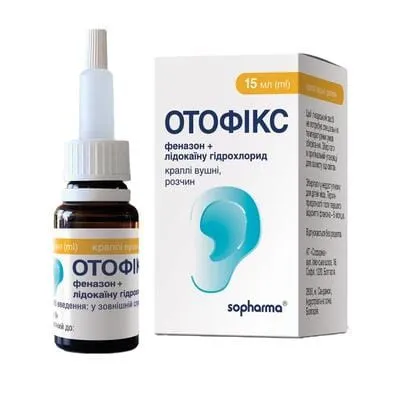
OTOFIX
UkraineThe drug is used for local anesthesia and treatment of inflammation in various middle ear conditions, such as acute otitis, viral otitis (following influenza), or barotraumatic otitis. It is important that the eardrum is intact.
Frequently asked questions
How should Otofix be taken correctly?
Adults and children from 1 month of age should instill 4 drops into the affected ear 2–3 times a day. Before use, the vial should be warmed in the hands so that the solution is not cold. The course of treatment should not exceed 10 days.
Who should not use this drug?
Use is prohibited in case of hypersensitivity to the components of the drug or to local anesthetics, as well as if the eardrum is damaged (perforated).
What are the possible side effects of Otofix?
Local allergic reactions may occur, such as itching, irritation, redness of the skin of the ear canal, or a rash.
Can the drug be used during pregnancy or breastfeeding?
Generally, the drug does not affect pregnant or breastfeeding women, as the substances barely enter the blood or breast milk. However, it is necessary to consult a physician before use.
Does the drug affect the ability to drive a car?
No, the use of the drug does not affect reaction speed or the ability to drive vehicles or operate machinery.
Instructions for use
INSTRUCTION FOR MEDICAL USE OF THE MEDICINAL PRODUCT OTOFIX (OTOFIX®)
Composition:
Active substances: phenazone, lidocaine hydrochloride;
1 g of solution contains 40 mg of phenazone and 10 mg of lidocaine hydrochloride;
Excipients: sodium thiosulfate, 96% ethanol, purified water, glycerol.
Pharmaceutical form. Ear drops, solution.
Main physicochemical properties: clear solution, colorless to yellowish-brown.
Pharmacotherapeutic group.
Agents used in otology. Analgesics and anesthetics in combination.
ATC code S02D A30.
Pharmacological properties.
Pharmacodynamics.
Otofiks is a combination medicinal product containing phenazone and lidocaine.
Phenazone is a pyrazolone derivative possessing analgesic and anti-inflammatory properties.
Lidocaine is a local anesthetic of the amide group. The combination of phenazone with lidocaine provides a synergistic analgesic/anti-inflammatory effect.
Pharmacokinetics.
Absorption of any component of the drug through the skin has not been studied. Absorption is almost negligible.
Systemic absorption of this solution is not expected (in the absence of tympanic membrane damage).
The effect of the drug (reduction of tympanic membrane pain and inflammation) begins within 5 minutes after instillation. Pain syndrome almost completely disappears within 15–30 minutes.
Clinical characteristics.
Indications.
Local symptomatic treatment of certain painful conditions of the middle ear with intact tympanic membrane in children from 1 month of age and adults, in cases of:
- acute otitis media;
- post-viral flaccid bullous otitis (post-influenzal);
- barotraumatic otitis.
Contraindications.
- Hypersensitivity to the active substances, any component of the medicinal product, or to amide-type local anesthetics.
- Perforation of the tympanic membrane of traumatic or infectious origin (see section "Special precautions and warnings").
Interaction with other medicinal products and other forms of interaction.
There is no data available on potential interactions.
Special precautions for use
Before starting treatment with the medicinal product, it is recommended to check for the presence of tympanic membrane perforation. If the tympanic membrane is perforated, instillation of the medicinal product into the ear may result in contact of the drug with structures of the middle ear and may cause adverse reactions in these tissues.
The medicinal product contains an active substance which may result in positive doping test results.
Use during pregnancy or breastfeeding.
No consequences of using the medicinal product during pregnancy are expected, since systemic exposure to phenazone and lidocaine is negligible.
Under normal conditions of use, phenazone and lidocaine do not pass into breast milk. If necessary, Otosan can be used during pregnancy or breastfeeding after consultation with a physician.
Ability to affect reaction speed when driving or operating machinery.
Otosan does not affect the ability to drive or operate potentially dangerous machinery.
Dosage and Administration.
For children from 1 month of age and adults: instill 4 drops into the external auditory canal of the affected ear 2–3 times daily, gently squeezing the elastic part of the dropper.
The treatment course should not exceed 10 days. After this period, the treatment should be re-evaluated.
Method of administration
For use in the ear.
To avoid discomfort caused by contact between the cold solution and the skin of the ear canal, warm the bottle in your hands before administering the medication.
Instructions for use:
- Unscrew the cap of the bottle;
- Screw the dropper onto the cap;
- Remove the protective cap from the dropper;
- Turn the bottle upside down and gently squeeze the dropper until a drop appears;
- Squeeze again until the required number of drops is obtained;
- After use, replace the dropper back onto the white cap.
Children.
There are no safety and efficacy data available for the use of Otowax in children under 1 month of age.
Use in children from 1 month of age only after consultation with and upon recommendation by a physician.
Overdose.
Overdose has not been observed when the product is used at the recommended dosage.
Side effects.
The adverse reactions listed below are classified according to system organ classes and frequency of occurrence.
Ear and balance organs: Local reactions: allergic reactions, including irritation, hyperemia of the external auditory canal, itching, skin rashes.
Reporting suspected adverse reactions.
Reporting of suspected adverse reactions after registration of the medicinal product is important. It allows continuous monitoring of the benefit-risk balance of the medicinal product. Medical and pharmaceutical personnel, as well as patients or their legal representatives, are encouraged to report any suspected adverse reactions and lack of effectiveness of the medicinal product via the Automated Information System for Pharmacovigilance at the following link: https://aisf.dec.gov.ua/.
Shelf life. 3 years.
Shelf life after first opening of the container: 6 months.
Storage conditions.
Keep out of reach of children.
This medicinal product does not require special storage temperature conditions. Store in the original packaging to protect from light.
Packaging.
15 ml (16.65 g) of solution in a glass bottle; 1 bottle with an applicator dropper in a cardboard box.
Availability.
Over-the-counter (without prescription).
Manufacturer.
JSC "Sofarma".
Manufacturer's address and location of business activity.
16 Iliensko Shose St., Sofia, 1220, Bulgaria.
2800 Sandanski, Industrial Zone, Bulgaria.
Similar drugs
| Brand name | Dosage form | Active substance / Dosage | Manufacturer |
|---|---|---|---|
| DROPLEX | drops, otic solution | K.O. Rompharm Company S.R.L. | |
| DROPLEX | drops, otic solution | WORLD MEDICINE ILAC SAN. VE TIC. A.S. | |
| FLOTTO | drops, otic solution | Rompharm Company SRL (manufacturing of unpackaged products, primary packaging, quality control testing (chemical/physical parameters), batch release; secondary packaging, quality control testing (microbiological parameters)) | |
| OTICS | drops, otic solution | Arpimed LLC | |
| OTICS PLUS | drops, otic solution | Arpimed LLC | |
| OTYKAIN-ZDOROVYA | drops, otic solution | LLC "Corporation "Zdorovya" (all stages of manufacturing, quality control, batch release; all stages of manufacturing, except quality control and batch release) |
The original data is available in the language of the country of manufacture.
Data source: State Register of Medicinal Products of Ukraine
Data last verified: August 13, 2026