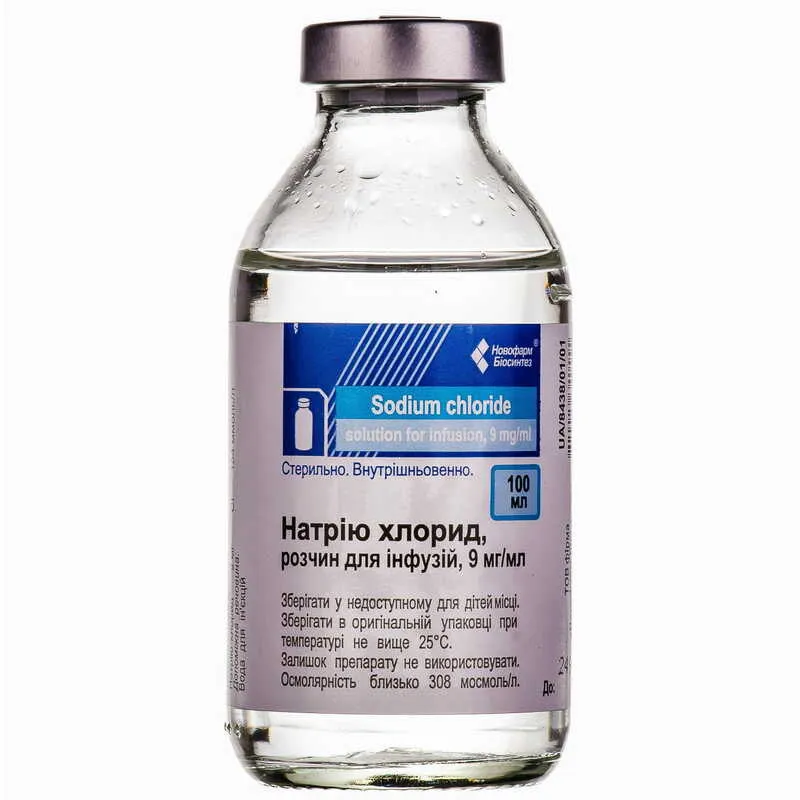
SODIUM CHLORIDE SOLUTION 0.9 %
UkraineIt is used to restore the balance of water and salts in the body during dehydration, injuries, burns, or after surgery. It also helps to improve blood circulation in cases of significant blood loss and shock states, and can serve as a solvent for other medications or be used for washing wounds and mucous membranes.
Frequently asked questions
How to correctly use Sodium chloride solution 0.9 %?
The drug is administered intravenously (via drip), rectally (as enemas), orally (through the mouth), or externally for wound irrigation. Dosage and infusion rate depend on the patient's condition and the clinical situation.
Who should not use this drug?
Contraindications include fluid overload (hyperhydration), elevated levels of sodium or chloride in the blood, chloride acidosis, as well as conditions where there is a risk of developing pulmonary edema. The solution should not be used for eye irrigation during ophthalmic surgeries.
What are the possible side effects of Sodium chloride solution 0.9 %?
When used correctly, no side effects are observed. However, massive administration of large volumes of fluid may lead to the development of chloride acidosis.
What happens in case of overdose?
Overdose may lead to excessive fluid accumulation in the body, disruption of the acid-base balance (chloride acidosis), potassium depletion, and the risk of developing heart failure.
Can the drug be taken with other medicines?
The drug is compatible with most medicinal products and can be used to dissolve them, provided these medicines are not incompatible with sodium chloride.
Is it necessary to monitor the condition during treatment?
Yes, during prolonged or massive administration, it is necessary to monitor electrolyte levels in the blood and urine, as well as the volume of urine output. Particular attention should be paid to patients with kidney, heart, or liver diseases.
Instructions for use
INSTRUCTIONS FOR MEDICAL USE OF THE MEDICINAL PRODUCT Sodium Chloride 0.9% Solution (Natrii chloridi Solutio 0,9%)
Composition:
Active substance: sodium chloride;
100 ml of solution contain sodium chloride 0.9 g;
Excipient: water for injections.
Pharmaceutical form. Infusion solution.
Main physicochemical properties: clear colorless liquid, theoretical osmolarity 308 mosmol/L.
Pharmacotherapeutic group. Plasma substitutes and perfusion solutions. Electrolyte solutions. ATC code B05XA03.
Pharmacological properties.
Pharmacodynamics.
Sodium chloride 0.9% solution normalizes water and electrolyte balance and eliminates fluid deficiency in the human body, which develops during dehydration or due to accumulation of extracellular fluid in large burn wounds and trauma, as well as during abdominal surgeries and peritonitis.
Sodium chloride 0.9% solution improves tissue perfusion and enhances the effectiveness of blood transfusion measures in massive blood loss and severe forms of shock.
It also exerts a detoxifying effect due to a transient increase in fluid volume, reduction of toxic substances concentration in the blood, and stimulation of diuresis.
Pharmacokinetics.
Rapidly leaves the vascular system. The drug remains in the vascular bed for a short period, then transfers into the interstitial and intracellular compartments. After 1 hour, only about half of the infused solution remains within blood vessels. Salts and fluid are very rapidly excreted by the kidneys, increasing diuresis.
Clinical characteristics.
Indications.
For replenishment of body fluid deficiency and as part of intensive therapy measures; as a solvent for other compatible medicinal products. Can be used locally for wound irrigation, nasal mucosa, as well as for catheters and transfusion systems.
Contraindications.
Hyperhydration, hyperchloremia, hypernatremia, chloride acidosis, conditions associated with the risk of pulmonary edema development.
The preparation must not be used for eye irrigation during ophthalmic surgery.
Interaction with other medicinal products and other types of interactions.
The preparation is compatible with most medicinal products; therefore, it can be used as a solvent for various medicinal agents—except for those drugs which are incompatible with sodium chloride as a solvent.
Special precautions.
During prolonged administration, especially in large volumes, electrolyte levels in plasma and urine, as well as diuresis, should be monitored.
Use with caution in patients with impaired renal excretory function, decompensated heart defects, and edema-ascites syndrome in patients with liver cirrhosis.
Concomitant administration with corticosteroids or corticotropin requires constant monitoring of blood electrolyte levels.
In shock states and blood loss, transfusion of blood, plasma, plasma substitutes, and 0.9% Sodium Chloride solution can be administered simultaneously.
Use during pregnancy or breastfeeding.
The drug may be used if indicated.
Ability to affect reaction rate while driving or operating machinery.
Does not affect.
Method of Administration and Dosage.
Administer intravenously, rectally, and externally.
For intravenous infusion, administer up to 3 L or more of solution per day at a rate of 4–10 mL/kg/hour, depending on the clinical condition and degree of fluid loss. May be administered orally. For use in enemas at a dose of 75–100 mL. Suitable for wound and mucous membrane irrigation.
Children.
In children with shock due to dehydration (without prior laboratory assessment), administer 20–30 mL/kg. Subsequently, adjust dosage according to laboratory parameters. The total daily dose depends on the water-electrolyte balance.
Overdose.
May lead to chloride acidosis, increased renal potassium excretion, hyperhydration, and hypervolemia, potentially resulting in heart failure. If symptoms of these conditions occur, discontinue the drug, assess the patient's condition, and provide appropriate supportive treatment.
Side effects.
Not observed when the medicinal product is used correctly. Chloride acidosis may develop with massive infusions.
Shelf life. 3 years.
Storage conditions. Store at a temperature not exceeding 25 °C in a place inaccessible to children.
Incompatibility. Not established.
Packaging. 100, 200, 250, 400, 500 ml in bottles.
Prescription status. Prescription only.
Manufacturer. Private Joint-Stock Company "Infuziya".
Manufacturer's address and place of business.
Vinnitsia region, Vinnitsia district, village Vinnitski Khutory, Nemirovskoe shose str., 84A, Ukraine, 23219.
Marketing Authorization Holder. Private Joint-Stock Company "Infuziya".
Address of the Marketing Authorization Holder.
21-A, Moskovskyi Prospekt, Kyiv, Ukraine, 04073.
Similar drugs
| Brand name | Dosage form | Active substance / Dosage | Manufacturer |
|---|---|---|---|
| SODIUM CHLORIDE | solution for infusion |
|
Yuria-Pharm LLC |
| SODIUM CHLORIDE | solution for infusion |
|
DIACO BIOPHARMACEUTICS S.R.L. |
| SODIUM CHLORIDE | solution for infusion |
|
PJSC "Halychpharm" |
| SODIUM CHLORIDE | solution for infusion |
|
Subsidiary Enterprise "Farmatreyd" |
| SODIUM CHLORIDE | solution for infusion |
|
Yuria-Pharm LLC |
| SODIUM CHLORIDE | solution for infusion |
|
LLC Firm Novofarm-Biosyntez |
| SODIUM CHLORIDE ANANTA | solution for infusion |
|
Evrolife Healthcare Pvt. Ltd. |
| SODIUM CHLORIDE SOLUTION ISOTONIC 0.9 % B. BRAUN | solution for infusion |
|
B. Braun Melsungen AG (manufacturing, primary and secondary packaging, batch release, batch control) |
| SODIUM CHLORIDE-DARNITSA | solution for infusion |
|
PJSC «Pharmaceutical Company «Darnitsa» |
The original data is available in the language of the country of manufacture.
Data source: State Register of Medicinal Products of Ukraine
Data last verified: August 13, 2026