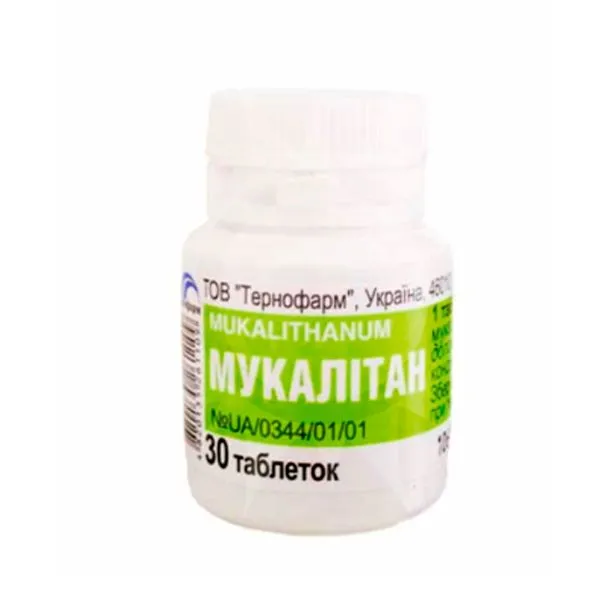
MUCALITAN
UkraineThe drug is used for cough during acute and chronic respiratory diseases when phlegm becomes thick, viscous, or difficult to expectorate. This includes bronchitis, pneumonia, bronchiectasis, and bronchial asthma.
Frequently asked questions
How should Mucalitan be taken correctly?
For adults and children aged 12 years and older, it is recommended to take 1–2 tablets 3–4 times a day before meals. For children aged 1 to 3 years, take 1 tablet; for children aged 3 to 12 years, take 1–2 tablets. The tablets can be dissolved in one-third of a glass of warm water (syrup may be added). The course of treatment usually lasts from 7 days to 1–2 months.
What side effects can Mucalitan cause?
In some cases, allergic reactions such as skin itching or urticaria (hives) may occur. Exceeding the dosage or prolonged use may cause nausea and vomiting.
Who should not take this medication?
The drug should not be used in case of hypersensitivity to mucaltine or other components. It is also not recommended for use with a dry cough, as it may exacerbate the cough.
Can the drug be combined with other medicines?
Mucalitan can be taken together with other expectorants and antitussives, but it must not be used simultaneously with cough suppressants (e.g., codeine).
Are there any special precautions for people with diabetes?
Yes, since the drug contains sugar, patients with diabetes mellitus should take this into account.
When should you consult a doctor during treatment?
If shortness of breath, fever, or purulent sputum occurs during the administration of the drug, it is necessary to consult a doctor.
Instructions for use
INSTRUCTIONS FOR MEDICAL USE OF THE MEDICINAL PRODUCT MUKALITHAN (MUКALITHANUM)
Composition:
Active ingredient: mucaltin;
1 tablet contains 0.05 g of mucaltin;
Excipients: citric acid monohydrate, sodium bicarbonate, confectioner's sugar, talc, calcium stearate.
Pharmaceutical form. Tablets.
Main physicochemical properties: grayish-brown tablets with specks, flat cylindrical, bevelled-edged.
Pharmacotherapeutic group.
Expectorants. ATC code R05C A05.
Pharmacological properties.
Pharmacodynamics.
Mucalitin is an effective expectorant whose action is provided by its secretolytic and broncholytic properties. The drug exerts a moderate antitussive effect, reducing the frequency and intensity of coughing episodes. It has soothing, anti-inflammatory, and demulcent properties. Mucalitin normalizes altered bronchopulmonary secretion and improves sputum expectoration: it reduces sputum viscosity and adhesive properties, facilitating the movement of sputum from the lower to the upper respiratory tract and its subsequent expectoration.
Pharmacokinetics.
Not studied.
Clinical characteristics.
Indications.
Cough associated with acute and chronic respiratory tract diseases accompanied by the production of thick and viscous bronchial secretions and/or impaired expectoration: bronchitis, pneumonia, bronchiectasis, bronchial asthma.
Contraindications.
Hypersensitivity to mucaltin or to any of the excipients.
Interaction with other medicinal products and other forms of interaction.
Currently, data on drug interactions with Mucaltin are lacking. Do not administer simultaneously with cough suppressants (e.g., codeine).
Mucaltin may be used concomitantly with other antitussive and expectorant agents.
Special precautions for use
In some patients with chronic inflammatory lung diseases, mucus viscosity may temporarily increase at the beginning of treatment with Mucalitan due to the mobilization of accumulated bronchial secretions containing large amounts of debris, proteins, and inflammatory components. Therefore, in cases of diffuse bronchial involvement, significant changes in the physicochemical properties of sputum, and impaired mucociliary transport, Mucalitan therapy should be combined with mucolytic agents (e.g., bromhexine).
The drug is not recommended for dry cough, as it may intensify the cough. If dyspnea, fever, or purulent sputum develops during treatment, medical advice must be sought.
It is advisable to take individual doses of the drug every 4 hours.
The product contains sugar, which should be taken into account by patients with diabetes mellitus.
Use during pregnancy or breastfeeding
There is no experience with the use of the medicinal product during pregnancy or breastfeeding.
Ability to affect reaction speed when driving or operating machinery
The drug does not affect the speed of reaction when driving vehicles or operating other machinery.
Dosage and Administration.
For adults and children aged 12 years and older: administer 1–2 tablets 3–4 times daily, taken before meals. Single doses for children, depending on age, are as follows: 1–3 years – 1 tablet, 3–12 years – 1–2 tablets.
When administering to children, the tablet may be dissolved in ⅓ cup of warm water; sugar or fruit syrup may be added to taste.
Duration of treatment: from 7 days up to 1–2 months, depending on the form of the disease.
Children.
The drug may be administered to children aged 1 year and older.
Overdose.
Overdose is not possible when the recommended therapeutic doses are used. However, prolonged use or exceeding the recommended doses may cause nausea and vomiting.
Treatment is symptomatic.
Side effects.
In some cases, allergic reactions such as urticaria and skin itching may occur.
Shelf life.
3 years.
Storage conditions.
Store in the original packaging at a temperature not exceeding 25 °C.
Keep out of reach of children.
Packaging.
30 tablets in polymer containers.
Availability category.
Over-the-counter.
Manufacturer/Marketing Authorization Holder.
TOV "Ternopharm".
Address of manufacturer and location of its business activities / Address of the marketing authorization holder.
TOV "Ternopharm".
Ukraine, 46010, Ternopil, Fabrychna St., 4.
Tel./Fax: (0352) 521-444, www.ternopharm.com.ua
Similar drugs
| Brand name | Dosage form | Active substance / Dosage | Manufacturer |
|---|---|---|---|
| MUCALTIN | tablets |
|
PJSC "Halychpharm" |
The original data is available in the language of the country of manufacture.
Data source: State Register of Medicinal Products of Ukraine
Data last verified: August 13, 2026