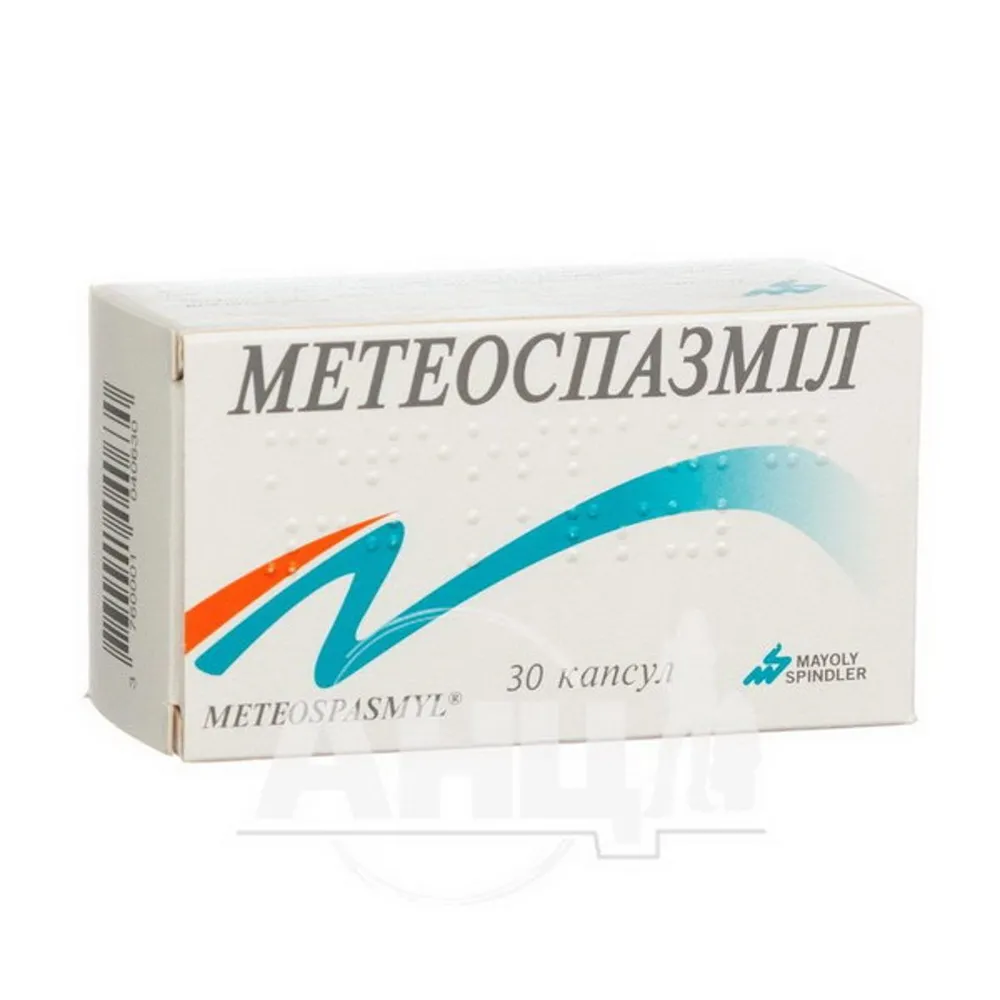
METЕOSPAZMIL
UkraineThe drug is used for the symptomatic treatment of intestinal disorders, especially those accompanied by meteorism (bloating).
Frequently asked questions
How should Meteospazmil be taken correctly?
Adults should take 1 capsule 2–3 times daily before meals or when pain occurs. The duration of the course should be determined by a physician.
Who should not take this drug?
The drug is contraindicated in cases of hypersensitivity to its components, as well as in intestinal obstruction or obstructive gastrointestinal diseases.
What are the possible side effects of Meteospazmil?
Possible reactions include headache, dizziness, nausea, skin rash, itching, edema, or anaphylactic shock. An increase in certain liver parameters (bilirubin and transaminases) is also possible.
Can the drug be taken during pregnancy or breastfeeding?
Use of the drug is not recommended during pregnancy and breastfeeding.
Can the drug be taken by children?
This drug is not used in pediatric practice.
Does the drug affect the ability to drive a car?
The drug may have a minor effect on the ability to drive vehicles or operate machinery, as dizziness has been observed in some patients.
Instructions for use
INSTRUCTION FOR MEDICAL USE OF THE MEDICINAL PRODUCT METEOSPASMIL (METEOSPASMYL®)
Composition:
Active substances:
1 capsule contains alverine citrate 60 mg; simethicone 300 mg;
Excipients: gelatin, glycerin, titanium dioxide (E 171).
Pharmaceutical form. Capsules.
Main physicochemical properties: opaque, soft, elongated capsules of white to yellowish color, containing a thick whitish suspension.
Pharmacotherapeutic group. Drugs used in functional gastrointestinal disorders. Alverine combinations.
ATC code A03A X58.
Pharmacological properties.
Pharmacodynamics.
Alverine is a myotropic spasmolytic.
Simethicone is a physiologically inert substance that has no pharmacological activity. It disrupts the surface tension of air bubbles, promoting their coalescence.
Pharmacokinetics.
After oral administration, simethicone is not adsorbed and is excreted unchanged following passage through the gastrointestinal tract.
Alverine is absorbed in the gastrointestinal tract and rapidly metabolized into pharmacologically active and inactive metabolites. After oral administration, peak plasma concentration is reached within 1–1.5 hours. The primary route of elimination of alverine metabolites is via the kidneys.
Clinical characteristics.
Indications.
Symptomatic treatment of intestinal functional disorders, particularly those manifested by flatulence.
Contraindications.
Hypersensitivity to alverine or to any other component of the medicinal product.
Intestinal obstruction, including paralytic obstruction; obstructive gastrointestinal disorders.
Interaction with other medicinal products and other forms of interaction.
None reported.
Special precautions for use
Liver function
Elevated levels of aspartate aminotransferase (AST) and alanine aminotransferase (ALT) more than 2 times above the upper limit of normal (ULN) have been reported in patients receiving treatment with alverine/simethicone. This increase may be associated with a concomitant rise in total serum bilirubin (see section "Adverse reactions"). If liver aminotransferase levels increase more than 3 times above ULN, or if jaundice occurs, treatment with Mетеospazmil should be discontinued.
Use during pregnancy or breastfeeding
Pregnancy
Simethicone: Due to negligible systemic exposure to simethicone, a negative effect during pregnancy is not expected.
Alverine: There are insufficient data on teratogenicity in animals. To date, no clinical effects such as developmental malformations or fetotoxic effects have been reported. However, observations on alverine exposure during pregnancy are insufficient to exclude any risk.
Therefore, the use of Mетеospazmil is not recommended during pregnancy.
Breastfeeding
Due to negligible systemic exposure to simethicone, a negative effect during breastfeeding is not expected.
There are no data available on the excretion of alverine into human breast milk.
Therefore, the use of Mетеospazmil is not recommended during breastfeeding.
Ability to influence reaction speed when driving or operating machinery
Mетеospazmil has a negligible influence on the ability to drive or operate machinery. Adverse reactions such as dizziness have been observed in some patients (see sections "Adverse reactions" and "Overdose"). These types of disorders may affect the ability to drive or operate machinery.
Dosage and Administration.
For oral use in adults: take 1 capsule 2–3 times daily before meals or as needed for pain.
The duration of treatment is determined individually by a physician.
Children.
The drug is not used in pediatric practice.
Overdose.
When doses higher than recommended are used, cases of dizziness have been reported.
Side effects.
The adverse reactions listed below have been reported with the following frequencies: very common (≥ 1/10), common (≥ 1/100 and < 1/10), uncommon (≥ 1/1000 and < 1/100), rare (≥ 1/10000 and < 1/1000), very rare (< 1/10000), and frequency not known (cannot be estimated from available data).
Nervous system disorders: frequency not known – headache.
Immune system disorders: very rare – anaphylactoid reactions, anaphylactic shock.
Ear and labyrinth disorders: frequency not known – dizziness.
Hepatobiliary disorders: very rare – cytolytic hepatitis (see section "Special precautions").
Gastrointestinal disorders: frequency not known – nausea.
Skin and subcutaneous tissue disorders: frequency not known – angioneurotic edema, skin rash, urticaria, and pruritus.
Investigations: frequency not known – increased levels of transaminases, alkaline phosphatase, and bilirubin.
Reporting of suspected adverse reactions
Reporting suspected adverse reactions after medicine authorization is important. It allows continuous monitoring of the benefit-risk balance of the medicine. Healthcare professionals are encouraged to report any suspected adverse reactions via the national reporting system.
Shelf life. 3 years.
Storage conditions.
Store at a temperature not exceeding 25 °C in a place inaccessible to children.
Packaging.
10 capsules per blister, 2 or 3 blisters per cardboard box.
Availability. Over-the-counter.
Manufacturer.
- Laboratoires Mayoly Spindler.
- Laboratoires Galénique Vernin.
Manufacturer's address and location of operations.
- 6, Avenue de l’Europe, 78400 Chatou, France.
- 20 rue Louis Charles Vernin, 77190 Dammarie-lès-Lys, France.
The original data is available in the language of the country of manufacture.
Data source: State Register of Medicinal Products of Ukraine
Data last verified: August 13, 2026