LARGINID
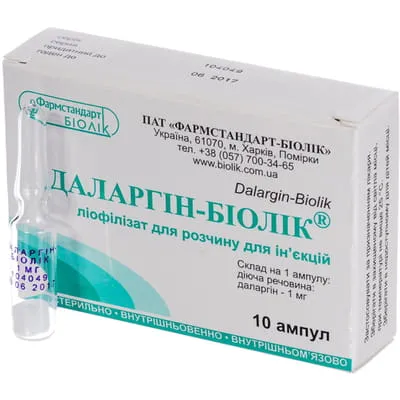
UkraineThe drug is used as part of complex therapy for acute gastric and duodenal ulcers, obliterating diseases of the lower extremities, pancreatitis, pancreonecrosis, as well as for mental state disturbances during alcoholism.
Frequently asked questions
How should Larginid be taken correctly?
The drug is administered intramuscularly or intravenously. The dosage and method of administration depend on the disease: for example, for ulcers, the dose is 1–2 mg (intramuscularly 2 times a day or intravenously 1 time a day), and for pancreatitis — intravenously according to a special scheme. The solution must be prepared immediately before use by dissolving the contents of the ampoule in a 0.9% sodium chloride solution.
What side effects can Larginid cause?
Possible side effects include decreased blood pressure, palpitations, tachycardia, headache, dizziness, numbness of the extremities or face, difficulty breathing, allergic reactions, itching, skin redness, nausea, and abdominal pain. General weakness, chills, increased temperature, and local injection site reactions (swelling, rash, itching) are also possible.
Who should not use this drug?
The drug is contraindicated in cases of hypersensitivity to the active substance and severe arterial hypotension. It is also contraindicated during pregnancy; breastfeeding should be discontinued during treatment.
Can the drug be combined with other medicines?
If you experience severe pain, antacid agents should be prescribed along with the drug.
Can you drive a car during treatment?
If you experience dizziness while using the drug, you should refrain from driving vehicles or operating machinery.
Can the drug be prescribed to children?
Prescribing the drug to children is not recommended, as information regarding its safety and efficacy for this age group is unavailable.
Instructions for use
INSTRUCTIONS FOR MEDICAL USE OF THE MEDICINAL PRODUCT LARGINID (LARGINID)
Composition:
Active substance: dalargin;
1 ampoule contains 1 mg of dalargin.
Pharmaceutical form. Lyophilisate for solution for injection.
Main physicochemical properties: white porous mass.
Pharmacotherapeutic group.
Agents affecting the gastrointestinal tract and metabolic processes. ATC code A16AX.
Pharmacological Properties.
Pharmacodynamics.
Dalargin is a peptide compound (tyrosine-2-alanyl-glycine-phenylalanyl-leucyl-arginine diacetate) containing residues of 6 amino acids. Dalargin belongs to agents that regulate metabolic processes. The drug accelerates healing of gastric and duodenal ulcers and reduces gastric acidity due to antisecretory activity. LARGINIDE also has a hypotensive effect. A positive effect of the medicinal product on mental functions in patients with alcoholism is observed.
Pharmacokinetics.
After injection, the hexapeptide dalargin undergoes rapid degradation under the action of endogenous peptidases, resulting in a half-life of several minutes from systemic circulation following administration.
Clinical characteristics.
Indications.
As part of complex therapy:
- Exacerbation of gastric and duodenal ulcer disease with prolonged ulcer healing;
- Obliterative diseases of the lower limbs;
- Mental state disorders in alcoholism;
- Pancreatitis;
- Pancreonecrosis.
Contraindications.
Hypersensitivity to the active substance.
Severe arterial hypotension.
Interaction with other medicinal products and other types of interactions.
If there is a pronounced pain symptom, antacid agents should be prescribed concomitantly with LARGINID.
Special precautions.
Information not available.
Use during pregnancy or breastfeeding.
The medicinal product is contraindicated during pregnancy.
If treatment with LARGINID is necessary, breastfeeding should be discontinued.
Ability to affect reaction speed when driving or operating machinery.
Not studied.
If dizziness occurs during treatment with LARGINID, driving or operating machinery should be avoided.
Administration and dosage.
LARGINID is administered intramuscularly and intravenously. Injection solutions should be prepared immediately before use. The ampoule contents should be dissolved in 0.9% sodium chloride solution as follows:
| Amount of dalargin |
Amount of 0.9% sodium chloride solution |
|
| intramuscularly |
intravenously |
|
| 1 mg |
1 ml |
5 ml |
| 2 mg |
2 ml |
10 ml |
In peptic ulcer disease of the stomach and duodenum or occlusive diseases of the lower extremities, the single dose of LARGINID is 1–2 mg.
Intramuscular injections should be administered twice daily; intravenous injections—once daily. The maximum daily dose (with intramuscular administration) is up to 5 mg.
The treatment course lasts 3–4 weeks. The total dose of LARGINID for the treatment course is 30–50 mg.
In psychiatric disorders of alcoholic origin, administer 1 mg of the drug intravenously in 10 ml of 0.9% sodium chloride solution.
In acute pancreatitis, administer the drug intravenously: 2 mg on the first day, then 5 mg 1–2 times daily. The treatment course lasts from 4 to 6 days.
In pancreatic necrosis, administer 5 mg intravenously 3–4 times daily (every 6–8 hours). The treatment course lasts from 2 to 6 days.
Children.
There is no information regarding the safety and efficacy of LARGINID in children; therefore, the drug is not recommended for use in this age group.
Overdose.
Not described.
Adverse Reactions.
Vascular system: decreased blood pressure.
Cardiac system: tachycardia, palpitations.
Nervous system: headache, dizziness, numbness of upper limbs and face.
Respiratory system, thoracic organs and mediastinum: increased or difficult breathing, dyspnea.
Immune system: allergic reactions.
Skin and subcutaneous tissue: itching, hyperemia, urticaria, redness or burning of facial skin, pallor of the skin, sweating.
Gastrointestinal tract: nausea, abdominal pain, including epigastric pain.
General disorders and administration site reactions: general weakness, chills, increased body temperature, chest pain, facial swelling; hyperemia, rash, itching at the injection site.
Reporting of adverse reactions after drug registration is of great importance. It enables continuous monitoring of the benefit-risk balance of the medicinal product. Medical and pharmaceutical professionals, as well as patients or their legal representatives, are encouraged to report all suspected adverse reactions and lack of efficacy via the Automated Pharmacovigilance Information System at: https://aisf.dec.gov.ua
Shelf life. 3 years.
Storage conditions.
Store in a light-protected place at a temperature not exceeding 25 °C.
Keep out of reach of children.
Incompatibility.
Do not use solvents not specified in the section "Instructions for use and dosage".
Packaging.
1 mg in ampoules; 5 ampoules in a blister pack, 2 blisters in a carton.
Prescription status. Prescription only.
Manufacturer.
LLC "BIOLIK PHARMA".
Manufacturer's location and address of business activity.
Legal entity location:
70 Pomyrky, Kharkiv, Kharkiv region, 61070, Ukraine.
Address of business activity:
Pomyrky-70, building b/n, Kharkiv, Kharkiv region, 61070, Ukraine.
The original data is available in the language of the country of manufacture.
Data source: State Register of Medicinal Products of Ukraine
Data last verified: August 13, 2026