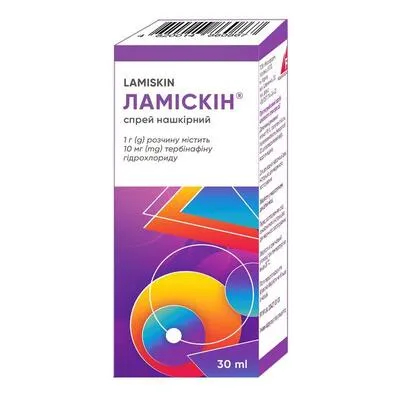
LAMISCAN
UkraineThe drug is used to treat fungal skin infections caused by dermatophytes, as well as to treat tinea versicolor in adults.
Frequently asked questions
How should Lamiscan be used correctly?
Before use, the affected areas of the skin must be thoroughly cleaned and dried. Spray the affected area and the adjacent healthy skin from a distance of 5-10 cm so that the solution thoroughly moistens the skin. Upon first use, the spray must be pressed several times to prime the pump. The duration of treatment is determined by a physician: typically, it is once daily for one week for fungal infections of the feet, or twice daily for one week for tinea versicolor.
What are the possible side effects of Lamiscan?
Possible local reactions include: itching, peeling, burning, pain, or irritation at the application site, redness (erythema), changes in skin pigmentation, or the formation of crusts. Eye irritation may also occur if the spray accidentally comes into contact with the eyes. In rare cases, a rash or worsening of the fungal infection may be observed.
Who should not use this drug?
The drug is contraindicated in individuals with hypersensitivity to terbinafine or to any other component of the formulation. Due to a lack of safety data, Lamiscan is not recommended for children. Use of the drug is also not recommended during breastfeeding.
Can the spray be applied to the face?
No, the spray must not be applied to the face.
What should be done if the spray gets into the eyes?
The eyes should be thoroughly rinsed with running water.
Can the drug be used during pregnancy?
Lamiscan should not be used during pregnancy, except in cases of extreme necessity.
Instructions for use
INSTRUCTIONS FOR MEDICAL USE OF THE MEDICINAL PRODUCT LAMISKIN (LAMISKIN)
Composition:
Active substance: terbinafine hydrochloride;
1 g of solution contains 10 mg of terbinafine hydrochloride;
Excipients: ethanol 96%, propylene glycol, polyethylene glycol (macrogol) 20 cetostearyl ether, purified water.
Pharmaceutical form. Topical spray, solution.
Main physicochemical characteristics: clear, colorless to pale yellow liquid.
Pharmacotherapeutic group. Antifungal agents for topical use.
ATC code D01AE15.
Pharmacological properties.
Pharmacodynamics.
Terbinafine is an allylamine with a broad spectrum of antifungal activity. At appropriate concentrations, terbinafine exerts a fungicidal effect against dermatophytes such as Trichophyton (e.g., T. rubrum, T. mentagrophytes, T. verrucosum, T. violaceum), Microsporum canis, and Epidermophyton floccosum, as well as against molds and some dimorphic fungi. Activity against yeast fungi may be either fungicidal (e.g., Pityrosporum orbiculare or Malassezia furfur) or fungistatic, depending on the species.
Terbinafine specifically inhibits an early step in the biosynthesis of sterols in the fungal cell membrane. This leads to ergosterol deficiency and intracellular accumulation of squalene, resulting in fungal cell death. Terbinafine acts by inhibiting the enzyme squalene epoxidase in the fungal cell membrane. This enzyme is not part of the cytochrome P450 system. Terbinafine does not affect hormone metabolism or that of other medicinal products.
Pharmacokinetics.
When applied topically, less than 5% is absorbed; therefore, systemic absorption of terbinafine is very low.
Clinical characteristics.
Indications.
Treatment of fungal skin infections caused by dermatophytes and pityriasis versicolor in adults.
Contraindications.
Hypersensitivity to terbinafine or to any other component of the medicinal product.
Interaction with other medicinal products and other forms of interaction.
Interaction is unknown.
Special precautions for use.
The medicinal product is for external use only.
The medicinal product should be used with caution in patients with skin lesions, as ethanol contained in the formulation may cause irritation. The spray must not be applied to the face.
The medicinal product may cause eye irritation. In case of accidental contact with eyes, thoroughly rinse them with running water.
The medicinal product must be stored out of reach of children.
The medicinal product contains propylene glycol, which may cause skin irritation.
Use during pregnancy or breastfeeding.
Pregnancy
There are no data on the use of terbinafine in pregnant women. Animal studies do not indicate any harmful effect on pregnancy or fetal health. Lamisil should not be used during pregnancy except in cases of extreme necessity.
Lactation
Terbinafine passes into breast milk in small amounts; therefore, the medicinal product must not be used during breastfeeding.
Contact between infants and any treated areas of skin, including the breasts, should be avoided.
Fertility
Studies in animals have not shown any effect of terbinafine on fertility.
Ability to influence reaction rate while driving or operating machinery.
The medicinal product has no or negligible effect on the ability to drive or operate machinery.
Method of Administration and Dosage
Lamisil is intended for topical use only.
Before application, the affected areas of skin should be thoroughly cleaned and dried. Lamisil should be sprayed onto the affected areas in sufficient quantity to ensure thorough wetting, and also applied to adjacent areas of both affected and intact skin. The spray should be applied from a distance of 5–10 cm. When used for the first time, the spray pump must be primed by pressing several times (usually up to 3 actuations) until the solution is dispensed.
The duration of treatment and frequency of application are determined by the physician depending on the indication:
- for tinea pedis and tinea of glabrous skin – once daily for one week;
- for interdigital and plantar intertrigo – once daily for one week;
- for pityriasis versicolor – twice daily for one week.
Improvement of symptoms is usually expected within a few days. Inconsistent application or premature discontinuation of treatment may lead to recurrence of the disease. If there are no signs of improvement after one week, the patient should consult a physician.
Elderly Patients
There is no evidence that elderly patients require a different dosage or are more likely to experience adverse effects not observed in younger patients.
Children
Due to insufficient data on safety and efficacy, Lamisil is not recommended for use in children.
Overdose
Symptoms
Low systemic absorption of terbinafine with topical application results in an extremely low risk of overdose. Accidental ingestion of the contents of one 30 ml Lamisil bottle (containing 300 mg of terbinafine hydrochloride) is comparable to taking one 250 mg terbinafine tablet (a single oral dose for adults). If the contents of more than one bottle are accidentally ingested, effects similar to those seen with oral overdose may be expected (headache, nausea, epigastric pain, and dizziness). The ethanol content of the medicinal product (25% by weight) should also be taken into account.
Treatment
Management of overdose following accidental ingestion consists of removing the active substance, primarily by administering activated charcoal, and providing symptomatic therapy as necessary.
Adverse Reactions
Local symptoms such as itching, scaling, or burning of the skin, pain or irritation at the application site, pigmentary disturbances, erythema, crusting, and others may occur at the site of application. These mild symptoms should be differentiated from hypersensitivity reactions, including rash, which have been reported in isolated cases and which require discontinuation of treatment. In case of accidental contact with eyes, terbinafine hydrochloride may cause eye irritation. In rare cases, a latent fungal infection may worsen.
Adverse reactions listed below by organ class and frequency.
Frequency is defined as: very common (≥ 1/10); common (≥ 1/100 to < 1/10); uncommon (≥ 1/1,000 to < 1/100); rare (≥ 1/10,000 to < 1/1,000); very rare (< 1/10,000); or frequency not known (cannot be estimated from available data). Within each frequency group, adverse reactions are listed in order of decreasing severity.
Potential adverse effects
Immune system disorders
Frequency not known: hypersensitivity reactions.
Eye disorders
Rare: eye irritation.
Skin and subcutaneous tissue disorders
Common: skin scaling, itching.
Uncommon: skin injury, scab, skin lesion, pigmentary disturbance, erythema, skin burning sensation.
Rare: sensation of dry skin, contact dermatitis, eczema.
Frequency not known: rash.
General disorders and administration site conditions
Uncommon: pain, pain at application site, irritation at application site.
Rare: worsening of symptoms.
Reporting of suspected adverse reactions
Reporting suspected adverse reactions after authorization of the medicinal product is important. It allows ongoing monitoring of the benefit/risk balance of the medicinal product. Medical and pharmaceutical professionals, as well as patients or their legal representatives, should report any suspected adverse reactions and lack of efficacy of the medicinal product via the Automated Information System for Pharmacovigilance at the following link: https://aisf.dec.gov.ua.
Shelf life. 2 years.
After first opening of the bottle, do not store for more than 6 months.
Storage conditions.
Store in the original packaging at a temperature not exceeding 25 °C.
Keep out of reach and sight of children.
Packaging. 30 ml of solution in a polymer bottle with a spray pump and atomizer; 1 bottle per cardboard box.
Availability category. Over-the-counter.
Manufacturer. LLC "Micropharm".
Manufacturer's address and location of business activity.
20 Shevchenka Street, Kharkiv, Ukraine, 61013.
Similar drugs
| Brand name | Dosage form | Active substance / Dosage | Manufacturer |
|---|---|---|---|
| TERBINORM | spray, topical solution |
|
K.O. Rompharm Company S.R.L. |
| TERBINORM | spray, topical solution |
|
WORLD MEDICINE ILAC SAN. VE TIC. A.S. |
The original data is available in the language of the country of manufacture.
Data source: State Register of Medicinal Products of Ukraine
Data last verified: August 13, 2026