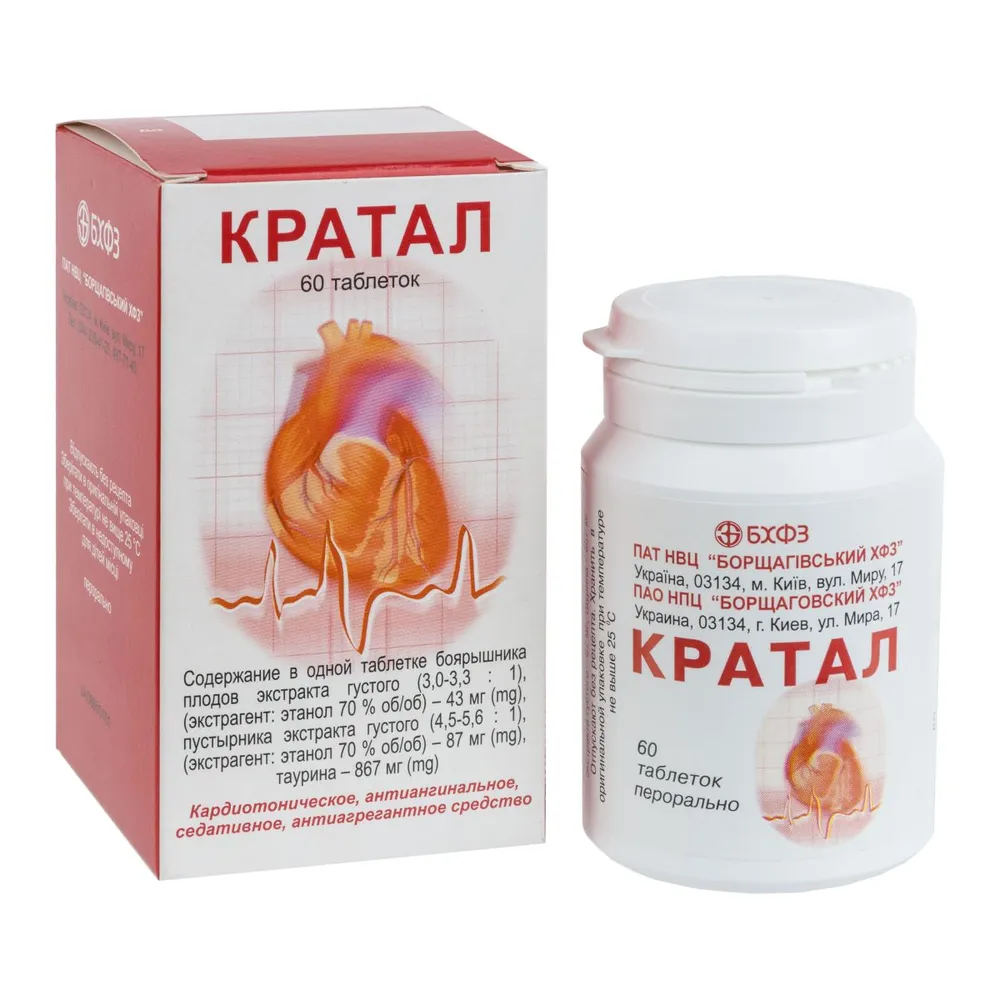
KRATALL
UkraineThe drug is used for neurocirculatory dystonia, as well as as part of combination therapy for chronic ischemic heart disease and radiation syndrome.
Frequently asked questions
How should the drug be taken correctly?
Take 1-2 tablets 3 times a day before meals. The duration of the treatment course is usually 3-4 weeks, and the exact dose should be determined by a physician.
Who should not take Kratall?
The drug is contraindicated in cases of hypersensitivity to its components, severe bradycardia (low pulse), and arterial hypotension (low blood pressure). It is also contraindicated during pregnancy.
What are the possible side effects?
Possible allergic reactions (rash, itching, skin edema), digestive problems, general weakness, fatigue, dizziness, drowsiness, as well as decreased blood pressure and slowing of the heart rate.
Can this medicine be combined with other drugs?
The drug enhances the effects of nitrates, beta-blockers, calcium antagonists, and cardiac glycosides. However, it should not be used together with cisapride and Class III antiarrhythmic agents.
Can you drive a vehicle during treatment?
During the period of taking the drug, patients should refrain from driving vehicles and working with potentially dangerous machinery.
When should you seek medical attention immediately?
Urgent medical assistance is required if swelling of the legs or ankles occurs, if chest pain develops (which may radiate to the left arm, neck, or upper abdomen), or if shortness of breath occurs.
Instructions for use
INSTRUCTION FOR MEDICAL USE OF THE MEDICINAL PRODUCT KRAATAL (CRATAL)
Composition:
Active substances: One tablet contains hawthorn fruit dry extract (Crataegi fructus extractum spissum) (3.0-3.3:1), (extraction solvent: ethanol 70% v/v), calculated as dry substance – 43 mg; motherwort herb dry extract (Leonuriae herba extractum spissum) (4.5-5.6:1), (extraction solvent: ethanol 70% v/v), calculated as dry substance – 87 mg; taurine, calculated as 100% dry substance – 867 mg.
Excipients: microcrystalline cellulose, sodium croscarmellose, magnesium stearate, colloidal anhydrous silicon dioxide.
Pharmaceutical form. Tablets.
Main physicochemical properties: oval tablets, light grey to light brown or dark brown in color, with speckles, having a biconvex surface.
Pharmacotherapeutic group. Combined cardiac preparations. ATC code C01EX.
Pharmacological properties.
Pharmacodynamics.
Kratall exerts mild cardiotonic, antianginal, antioxidant, antiarrhythmic, antihypoxic, antiaggregant, and antiatherogenic effects; inhibits the renin-angiotensin and kallikrein-kinin systems, lipid peroxidation processes, and positively influences cyclic adenosine monophosphate (cAMP) production. It improves blood supply and functional state of the myocardium, increases the "coronary reserve", enhances contractile and pumping functions of the cardiac muscle, reduces arterial pressure, and normalizes heart rate.
Kratall reduces manifestations of digitalis intoxication. It increases work capacity, improves mood, and exerts calming and neuroprotective effects (eliminates somatonegative disturbances—irritability, mood changes).
Pharmacokinetics.
The components of the drug are almost completely absorbed from the gastrointestinal tract. The time to reach maximum plasma concentration of taurine and other components of the drug is 2 hours. Kratall is evenly distributed in body tissues and fluids. The main portion is excreted in urine; the half-life period is 6–8 hours.
Clinical characteristics.
Indications.
- Neurocirculatory dystonia;
- as part of combination therapy in:
- chronic ischemic heart disease;
- post-radiation syndrome.
Contraindications.
- Hypersensitivity to the components of the drug;
- pronounced bradycardia and arterial hypotension.
Interaction with other medicinal products and other forms of interactions.
Potentiates antianginal effects of nitrates, β-blockers, calcium antagonists, anti-hypoxants, neuroprotectants, and cardiac glycosides. Reduces manifestations of digitalis intoxication. The drug should not be used concomitantly with class III antiarrhythmic agents and cisapride.
Special precautions for use.
Do not exceed the recommended doses of the medicinal product.
If symptoms do not disappear or worsen during treatment, consult a physician.
If swelling of the ankles or legs occurs, or if chest pain develops that may radiate to the left arm, upper abdomen, or neck area, or if shortness of breath appears, IMMEDIATE medical consultation is required.
Use during pregnancy or breastfeeding.
There are currently no data regarding the use of the medicinal product during pregnancy or breastfeeding.
The medicinal product is contraindicated during pregnancy.
If it is necessary to use the medicinal product in breastfeeding women, breastfeeding should be discontinued for the duration of treatment.
Ability to influence reaction speed when driving or operating machinery.
Patients taking Ketal should refrain from driving vehicles and operating potentially hazardous machinery during treatment.
Method of Administration and Dosage.
The duration of treatment and dosage is determined individually by a physician. The drug should be taken orally, 1-2 tablets 3 times daily before meals. The treatment course lasts 3-4 weeks.
Children.
There is no experience with the use of this drug for the treatment of children.
Overdose.
Symptoms: hypersensitivity reactions, allergic reactions, dyspeptic symptoms, general weakness, fatigue, dizziness, drowsiness, arterial hypotension, bradycardia.
Treatment: discontinue the drug and administer symptomatic therapy.
Side effects.
Possible manifestations of increased sensitivity, allergic reactions (including hyperemia, rashes, itching, skin swelling, urticaria), dyspeptic symptoms, general weakness, increased fatigue, dizziness, drowsiness, arterial hypotension, bradycardia.
If any adverse events occur, the patient must consult a physician.
Shelf life. 3 years.
Do not use after the expiry date stated on the packaging.
Storage conditions.
In the original packaging at a temperature not exceeding 25 °C.
Keep out of reach of children.
Packaging.
10 tablets in a blister pack, 2 blisters in a carton; 60 tablets in a container and carton; 90 tablets in a container and carton.
Dispensing category. Over-the-counter.
Manufacturer.
Public joint-stock company “Scientific and Production Center “Borshchahivskiy Chemical and Pharmaceutical Plant”.
Manufacturer’s address and place of business.
17, Miru Street, Kyiv, 03134, Ukraine.
Similar drugs
| Brand name | Dosage form | Active substance / Dosage | Manufacturer |
|---|---|---|---|
| ADVOCARD® | tablets | Farmakos LLC (full production cycle of medicinal products, primary and secondary packaging, quality control, batch release) | |
| PECHEVSKYY VALIKARDOL SUGAR-FREE | tablets | PJSC "Tekhnolog" | |
| THIODARONE® | tablets |
|
PJSC "Halychpharm" |
| VALIDOL-DARNITSA | tablets | PJSC «Pharmaceutical Company «Darnitsa» | |
| VALIDOL-LUBNIFARM | tablets | JSC "Lubnipharm" |
The original data is available in the language of the country of manufacture.
Data source: State Register of Medicinal Products of Ukraine
Data last verified: August 13, 2026