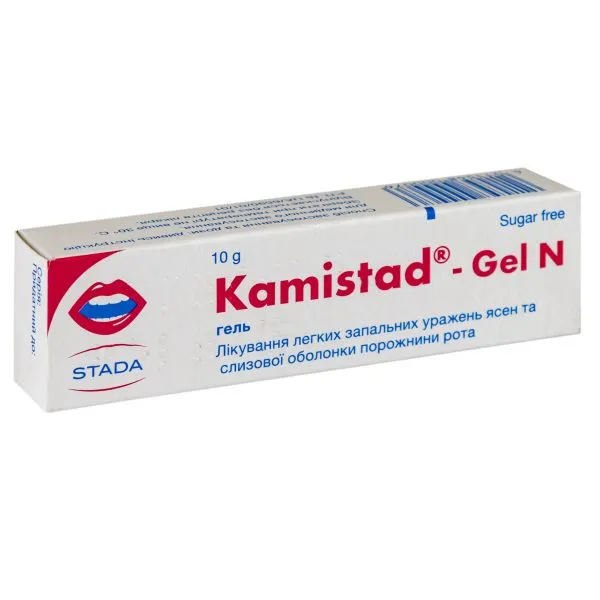
KAMISTAD® - GEL
UkraineThe product is used for the treatment of mild inflammatory lesions of the gums and oral mucosa.
Frequently asked questions
How should Kamistad® - gel be used correctly?
Adults should apply a ½ cm strip of gel to the affected areas of the mouth 3 times a day, massaging gently. Children aged 12 and over should apply the same amount of gel, but no more than 3 times a day.
Who should not use this gel?
The product is contraindicated in case of hypersensitivity to lidocaine, chamomile, or other components of the composition, as well as in the presence of oral mucosal damage. It must not be used in children under 12 years of age. Use of the product is also not recommended during pregnancy and breastfeeding.
What are the possible side effects of Kamistad® - gel?
Temporary mild burning, irritation, or redness of the skin may occur. Very rarely, allergic reactions such as skin rash, itching, or swelling may occur. The product may also cause numbness of the tongue.
Can I eat after applying the gel?
Since the product may cause numbness of the tongue, food and drinks should be consumed with caution.
What should I do if an allergic reaction occurs?
If you notice any signs of an allergic reaction, you must discontinue use of the gel and be sure to consult a physician.
Instructions for use
INSTRUCTIONS FOR MEDICINAL USE OF THE MEDICINAL PRODUCT Kamistad® - Gel N (Kamistad® - Gel N)
Composition:
Active substances: 1 g of gel contains lidocaine hydrochloride monohydrate – 20 mg, extract of chamomile flowers (Matricaria recutita L.) (1:4-5) (extractant ethanol 50 % (v/v) with 1.37 % tromethamine) – 185 mg;
Excipients: benzalkonium chloride 50 % solution, cinnamon bark oil, sodium saccharin, carbomers, tromethamine, formic acid 98 %, ethanol 96 %, purified water.
Pharmaceutical form. Gel.
Main physicochemical characteristics: homogeneous yellow-brown gel, free of solid crystals.
Pharmacotherapeutic group.
Agents for local use in dentistry.
ATC code A01A D11.
Pharmacological properties.
Pharmacodynamics.
The combination of active substances in the drug has analgesic, anti-inflammatory, and antibacterial properties.
Lidocaine is a potent amide-type local anesthetic. Its mechanism of action is based on stabilization of cell membranes by blocking sodium channels.
Chamomile, or liquid chamomile extract, contains a complex mixture of structurally different components with anti-inflammatory and antibacterial properties, combined to enhance the overall therapeutic effect. Sesquiterpenes, accounting for over 50% of the active constituents of chamomile, are therapeutically the most important. The anti-inflammatory effect of chamomile is primarily due to the presence of chamazulene and (-)-alpha-bisabolol, which also possess antibacterial and antifungal properties.
Clinical characteristics.
Indications.
Treatment of mild inflammatory conditions of the gums and oral mucosa.
Contraindications.
Hypersensitivity to lidocaine or to other amide-type local anesthetics, to chamomile, or to any other components of the medicinal product.
Damage to the oral mucosa.
Interaction with other medicinal products and other forms of interaction.
Data not available.
Special precautions for use.
High doses should not be used for longer than the specified period without consulting a doctor.
Avoid contact of the medication with eyes or open wounds. Hands should be thoroughly washed after using Kamistad® - gel N.
The product contains benzalkonium chloride solution, which may cause skin irritation.
The product may cause numbness of the tongue; therefore, food and drinks should be consumed with caution after application of the product.
Use during pregnancy or breastfeeding.
There is no clinical experience with the use of the product during pregnancy or breastfeeding; therefore, the product should not be used during these periods.
Ability to affect reaction rate when driving or operating machinery.
No effects on the ability to drive or operate machinery have been observed.
Dosage and Administration.
Adults: Apply a ½ cm strip of Kamistad® - Gel N to the affected areas of the oral mucosa 3 times daily, with gentle massage. The duration of treatment is determined individually by a physician, depending on the course of the disease.
Children aged 12 years and older: Apply a ½ cm strip of Kamistad® - Gel N to the oral mucosa. Do not apply more than 3 times within 24 hours.
Kamistad® - Gel N should be used until inflammation of the oral mucosa subsides.
Children.
Do not use in children under 12 years of age.
Overdose.
To date, no cases of intoxication or overdose have been reported.
Adverse reactions.
The frequency of adverse reactions is defined according to the following criteria:
Very common (≥1/10); common (≥1/100 to <1/10); uncommon (≥1/1000 to <1/100); rare (≥1/10,000 to <1/1000); very rare (≥1/10,000 or unknown).
Skin and subcutaneous tissue disorders
Uncommon: transient mild burning, irritation, or redness may occur after application of the gel.
Immune system disorders
Very rare: since the product contains lidocaine, cinnamon, and chamomile, allergic reactions may occur, including contact allergic reactions, skin rashes, pruritus, and angioneurotic edema. Such reactions may also occur in patients with hypersensitivity to plants of the Asteraceae family (e.g. wormwood) and Peru balsam (due to cross-reactivity).
If any hypersensitivity reactions occur, use of KAMISTAD®-N gel should be discontinued immediately and medical advice must be sought.
Shelf life. 5 years.
Do not use the medicinal product after the expiry date stated on the packaging.
Storage conditions.
Store at temperatures not exceeding 30°C.
Packaging.
10 g of gel in a tube; 1 tube in a cardboard box.
Availability. Over-the-counter.
Manufacturer.
STADA Arzneimittel AG (batch release).
Manufacturer's name and address.
Stadashausstrasse 2-18, 61118 Bad Vilbel, Germany.
The original data is available in the language of the country of manufacture.
Data source: State Register of Medicinal Products of Ukraine
Data last verified: August 13, 2026