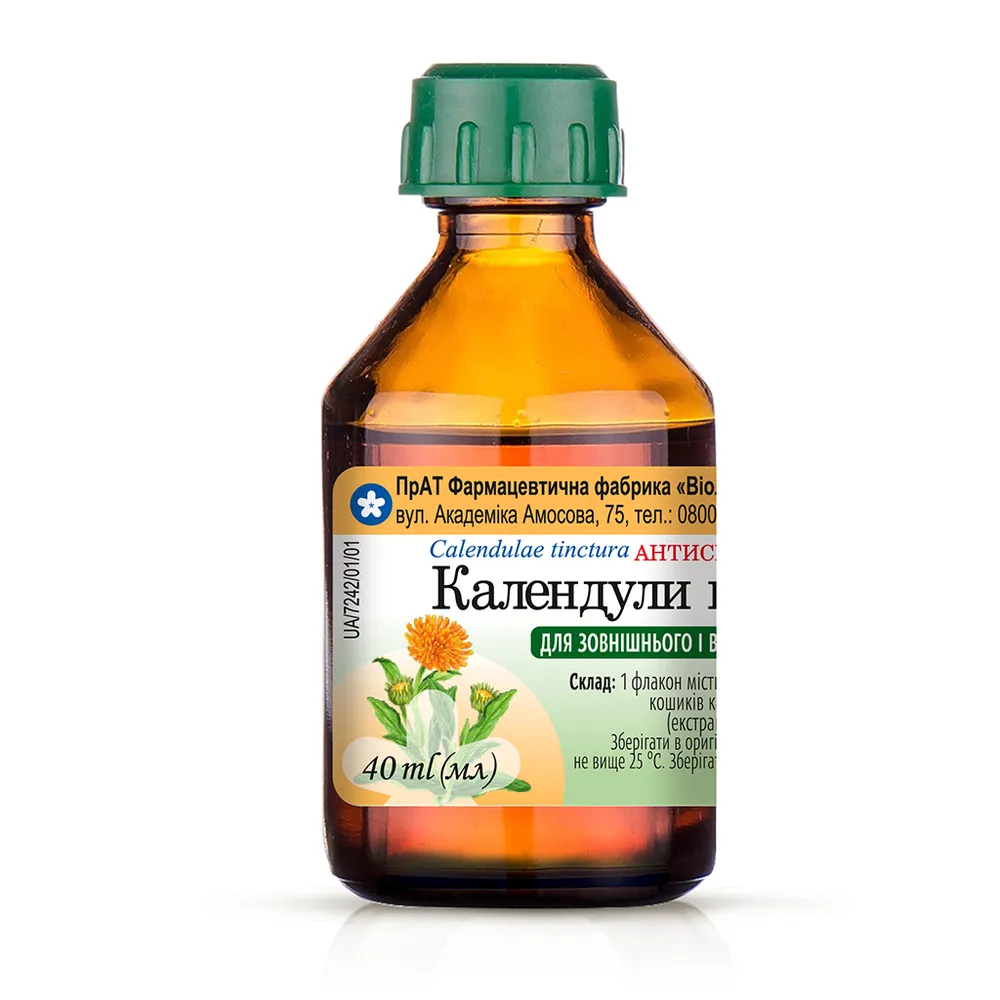
CALENDULA TINCTURE
UkraineThe preparation is used topically as an antiseptic for cuts, burns, infected wounds, and inflammation of the mucous membranes of the mouth, throat, or tonsils. It is also taken orally as a choleretic agent for diseases of the biliary tract (as part of complex therapy).
Frequently asked questions
How should Calendula tincture be taken correctly?
For mouth rinsing, dilute 1 teaspoon of the preparation in a glass of warm boiled water. For oral administration in adults, it is recommended to take 10–20 drops 3–4 times a day, 15–30 minutes before meals, diluted in a small amount of water. For children aged 12 and older, the dosage is 1 drop per year of age, 3–4 times a day.
What are the possible side effects of Calendula tincture?
Allergic reactions are possible (skin redness, rash, itching, swelling). When taken orally, a bitter taste in the mouth, burning sensation, or abdominal pain may occur.
Who should not use this preparation?
Use is contraindicated in cases of individual intolerance to the components, as well as for women during pregnancy and breastfeeding.
Can children take this preparation?
Due to the ethanol content, the preparation is permitted for use only in children aged 12 years and older.
How does the preparation interact with other medicines?
The tincture may enhance the effect of other anti-inflammatory and choleretic agents, such as preparations based on chamomile or St. John's wort.
Does the preparation affect the ability to drive a vehicle?
When taken orally, it is prohibited to drive a vehicle or operate machinery, as a sedative effect may develop.
Instructions for use
INSTRUCTION FOR MEDICAL USE OF THE MEDICINAL PRODUCT CALENDULAE TINCTURE
Composition:
Active substance: tincture of calendula flowers and flower heads (Calendulaeflos);
One bottle (jar) of the medicinal product contains 50 ml or 100 ml of tincture of calendula flowers and flower heads (Calendulaeflos) (1:10) (extraction solvent – 70% ethanol);
Excipients: none, except the extraction solvent;
1 ml of the medicinal product contains 0.65 ml of ethanol.
Pharmaceutical form. Tincture.
Main physicochemical properties: clear yellowish-brown liquid with a characteristic odor. Sediment may form during storage.
Pharmacotherapeutic group.
Medicinal products promoting wound healing (scar formation). ATC Code D03A X09.
Pharmacological properties.
Pharmacodynamics.
Biologically active substances contained in the flowers and flower heads of calendula (flavonoid and carotenoid glycosides, saponins, tannins, essential oil, organic acids) exert antimicrobial, anti-inflammatory, and mild cholagogue effects.
Pharmacokinetics.
Not studied.
Clinical characteristics.
Indications.
For topical use as an antiseptic in infected (purulent) wounds, cuts, skin burns, and inflammation of mucous membranes of the oral cavity, gums (stomatitis, gingivitis), pharynx, and tonsils (pharyngitis, tonsillitis). Internally, the drug is used as a choleretic agent in biliary dyskinesia, cholangitis, and cholecystitis (as part of complex therapy).
Contraindications.
Individual hypersensitivity to any component of the drug.
Interaction with other medicinal products and other forms of interaction.
Calendula tincture enhances the effect of other anti-inflammatory and choleretic agents, particularly drugs based on chamomile and yarrow.
Special precautions for use.
Before starting treatment with the medicine, consult a doctor. The medicine contains ethanol. Prolonged use of the medicine is not recommended.
Use during pregnancy or breastfeeding.
Use is contraindicated.
Ability to influence reaction rate when driving or operating machinery.
During the period of taking the medicine internally, driving a vehicle or operating potentially hazardous machinery is prohibited. The sedative effect develops gradually over 3 weeks.
Dosage and Administration.
Take orally, 15–30 minutes before meals, diluted in a small amount of warm boiled water. The recommended dose for adults is 10–20 drops of the tincture 3–4 times daily. For children aged 12 years and older – 1 drop of tincture per year of life, 3–4 times daily.
For mouth rinsing, dilute 1 teaspoon of calendula tincture in a glass of warm boiled water. The method of using the drug for local applications depends on the nature of the skin lesion and is determined by the physician.
The duration of treatment is determined individually by the physician, taking into account the nature, severity, and course of the disease, stability of the therapeutic effect achieved, and the drug's tolerability.
Children.
Since the drug contains ethanol, it is indicated for children aged 12 years and older.
Overdose.
With a significant increase in dose, symptoms of increased sensitivity may occur, requiring discontinuation of the drug and implementation of symptomatic therapy.
Side effects.
Immune system side effects: the drug is usually well tolerated, but allergic reactions (including skin redness, rash, itching, angioedema) may develop in some patients with individual hypersensitivity.
Gastrointestinal side effects: when taken orally, a bitter taste in the mouth, burning sensation in the epigastric area, and abdominal pain are possible.
If any adverse reactions occur, discontinue use of the drug immediately and consult a physician without delay.
Shelf life. 4 years.
Do not use the drug after the expiry date stated on the packaging.
Storage conditions.
Store in the original packaging at a temperature not exceeding 25 °C.
Keep out of reach of children.
Packaging.
50 ml or 100 ml in bottles and 100 ml in jars.
Availability.
Over-the-counter (without prescription).
Manufacturer.
Private Joint-Stock Company "Biolyk".
Manufacturer's location and address of business activity.
131, Nezalezhnosti Str., Ladizhin, Vinnytsia region, 24321, Ukraine.
The original data is available in the language of the country of manufacture.
Data source: State Register of Medicinal Products of Ukraine
Data last verified: August 13, 2026