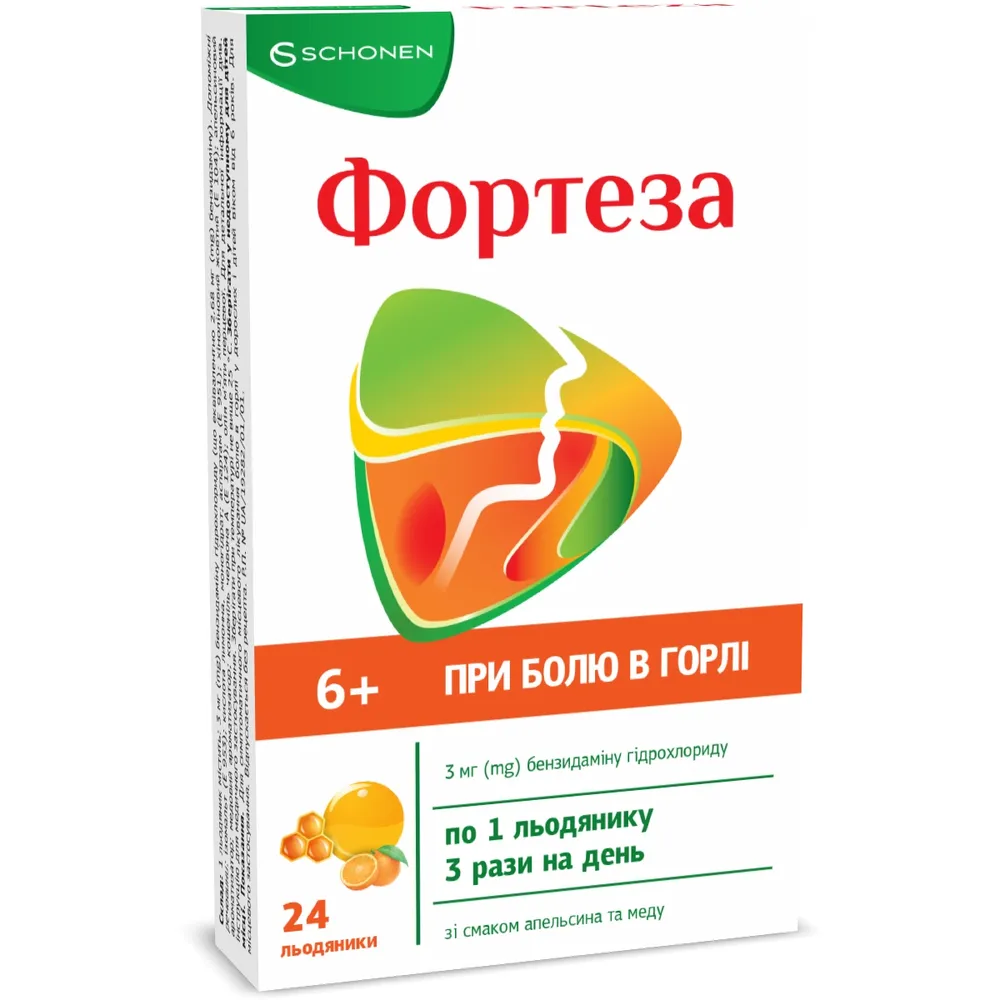
FORTESA
UkraineThe drug is used for the symptomatic local treatment of sore throat in adults and children aged 6 years and older.
Frequently asked questions
How should the lozenges be taken correctly?
The lozenges should be dissolved slowly in the mouth; they must not be chewed or swallowed whole. For adults and children from 6 years of age, it is recommended to take 1 lozenge 3 times a day. The course of treatment should not exceed 7 days.
Who should not use Fortesa?
The drug must not be used in case of hypersensitivity to its components, nor in women during pregnancy and breastfeeding. It is not recommended for people with hypersensitivity to salicylates (e.g., aspirin) or other anti-inflammatory agents. Additionally, the drug should be used with caution in patients with bronchial asthma.
What are the possible side effects?
Possible reactions include a burning sensation or dryness in the mouth, hypersensitivity reactions, skin photosensitivity, and very rarely—bronchospasm or edema. Anaphylactic reactions are also possible.
Can the drug be taken with other medicines?
No clinically significant cases of interaction with other medicinal products have been reported; however, it is not recommended for patients with hypersensitivity to salicylates or non-steroidal anti-inflammatory drugs.
When should you consult a doctor?
If symptoms do not subside within 3 days, worsen, or if you develop a fever, it is essential to consult a doctor.
Are there any special precautions for children or people with certain medical conditions?
Children aged 6–11 years should use the drug under adult supervision. Due to the composition of the product, it must not be taken by individuals with phenylketonuria (due to aspartame) or rare hereditary fructose intolerance (due to isomalt).
Instructions for use
INSTRUCTION FOR MEDICAL USE OF THE MEDICINAL PRODUCT FORTEZA (FORTEZA)
Composition:
Active substance: benzidamine hydrochloride;
1 lozenge contains 3 mg of benzidamine hydrochloride (equivalent to 2.68 mg of benzidamine);
Excipients: isomalt (E 953); citric acid monohydrate; aspartame (E 951); quinoline yellow (E 104); orange flavor; honey flavor; cochineal red A (E 124); peppermint oil.
Pharmaceutical form. Lozenges.
Main physicochemical properties: round orange lozenges, 19 mm in diameter, with orange and honey flavor.
Pharmacotherapeutic group.
Medicinal products used in throat disorders. Benzidamine. ATC code R02AX03.
Pharmacological properties.
Pharmacodynamics.
Clinical studies have demonstrated that benzidamine is effective in reducing pain caused by localized irritation processes of the oral and pharyngeal mucosa. In addition, benzidamine exerts a moderate local anesthetic effect.
Pharmacokinetics.
Absorption
Absorption through the mucous membranes of the oral cavity and pharynx has been confirmed by measurable amounts of benzidamine in human plasma. Approximately 2 hours after administration of a 3 mg lozenge, the maximum plasma concentration of benzidamine reaches 37.8 ng/mL, and the AUC value is 367 ng/mL*h. However, these concentrations are too low to produce systemic pharmacological effects.
Distribution
It has been established that when applied locally, benzidamine accumulates in inflamed tissues, where it reaches effective concentrations due to its ability to penetrate the epithelial lining.
Metabolism and excretion
The drug is excreted mainly in the urine, primarily as inactive metabolites or conjugated compounds.
Clinical characteristics.
Indications.
For symptomatic local treatment of sore throat in adults and children aged 6 years and older.
Contraindications.
Hypersensitivity to the active substances or to any of the excipients.
Interaction with other medicinal products and other forms of interactions.
Interaction studies have not been conducted; clinically significant interactions with other medicinal products have not been reported.
Special precautions for use
Benzidamine is not recommended for patients with hypersensitivity to salicylates (e.g., acetylsalicylic acid and salicylic acid) or other non-steroidal anti-inflammatory drugs (NSAIDs).
In patients with bronchial asthma, including a history thereof, benzidamine may provoke bronchospasm. Therefore, the drug should be used with caution in such patients.
In some patients, ulcers of the oral mucosa may be caused by serious underlying pathological conditions. Therefore, patients whose symptoms worsen or do not improve within 3 days, or who develop fever or other new symptoms, should seek medical advice.
The medicinal product contains aspartame, which is a source of phenylalanine and may be harmful to patients with phenylketonuria.
The medicinal product contains isomalt and therefore should not be used in patients with rare hereditary fructose intolerance.
The medicinal product contains the dye carmine red A, which may cause allergic reactions.
Use during pregnancy or breastfeeding
Currently, there are insufficient adequate data available on the use of benzidamine in pregnant or breastfeeding women. It has not been studied whether this medicinal product is excreted in human milk. Animal studies are insufficient to draw conclusions regarding the effects of this drug on pregnancy and lactation. There are no data on the potential risk during pregnancy or breastfeeding.
The medicinal product Forteza should not be used during pregnancy or breastfeeding.
Ability to influence reaction speed while driving or operating machinery
When used at the recommended doses, the medicinal product has no effect on the ability to drive vehicles or operate machinery.
Method of Administration and Dosage
The lozenges should be slowly dissolved in the mouth, without swallowing or chewing.
Adults and children aged 6 years and older: 1 lozenge 3 times daily.
The treatment course should not exceed 7 days.
If symptoms persist for more than 3 days or if a high fever develops, consult a physician.
Children
The Fortesa medicinal product is intended for children aged 6 years and older.
Children aged 6–11 years should use the Fortesa medicinal product under adult supervision.
Overdose
There have been no reports of benzidamine overdose with topical use. However, it is known that benzidamine, when ingested in large quantities (hundreds of times higher than the possible doses of this medicinal form), particularly in children, may cause excitement, seizures, tremor, nausea, increased sweating, ataxia, and vomiting. Such acute overdose requires immediate gastric lavage, treatment of water-electrolyte imbalances, symptomatic therapy, and adequate hydration.
Adverse reactions
Adverse reactions are classified according to the frequency of occurrence as follows: very common (≥1/10); common (≥1/100 to <1/10); uncommon (≥1/1,000 to <1/100); rare (≥1/10,000 to <1/1,000); very rare (<1/10,000); frequency not known (cannot be estimated from the available data).
Gastrointestinal disorders — rare: burning sensation in the mouth, dry mouth; frequency not known: oral hypoaesthesia.
Immune system disorders — rare: hypersensitivity reaction; frequency not known: anaphylactic reaction.
Respiratory, thoracic and mediastinal disorders — very rare: laryngospasm or bronchospasm.
Skin and subcutaneous tissue disorders — uncommon: photosensitivity; very rare: angioneurotic edema.
Shelf life.
3 years.
Storage conditions.
Store at a temperature not exceeding 25 °C. Keep out of the reach and sight of children.
Packaging.
12 lozenges per blister, 1 or 2 blisters per cardboard box.
Pharmaceutical category.
Over-the-counter (available without prescription).
Manufacturer.
LOZIS FARMACEUTICA, S.L.;
INFARMAD, S.L.
Manufacturer's address and place of business.
Campus Imperial, Lecaroz, Navarra, 31795, Spain;
C/ Torre de los Gerberos, 35, R.I. Carretera de la Isla, Dos Hermanas, Seville, 41703, Spain.
Similar drugs
The original data is available in the language of the country of manufacture.
Data source: State Register of Medicinal Products of Ukraine
Data last verified: August 13, 2026